1 ROOF TYPES – DESIGN AND FUNCTION
1.1 Roof design
There are many different roof designs, including gable roofs, flat roofs, mono-pitch roofs, mansard roofs, hip or half-hip roofs, and Copenhagen mansard roofs.
Figure 1 shows some common roof types.
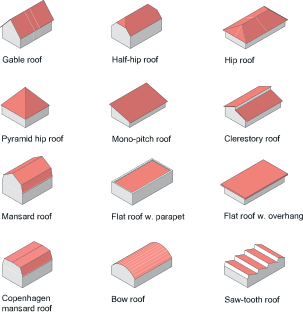
Figure 1. Shows some common roof types.
1.1.1 Pitched Roofs – Flat Roofs
Roofs are normally grouped into two main categories: ‘Pitched/sloping roofs’ and ’flat roofs’. Pitched roofs and flat roofs are commonly distinguished as follows:
- ’Pitched roof’ or ’sloping roof’ is the designation of roofs with a steepness of more than or equal to 10 ° (and normally less than 80 °).
- ’Flat roof’ is the designation of roofs with a steepness of less than 10 ° (approx. 1:6).
Each of these main categories contain many different sub-types, including vented and unvented roofs, cold and warm roofs, inverted roofs, duo-roofs, green roofs, and roof terraces. For more, see the following Sections; 1.2, Vented and Unvented Assemblies, and 1.3: Warm and Cold Roofs.
The shape and pitch of the roof may dictate the roof sub-types available. For pitched roofs, both continuous and discontinuous roof coverings are used while, for flat roofs, only continuous roofing is typically used. Types and roof covering materials along with specific requirements regarding roof pitch are outlined in Section 5.1, Types of Roof Covering.
The shape of a roof is a determining factor for the execution of roof details. Examples of details and their designations are shown in Figure 2.
1.1.2 Roof Types According to Structure
Roofs are also grouped according to their assembly, which is crucial for how the building or loft space can be utilised. Furthermore, the interior assembly and pitch are important factors when designing ventilation in vented roofs.
Roofs are commonly constructed with vented loft spaces (i.e., with a major vented cavity space between the thermal insulation and roof covering). Roofs can also be constructed as couple roofs, where the loft space below has the same pitch as the roof (i.e., the loft ceiling and roof surface are parallel). Some roofs combine a couple roof and vented loft space, such as roofs with attic trusses (see Figure 3).
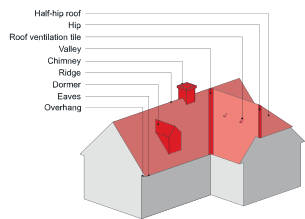
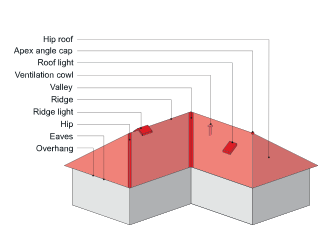
Figure 2. Example elements of a pitched roof.
Roof assemblies can be executed using timber (or steel) rafters (see Figure 3), on a deck of concrete slabs or profiled steel sheets (see Figure 4) or using prefabricated composite roofing slabs (see section 4, Composite Roofing Slabs).
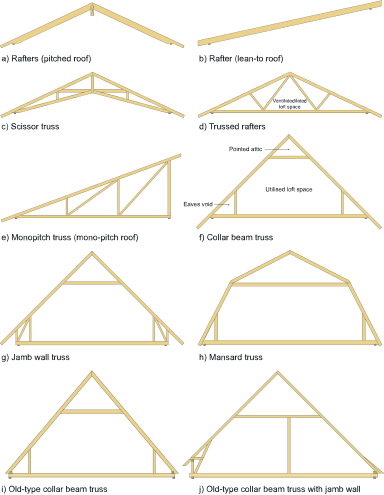
Figure 3. Some commonly used timber rafter types.
a + b: Examples of rafter types often used for couple roofs.
c, d + e: Examples of rafter types often used for gable roofs with a vented loft space.
f-j: Examples of rafter types for roofs with utilised loft spaces where part of the roof may be a couple roof while, at the top and sides, there may be vented loft spaces in the form of apexes and crawl spaces, respectively.
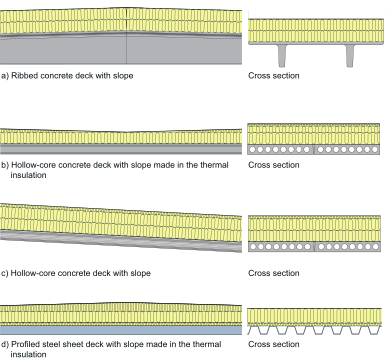
Figure 4. Examples of roof assemblies on a deck of concrete slabs and profiled steel sheets. All the assemblies shown are so-called warm roofs, meaning that an efficient vapour barrier must be fitted on the warm side of the thermal insulation.
- Ribbed concrete decks (TTS-decks) where the fall is integrated into the concrete deck.
- Horizontal concrete deck where the fall is integrated into the thermal insulation.
- Hollow-core concrete deck where the fall is produced by installing a sloping deck.
- Horizontal profiled steel sheet deck where the fall of the roof is integrated into the thermal insulation.
1.2 Vented and Unvented Assemblies
Activities performed in buildings such as human occupancy, showering, and laundry increase the moisture of indoor air. This results in vapour pressure which – particularly during winter – is higher inside the building than outside. The increased vapour pressure inside the building means that small amounts of moisture will, in many cases, migrate into the roof structure from the building by diffusion via the building materials. Convection (airflow) may also occur via air leakages in the roof structure due to pressure differences caused, for example, by wind pressure and thermal uplift (in the so-called ‘stack effect’).
The degree of moisture build-up in a building is relative to its use. Moisture load classes are used to distinguish between different categories of buildings (see Table 1).
Table 1. Examples of moisture load classes for building types in accordance with DS/EN ISO 13788 (Danish Standard, 2013a) modified in compliance with Danish practice
Moisture load class | Building type |
|---|---|
1 | Unused buildings, dry storage halls, sports halls without spectators, industrial buildings without moisture generation |
2 | Offices, shops, housing with normal habitation density, and ventilation1) |
3 | Housing with undisclosed habitation density2), sports halls with high numbers of spectators3) |
4 | Catering centres, canteens, showers, and changing facilities |
5 | Special buildings, e.g., launderettes, breweries, swimming pools |
- In Denmark, housing is considered to have normal ventilation when the provisions for ventilation specified in the Building Regulations are met.
- The habitation density may, for example, be undisclosed in rented accommodation.
- In Denmark, sports halls seating high numbers of spectators are categorised as moisture load class 3.
To avoid moisture accumulation, it is necessary to either remove the moisture at the same rate as it enters or to completely prevent it from migrating into moisture-sensitive areas. An impermeable vapour barrier is essential to effectively restrict moisture transmission.
In vented roof assemblies (the most common type of roof assembly) moisture is removed by venting the roof assembly with outside air between the roof covering and the underlying structure. In new assemblies using roofing underlayment, ventilation will often be required below the underlayment as well as below the roof covering to ensure a dry assembly. Venting below the roofing underlayment will remove moisture entering from the inside, while venting the roof covering will protect the battens and roof covering from moisture-induced deterioration.
For unvented assemblies (e.g., warm roofs, see section 1.3, Warm and Cold Roofs), moisture is not removed by ventilation.
In warm roofs, an impermeable vapour barrier is used to ensure that any moisture remains on the warm side of the thermal insulation to avoid the absorption of harmful moisture into the supporting structure.
In roof assemblies with an unvented roofing underlayment made of vapour-permeable material (cold roofs), moisture can dissipate through the underlayment, where it is removed by ventilation airflow between the underlayment and roof covering.
Finally, there are roof assemblies with moisture-adaptive vapour barriers (i.e., vapour barriers capable of responding to ambient moisture content). During cold periods, the roof assembly will experience a minor absorption of moisture from the inside. In subsequent warm periods with sunshine, the moisture will be driven down to the moisture-adaptive vapour barrier, where it will dissipate out of the assembly from the inside. To ensure proper functioning, the roof covering must reach high temperatures during the summer (i.e., the exposed roof surface must be sunlit and without any shade forming from surrounding houses, parapets, trees, or solar panels). Furthermore, there must be a vapour permeable interior surface.
Issues concerning roof ventilation are outlined in section 2.3, Roof Ventilation.
1.3 Warm and Cold Roofs
Roofs are grouped into two main types; ’cold roofs’ and ’warm roofs’. This classification depends on whether the supporting structure is located in the uninsulated or thermally insulated part of the roof assembly:
- In cold roofs the thermal insulation is located inside the assembly so that part of the supporting structure will be cold during the winter period. Cold roof assemblies are normally vented but can also be unvented (e.g., if installed with a moisture-adaptable vapour barrier).
- In warm roofs the thermal insulation is wholly or partly located above the supporting structure which is thus kept warm.
Warm roof assemblies are unvented.
The application of these two main roof types depends chiefly on existing moisture conditions, including the specific moisture load class the roof must comply with. The application of different roof types relative to moisture load class is specified in Table 2.
For warm roofs, an impermeable vapour barrier is used to ensure that any moisture remains on the warm side of the thermal insulation to avoid exposing the construction to harmful moisture.
Table 2. Overview of different roof type applications according to moisture load class. The first four roof types are cold roofs. Cold and deep-freeze storage, ice-skating rinks, or similar applications are outside the scope of the application classes and must always be assessed according to existing conditions. In the case of cold storage, the roof covering must function as a vapour barrier, as moisture transmission always occurs in an inward flow while, in deep-freeze storage and ice-skating rinks, there may be both outward and inward moisture transmission.
Roof type | Cold roofs | Warm roofs | |||
|---|---|---|---|---|---|
Ventilation conditions and assembly | Unvented with moisture-adaptive vapour barrier | Unvented with vapour-permeable roofing underlayment | Vented with vapour-im- permeable roofing underlayment | Vented with vapour-impermeable roof covering | Unvented with thermal insulation above assembly |
Moisture load class 1 | + | + | + | + | + |
Moisture load class 2 | + | + | + | + | + |
Moisture load class 3 | (+) | + | + | + | + |
Moisture load class 4 | + 1) | ||||
Moisture load class 5 | + 1) | ||||
- In application classes 4 and 5, a calculation of moisture content must be performed to assess the risk of moisture accumulation.
1.3.1 Cold Roofs
Traditionally, roofs are designed as cold roofs. This roof assembly is normally vented but can also be unvented. Cold roofs are typically timber structures but can also be metal (e.g., steel or aluminium) structures.
Cold roofs include:
- Lattice-trussed roofs with a vented loft space
- Couple roof assemblies with vent spaces (both flat and pitched)
- Collar roofs
- Vented timber or steel composite roofing slabs
- Unvented timber or steel composite roofing slabs
In cold roofs, there is a risk of moisture absorption or condensation inside the assembly. This is because the thermal insulation is located inside the assembly and parts of the supporting structure are thus exposed to low temperatures during winter. If moisture from the building migrates through the assembly, hitting cold surfaces, the relative air humidity will rise, which can potentially cause a build-up of condensate.
Roof coverings for cold roofs include several different types, including roof tiles, roofing sheets, bituminous felt, and roofing foil. Thus, both discontinuous and continuous roof coverings can be used (see Section 5.1, Types of Roof Covering).
The roof covering underlayment can be battens, purlins, boards, or sheet materials.
Examples of cold roof assemblies are shown in Table 3 and Figure 3.
Table 3. Examples of different cold roof assemblies.
Example | Roof type | Roof assembly |
|---|---|---|
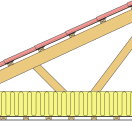 | Lattice-trussed roof (vented) | Roof covering Underlayment/condensate absorber (relative to roof covering) Vented loft space Thermal insulation Vapour barrier Interior ceiling finish |
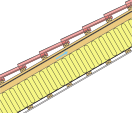 | Couple roof (rafters) (vented) | Roof covering Roofing underlayment (relative to roof covering) Vent space Thermal insulation Vapour barrier Interior ceiling finish |
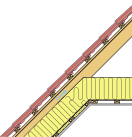 | Collar roof (vented) | Roof covering Roofing underlayment (relative to roof covering) Vent space Thermal insulation Vapour barrier Interior ceiling finish |
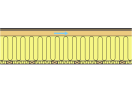 | Roof constructed of composite roofing slabs (vented) | Roof covering Underlayment Vent space Thermal insulation Vapour barrier Interior ceiling finish |
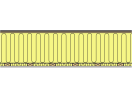 | Roof constructed of composite roofing slabs (unvented) | Roof covering Underlayment Thermal insulation Moisture-adaptive vapour barrier Interior ceiling finish |
1.3.2 Warm Roofs
Warm roofs are used in most moisture-tight applications. In warm roofs, the majority of the thermal insulation is located on the outside of the supporting structure. Thus, the temperature in the supporting structure is largely identical to the ambient temperature in the rooms below, and their temperature is normally higher than the dew point temperature in the specific point in the structure. There is therefore no risk of moisture or condensate build-up in the supporting structure. Both flat and pitched roofs can be constructed as warm roofs. The roof covering for a warm roof must be a continuous and watertight covering (usually bituminous felt or roofing foil). The thermal insulation material functions as underlayment for the roof covering.
Typically, in a warm roof both the roof covering and the vapour barrier will be vapour-impermeable. This means that any moisture that migrates into the thermal insulation is unable to dry out. Therefore, it is a precondition that the assembly is kept dry during both construction and use. Moisture build-up in the thermal insulation is avoided by using dry materials and by protecting the roof against rainfall during construction. There should be no wooden or other organic materials inside the assembly between the vapour barrier and roof covering. However, cement particle boards can be used as underlayment (e.g., for thermal insulation). The completed roof must be protected against overload and inspected and maintained regularly to avoid later leakages.
Warm roofs include:
- Roof assemblies with outside thermal insulation on concrete, steel, or timber decking
- Externally re-insulated (formerly cold) roof assemblies
- Inverted roof assemblies where the roof covering is placed below the thermal insulation. No vapour barrier is used.
- Duo-roofs, i.e., roof assemblies with thermal insulation both below and above the roof structure.
Examples of warm roofs are shown in Table 4.
For a detailed description of assemblies and examples of warm roofs (see Section 5.7, Roofing Membranes).
Table 4. Examples of warm roof assemblies. If cellular plastic insulation is used on a deck of steel sheets, the thermal insulation under the vapour barrier must consist of 2 x 25 mm mineral wool with staggered joints (for fire safety reasons). In the case of warm roofs, where part of the thermal insulation is placed below the vapour barrier, specific requirements exist to regulate the proportional thermal insulance factor (R-value) of the thermal insulation below and above the vapour barrier, respectively (see Table 6).
Example | Supporting structure | Roof assembly |
|---|---|---|
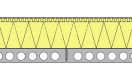 | Hollow-core concrete deck | Roof covering Thermal insulation Vapour barrier Concrete deck |
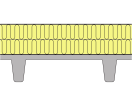 | Ribbed concrete deck | Roof covering Thermal insulation Vapour barrier Concrete deck |
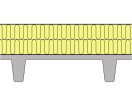 | Profile steel deck | Roof covering Thermal insulation Vapour barrier Thermal insulation and/or sheet materials Profiled steel sheet |
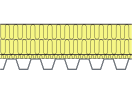 | Composite roofing slab | Roof covering Thermal insulation Vapour barrier Timber structure with thermal insulation |
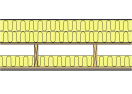 | Inverted roof (shown here as a roof terrace) | Floor tiles (min. fall 1:100) Gravel Geotextile fabric Two layers of extruded polystyrene Roofing membrane Concrete deck with firring strip |
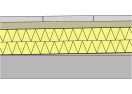 | Duo-roof (shown here as a roof terrace) | Floor tiles on paving pedestals Geotextile fabric Extruded polystyrene Roofing membrane (min. fall 1:100) Foamed glass or cellular plastic insulation (tapered) Vapour barrier Concrete deck with firring strip |
Concrete Deck as Thermal Insulation Underlayment
Warm roofs in new buildings with a concrete deck roof assembly will usually be damp when the thermal insulation is installed. Once the building is heated, moisture from the concrete will be driven into the thermal insulation and a vapour barrier will therefore be necessary to avoid moisture absorption.
A robust vapour barrier is normally used in concrete decks, doubling as a temporary cover against rainfall.
If a concrete deck has a thickness of at least 50 mm, is dry, and there are no leakages, it will normally be regarded as sufficiently vapour-impermeable to function as a vapour barrier in moisture load classes 1–2. A precondition for using a concrete deck as a vapour barrier is that the deck is free from moisture introduced during construction and that no other moisture absorption has occurred. Consequently, using a concrete deck as a vapour barrier is normally only possible in renovations where the concrete is dry and where it can be ascertained that the deck is free of leakages. In this case the vapour barrier or membrane may be omitted. Solutions involving composite roofing slabs require joints and intersections to be meticulously sealed, for example, using strips of roofing membrane. This prevents leakages and, in turn, potential convection.
Concrete cannot function as a vapour barrier in moisture classes 3, 4, and 5 where a regular vapour barrier must be used instead. Often, a humidity-class-3 roofing membrane and bituminous sheets with integrated aluminium foil complying with classes 4 and 5 are used (see SBi Guidelines 224, Moisture in Buildings (Brandt, 2013)), but other materials with similar properties can also be used.
To avoid any uncertainty as to whether the concrete can function as a vapour barrier or not, it is recommended to always use a vapour barrier on a concrete deck.
Buildings graded according to moisture load classes relative to their usage are shown in Table 1.
Profiled Steel Sheets as Underlays for Thermal Insulation
In warm roof assemblies on a roof structure using profiled steel sheets, one should be aware that while steel sheets are vapour-impermeable, joints and intersections are not. Consequently, a vapour barrier must always be used.
To achieve a level underlay and to protect the vapour barrier against fire, the vapour barrier should normally be installed 50 mm inside the thermal insulation (seen from the inside). This is suitable for moisture load classes 1–3, while for classes 4 and 5 a humidity calculation is required. For cellular plastic roof insulations, this solution is only suitable if the lower thermal insulation consists of two layers of mineral wool, each with a minimum thickness of 25 mm with staggered joints.
Normally, a vapour barrier made of roofing membrane (with welded or self-amalgamating joints) is installed on thermal insulation or sheet materials (e.g., cement particle boards). Penetrations and intersections in the vapour barrier are executed using the applicable methods for sealing vapour barriers (see Section 2.1.2, Vapour Barriers in Roofs, the Byg-Erfa info sheets in Dampspærrer – monteringsdetaljer (Vapour Barriers – Installation Details) (Byg-Erfa, 2015a), and Dampspærrematerialer og fugttransport – væg- og loftkonstruktioner (Vapour Barrier Materials and Moisture Transmission – Wall and Ceiling Structures), (Byg-Erfa, 2015b), and www.membranerfa.dk.
Securing the thermal insulation mechanically will perforate the vapour barrier in steel roofing, but if a heavy-duty vapour barrier (e.g., a roofing membrane) is laid out on a level underlay and installed 50 mm into the thermal insulation, the penetrations can be considered adequately vapour-impermeable within moisture load classes 1–3. For moisture load classes 4 and 5, special measures must be implemented to ensure vapour impermeability, for example, by using foamed glass in the lower thermal insulation or installing sheeting as underlay for the vapour barrier (on top of the profiled steel sheets and possibly above the lower 50 mm of the thermal insulation).
Buildings graded according to moisture load classes relative to their usage are shown in Table 1.
Timber or Wood-based Sheets as Underlay for Thermal Insulation
For warm assemblies on a timber deck or wood-based sheets, an efficient vapour barrier must always be installed, for example, a roofing membrane with welded or self-amalgamating joints. This functions both to protect against moisture absorption during construction and as an efficient vapour barrier. For acoustic and fire performance reasons, there will often be approx. 50 mm of thermal insulation inside the roof structure (seen from the warm side). This will be sufficient moisture protection for load classes 1–3, while classes 4 and 5 require a humidity calculation.
Table 5. Relative insulance in warm roof assemblies where part of the insulation is installed inside the assembly (i.e., below the vapour barrier). The relative values are calculated using the maximum moisture content in the relevant class. If it can be ascertained that the moisture content is lower (e.g., using climate control) calculations may indicate that the required insulance factor can be reduced. The table can also be used to find the required insulance factor of new insulation relative to the insulance factor of the original assembly when changing a cold roof to a warm roof, or for the outside re-insulation of a warm roof (cf. Table 28).
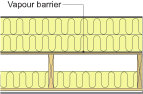 | Moisture load class | Relative insulance factor above and below the vapour barrier |
1 | 1:1,5 | |
2 | 1,5:1 | |
3 | 3:1 | |
4 | 8:1 | |
5 | To be calculated |