2 CHOICE OF ROOF STRUCTURE
For a roof to function satisfactorily, several legal and functional requirements must be met. The Building Regulations contain very few provisions specifically for roof structure performance, including thermal transmittance (U-value), roof drainage (roof pitch), fire safety, acoustic insulation, and protection against falling hazards. In addition, roofs are subject to the general provisions for structures in the Building Regulations (BR18, § 340–341), stipulating that satisfactory conditions must be achieved in terms of performance and durability and that the materials used must be durable and appropriate for the intended purpose.
The most important functions of a roof structure are as follows. It must:
- be watertight/act as a rain shield (prevent rainfall intrusion),
- provide drainage,
- be impermeable to vapour from the inside (diffusion and convection),
- prevent moisture accumulation (moisture which migrates into the structure must be able to escape),
- be airtight (for energy consumption and comfort),
- reduce heat loss (to be thermally insulating),
- be harmless (fire, chemicals in the materials, etc.),
- be sufficiently stable and robust to handle expected usage loads (no collapse or damage resulting from impacts or people falling),
- reduce outside noise to acceptable levels,
- be environmentally acceptable (have minimal environmental impact),
- help prevent break-ins, and
- be durable (have a long lifespan).
Certain roofs may have supplementary functions depending on specific requirements. For example, the roof should be capable of supporting maintenance people and servicing (e.g., of ventilation systems). There are separate requirements for roof terraces, roof gardens, and parking decks.
Individual roofing materials may also have unique functions, placing demands on the properties of the given material, for example, the vapour-impermeability or -permeability of roofing underlayment materials relative to the specific structural assemblies.
By combining the function of the roof with the conditions which the roof is exposed to, a set of requirements detailing the performance properties required for a roof can be formulated. These properties will, for example, depend on:
- the function of the building (its use) (e.g., whether it is a dry storage hall or a swimming pool),
- the shape intended for the building (e.g., for very large buildings, the options for roof shape will often be limited),
- the specific climate conditions the building will be exposed to, including both outdoor and indoor climate (moisture load classes) (cf. Section 1.2, Vented and Unvented Assemblies).
There will usually be several different options when deciding on a roof structure, but it will always be necessary to select one that will meet the functions outlined above. Other factors and needs should also be considered, including environmental requirements, local development plans, and aesthetic considerations.
It is a given that it must be possible to build the roof, and it should preferably be simple and safe to perform the necessary work operations on the building site. Due consideration should therefore be given to both contractors and the overall quality of the roof structure which will benefit in quality if risks (such as the risk of incorrect installation) are reduced.
Very often, economy will also be a decisive factor in the design of a roof. It is important to focus not only on keeping initial costs low, but also to consider how costs will accumulate over the lifespan, operations, and maintenance.
Ultimately, the choice of a specific roof type should always be made by carefully considering the advantages and disadvantages of the feasible options.
2.1 Water and Moisture Tightness
Roofs may be impacted by moisture in various forms, including:
- precipitation (driving rain and drifting snow) which may penetrate the structure from the outside,
- moisture in the outside air,
- moisture in the indoor air migrating into the assembly by diffusion through the materials, or by convection (airflow) via leakages,
- moisture from the building process (i.e., water introduced during or remaining from the construction phase),
- condensation of vapour in the outer parts of the assembly due to surface radiant emissions to the atmosphere, which reduce surface temperatures to below dew point.
Wind on the exterior surface of a roof can considerably increase moisture impact. The wind can cause precipitation to behave like driving rain or drifting snow, both of which can be directed upwards. Therefore, in adverse situations, both can penetrate structures where watertightness is partly achieved by overlapping joints, such as in roof tiles or parapet coping.
Wind can also generate both positive and negative pressure in roofs, although in roofs with a shallow pitch there will almost always be negative pressure across the whole of the exposed roof surface. In an unsuitable flat roof assembly, negative pressure may propagate into the vent space, thereby intensifying the convection of indoor air into the roof unless a completely airtight layer has been established in the assembly.
The risk of moisture absorption due to convection is greater in roofs than in exterior walls because the thermal uplift caused by the indoor air will always cause slight, but constant, positive pressure below the ceiling or roof. During winter, the positive pressure will result in indoor air migrating into the roof structure. Even when a good quality vapour barrier has been correctly fitted, small amounts of vapour will migrate into the loft space. Vapor will similarly be able to migrate through air leakages, such as those around trapdoors and penetrations.
2.1.1 General Protective Measures Against Moisture Absorption
Rain and melting snow must be prevented from entering roof assemblies, which must be watertight. However, in roof assemblies with roofing underlayment, small amounts of precipitation are able to migrate through the primary roof covering. Water must be drained away from the roof or roofing underlayment as quickly as possible, mitigating the risk of damage to underlying structures resulting from moisture absorption.
Moisture absorption in roof assemblies from humid indoor air must be prevented. Hence, roof assemblies usually include vapour barriers to prevent humid indoor air from entering the roof structure through diffusion or convection (see the following Section 2.1.2, Vapour Barriers in Roofs). If, rather than vapour barriers, alternative solutions are preferred, this must be documented, for example with calculations.
Care must be taken to avoid allowing moisture from the building process to migrate into the roof structure. Accordingly, the work should be carried out in dry weather and work in progress should be covered up at the end of each working day. Roofing components supplied with pre-installed roof covering must have their joints taped (i.e., a strip of roofing membrane must be fitted across the joints) immediately after installation. Alternatively, the whole building site must be covered, total covering being the most effective method (see Section 4, Composite Roofing Slabs).
2.1.2 Vapour Barriers in Roofs
Vapour barriers are normally supplied as roll material (e.g., polyethylene (PE) foil). Other types of material may also be used, such as sheet materials. If sheet materials are used, detailed installation instructions should be available, including guidelines on how the sheet materials should be joined and how penetrations should be designed because most guidelines in use concern roll materials.
Applicable Standards
Vapour barriers are subject to the following product standards:
- Vapour barriers made of plastic or rubber: DS/EN 13984, Flexible sheets for waterproofing – Plastic and rubber vapour control layers – Definitions and characteristics (Danish Standards, 2013b)
- Bituminous vapour barriers: DS/EN 13970, Flexible sheets for waterproofing – Bitumen water vapour control layers – Definitions and characteristics (Danish Standards, 2005a).
Vapour barriers made of sheet materials, must satisfy the provisions of the standards for the relevant products and their diffusion resistance must be documented.
Issues concerning vapour barriers in connection with roof renovation are outlined in Section 8.2.3, Vapour Barriers and Roof Renovation.
Properties Required of Vapour Barriers
A vapour barrier must:
- be made of a vapour-impermeable (vapour tight) material, which prevents water vapour transmission by diffusion (i.e., a material with a high diffusion resistance factor (Z-value)),
- be designed as an airtight installation because moisture penetrating the roof structure through convection (airflow) cannot normally be removed fast enough by ventilation or diffusion,
- be made of appropriate and robust material capable of being handled on a building site, and
- have a long lifespan when exposed to the stress loads imposed by the completed roof structure.
For renovations, separate rules apply (see Section 8.2.3, Vapour Barriers and Roof Renovation).
Please note that plaster ceilings can be regarded as airtight if they are intact (i.e., free of cracks or holes) but they are not vapour-impermeable and should be fitted with a vapour barrier.
Properties of Vapour Barriers
Vapour barriers should normally have a minimum Z-value of 50 GPa s m2/kg. The requisite Z-value can be determined by testing according to DS/EN 1931, Flexible Sheets for Waterproofing – Bitumen, Plastic, and Rubber Sheets for Roof Waterproofing – Determination of Water Vapour Transmission Properties (Danish Standards, 2000a), or to DS/EN/ISO 12572, Hygrothermal Performance of Building Materials and Products – Determination of Water Vapour Transmission Properties – Cup Method (Danish Standards, 2016a).
Vapour barriers must, furthermore, have excellent dimensional stability, strength, and elongation at fracture capacity and should be capable of tolerating reasonable levels of impact such as bumps and knocks without being damaged.
Its lifespan should be documented (e.g., assessed using accelerated ageing tests). Similarly, documentation should include ancillary materials such as butyl tape sealant, adhesive tape, foil adhesive, and caulking compound.
We recommend that ’systems solutions’ be used as much as possible, for example, where the vapour barrier and ancillary materials such as tape, foil-adhesive, sleeves, and caulking compound are supplied by the same source. This is the best way of ensuring that the materials used will work in combination and achieve optimal results.
Diffusion Resistance
As mentioned above, vapour barrier products usually have a high diffusion resistance (i.e., a minimum Z-value of 50 GPa s m2/kg). This means that materials like PE foil, PVC foil, or roofing membranes can be used as vapour barriers.
Systems solutions using materials with a diffusion resistance of less than 50 GPa s m2/kg are available on the market. If these systems solutions are used, care must be taken to construct the assembly in such a way as to avoid vapour damage from the interior of the building, for example, by using high-performance vapour-permeable materials further within the structure, beyond the initial vapor barrier.
Moisture-adaptive vapour barriers are vapour barriers with diffusion properties relative to the ambient moisture content. At low relative humidity levels, moisture-adaptive vapour barriers are vapour-impermeable (and function as vapour barriers) while at high relative humidity (RH) levels they are vapour-permeable. At high RH levels, therefore, the materials allow moisture to migrate (i.e., they do not function as vapour barriers at high RH levels). Moisture-adaptive vapour barriers require special conditions to function correctly, as they are dependent on the roof being heated by solar radiation during the summer. Their use is therefore typically limited to flat roofs (with slopes of less than 10 °) and mono-pitch roofs facing a south-eastern to south-south-western direction. The roof covering must be dark (e.g., bituminous felt, dark roofing foil, or zinc). Special care should be taken when applying moisture-adaptive vapour barriers in moisture load class 3. It is not advisable to use moisture-adaptive vapour barriers in moisture-load classes 4 and 5.
Buildings graded according to moisture load classes relative to their usage are shown in Table 1.
Airtightness
Convection (airflow) of moist indoor air via air leakage paths is usually the most common cause of vapour absorption in roof structures. Since thermal uplift leads to a greater risk of convection in roof structures than in exterior walls, it is particularly important that the vapour barrier is airtight. This requires that all details to be planned carefully and practically with appropriate ancillary materials including adhesive tape, foil adhesive, etc.
The 2018 Danish Building Regulations contain specific provisions for airtightness. These provisions stipulate that the flow rate through air leakage paths in the building envelope in new buildings heated to 15 °C or more, must not exceed 1.0 l/s per m² heated floor space at a pressure difference of 50 Pa (BR18, § 263). For the optional low-energy class, the requirements are 0.7 l/s per m2 of heated floor space (BR18, § 481).
Construction
Vapour barriers in roofs must be installed on the warm side of the thermal insulation or extended slightly into the thermal insulation from the warm side (depending on the specific moisture load class (see Section 1.3.2, Warm Roofs)). In this way, the risk of a high relative humidity or condensate build-up on the underside of the vapour barrier is avoided.
A vapour barrier must be installed and trapdoors and other openings leading to the loft space must be sealed off before heating the building, as moisture from the building process might otherwise migrate into the roof assemblies, causing moisture build-up.
Joints, penetrations, and intersections must normally be executed on firm decking of 15-mm plywood sheets for example. Firm decking is required to enable tape joints to be compressed effectively and thus achieve permanent tightness. In some cases, prefabricated penetrations are available which can themselves provide firm decking.
Joints and intersections are executed using an overlap of at least 50 mm. These are normally installed using clamps which should be mounted using a hand-held clamp gun to avoid damaging the vapour barrier. To achieve airtightness, all joints must be secured further by bonding, using tape, butyl tape sealant, foil adhesive, or caulking compound. Compressed joints cannot, in themselves, be regarded as airtight.
Electrical wiring and similar installations in loft spaces should be run below the vapour barrier to avoid perforating it. This could be achieved by installing the vapour barrier 45–50 mm into the thermal insulation layer.
If the vapour barrier is damaged during installation, it must be repaired or replaced.
Examples of joining vapour barriers are shown in Figure 5. Examples of vapour barrier joins at penetration points for roofs with continuous and discontinuous roof coverings are shown in Sections 7.2.1 and 7.3.1, respectively.
Further information on vapour barriers and airtightness can be found in:
- SBi Guidelines 224, Moisture in Buildings (Brandt, 2013)
- SBi Guidelines 214, Klimaskærmens lufttæthed (Airtightness in the Building Envelope) (Rasmussen & Nicolajsen, 2013)
- Dampspærrer – monteringsdetaljer (Vapour Barriers – Installation Details) (Byg-Erfa, 2015a)
- Dampspærrematerialer og fugttransport – væg- og loftkonstruktioner (Vapour Barrier Materials and Moisture Transport – Wall and Ceiling Structures) (Byg-Erfa, 2015b)
- Bygningers lufttæthed – tæthedskrav, bygningsudformning og måling (Airtightness in Buildings – Tightness Standards, Building Design, and Measurement) (Byg-Erfa, 2013)
- Lufttæthed i ældre bygninger – efter renovering og fornyelse (Airtightness in Older Buildings – After Renovation and Replacements) (Byg-Erfa, 2016a)
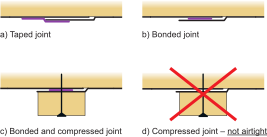
Figure 5. Vapour barrier joints must be made with an overlap of at least 50 mm joined with adhesive tape (a), or by affixing them using sealant tape or glue (b). Airtightness can only be achieved when the joint is executed on firm decking. The most reliable joint (c) is achieved by either taping or bonding coupled with compression. Although formerly commonly practiced, compressed joints (d) not affixed by tape or adhesive will not be airtight (Brandt, 2013).
2.2 Roof Drainage
2.2.1 Building Regulations Provisions
The 2018 Building Regulations specify that rainwater and snow melt must be ‘able to drain off efficiently’. Rainwater must be discharged via gutters or downpipes to a drainage system’ (BR18, § 338). However, gutters and similar systems can be omitted in buildings in particularly open locations (such as holiday homes) and in minor buildings such as garages, outhouses, and sheds, unless special provisions issued by the building authorities apply. Care must be taken to drain the water away from the building and to ensure that it will not cause inconvenience to roadways or neighbouring sites (cf. Section 1.4 in Byggereglementets vejledning om fugt og vådrum (Building Regulations Guidelines for Moisture and Wet Rooms) (Ministry of Transport, Building and Housing, 2018c)).
As a result of the provisions of the Building Regulations regarding water drainage, roofs and roofing underlayment must be constructed with well-defined falls in both new build and renovations. If the roof slope is steeper than 1:40, corresponding to 2.5 cm per m, roof run-off will normally drain away efficiently (cf. Section 1.4 in Byggereglementets vejledning om fugt og vådrum (Building Regulations Guidelines for Moisture and Wet Rooms) (Ministry of Transport, Building and Housing, 2018c)).
The slope is normally directed towards a roof outlet or a gutter (eaves gutter). Roof pitch is of vital importance for roof drainage.
Ensuring reliable roof drainage in pitched roofs (pitch ≥ 10 °) is typically easy to achieve, except at eaves where water will sometimes accumulate on the roofing underlayment if the eaves are not designed correctly.
Flat roofs (with a slope of less than 10 °) require minimum falls of 1:40 (i.e., 25 mm per m or approx. 1.4 °). Locally, in (in small areas) falls as low as 1:50 may be acceptable due to executional tolerances. If possible, falls should be steeper to avoid depressions which cause pooling on the exposed roof surface.
Falls in valleys and cricket intersections can be reduced further (e.g., to 1:165). However, using such shallow falls requires firm decking, corresponding to a deflection of maximum 1:400 of the effective span to allow for snow load.
Steeper slopes will reduce the risk of water penetrating roof coverings with overlapped junctions. Minimum roof pitch recommendations exist for many roof coverings to ensure watertightness (see Section 5.1.3, Roof Pitch and Areal Weight).
2.2.2 Preconditions for Downpipe Sizing
Downpipes or vertical rainwater drainage pipes can be sized according to the rules in DS 432, Code of Practice for Sanitary Drainage - Wastewater Installations (Danish Standards, 2009) (BR18, § 70).
The rules presuppose a fill-factor (f) of 1/3 in vertical pipes. This can be achieved only where inlet conditions are ideal (e.g., where the inlets have rounded edges and are correctly designed). The following fill-factors (f) are normative for ordinary installation by skilled workmen:
- Inlet from all sides f = 1/3
- Inlet from one side (gutter) f = 1/5–1/4
- Inlet from two sides (gutter) f = 1/4–1/3.
Roof run-off is usually calculated using a rainfall intensity of 0.014 l/(s · m2) corresponding to 140 l/(s · ha). Please note that for roof terraces, balconies, and roofs with a risk of pooling (’bath tubbing’), rainfall intensity is usually calculated using 0.023 l/(s · m2), corresponding to 230 l/(s · ha) due to the risk of damage to the building.
Allowing for future climate changes, rainfall intensity should be multiplied with the climate factors shown in Table 6.
Table 6. Climate factors which can be used to allow for future climate changes depending on the expected lifespan of the structure. The parameter n denotes the probability of rainfall events exceeding the design rainfall intensity in one year. For example, a structure with an expected lifespan of 100 years for a ten-year rainfall event will have a climate factor of 1.3. This indicates a 30% increase in expected rainfall volume compared to the present (Danish Standards, 2009).
Rain return period | 2 years | 10 years | 100 years |
|---|---|---|---|
N | ½ | 1/10 | 1/100 |
Climate factor | 1.2 | 1.3 | 1.4 |
The climate factors are calculated for an expected lifespan of 100 years. Consequently, when using the climate factor, consideration must also be given to the technical lifespan of the construction overall. For a shorter lifespan, the factor will be reduced proportionally to the reduction in expected lifespan.
If flooding caused by a blocked drain might result in water entering the building structure, a minimum of two downpipes should be installed (with separate discharge stacks, if possible), eaves overflows, or chutes in the parapet. This will be the case for many flat roofs with kerbs around the entire perimeter of the roof (see Section 2.2.4, Draining Flat Roofs and Section 5.7.3, Roof Slope for Membrane Roofs).
For detailed information on sizing rainwater installations (see DS 432 and SBi Guidelines 255, Afløbsinstallationer – systemer og dimensionering (Wastewater Installations – Systems and Sizing) (Brandt & Faldager, 2015)).
2.2.3 Draining Pitched Roofs
For pitched roofs with a roof covering of tiles, corrugated sheets, slate, or similar materials, rainwater is led to a gutter, a downpipe, and into the discharge system (normally a grated gully).
Runoff from thatched roofs and shingle roofs is normally discharged directly to the ground. Here, splashing may be reduced using rounded stones where the roof run-off hits the ground.
Gutters are often designed in a semi-circular shape, but other shapes exist (e.g., trapezoidal and rectangular). They are most often made of rigid PVC or zinc, but copper and stainless steel are also occasionally used (see Figure 6).
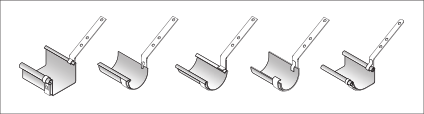
Figure 6. Examples of gutter profiles.
Gutters are normally installed with a 2‰ fall but can be installed without falls if an oversized gutter is used (Brandt & Faldager, 2015).
Gutters concealed in the overhang should be avoided as the overhang may decay if the gutter overflows (this will not be visible immediately).
The flow capacity of a gutter depends on its size, shape, and fall. To avoid too great a distance between eaves and gutter, the usual practice is to install gutters with a very slight fall or no fall at all. For horizontal gutters, only their size (cross-sectional flow area) and geometric shape affect the flow capacity. The capacity of a semi-circular gutter is:
hvor
This capacity can be increased by 40% by a longitudinal fall of more than 2‰, or in gutter runs of more than 6 m. Bends placed less than 2 metres from the outlet will reduce the flow capacity as follows:
- 10% for horizontal gutters with round-edge outlets,
- 20% for horizontal gutters with sharp-edge outlets,
- 25% for gutters with longitudinal falls.
Equation (1) and the adjustment values can, with adequate approximation, also be applied to rectangular gutters and other profiles.
Figure 7 shows gutter capacity according to cross-sectional flow area, catchment area, and rain intensity. The figure applies to pitched roofs with a slope of less than 50 °.
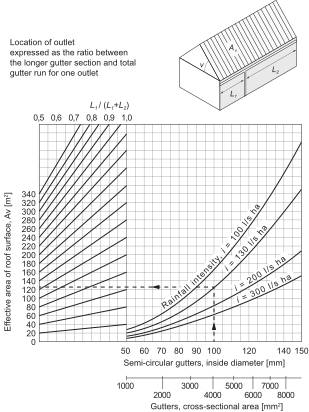
Figure 7. The capacity of horizontal gutters conditional on rain intensity, gutter size, and location of downpipe (Brandt & Faldager, 2015).
Example 1 (From SBi Guidelines 255)
According to Figure 7, in an area with a rain intensity, i, of 130 l/s per ha, a semi-circular gutter with a diameter of 100 mm is capable of draining a catchment area of 64 m2 if the downpipe is placed at the end of the gutter (L1/L1 + L2 = 1), or 128 m2 if the downpipe is placed at the centre (L1/L1 + L2 = 0.5) (Brandt & Faldager, 2015).
Downpipe Capacity
The quantity of water a downpipe can discharge depends on the shape of the inlet (i.e., whether the shape of the inlet is round- or sharp-edged). Furthermore, the capacity is conditional on the water being discharged into the downpipe from one or two sides. Data has been obtained for the flow capacity of a downpipe according to the Wyly-Eaton equation:
where:
The Wyly-Eaton equation only applies to fill-factors of less than approx. 1/3. Furthermore, it assumes that the discharge flow forms a hollow cylinder inside the pipe after the flow velocity has peaked.
For downpipes with inlets from two sides, the fill-factor is 1/4, whereas for a downpipe with an inlet from one side, it is 1/5. These fill-factors were determined for sharp-edged inlets. For round-edged inlets, the calculated increase is 10–30%.
The maximum capacity of downpipes placed at one end of a gutter corresponds to approx. 70% of the capacity of a centrally placed downpipe. Figure 8 shows the capacity of a downpipe relative to downpipe dimension, rainfall intensity, catchment area, and position. Design rainfall intensity can normally be selected to correspond to one overload per year for separate systems and one overload every two years for combined systems. For gutters on buildings close to pavements subject to heavy pedestrian traffic, the design intensity could be increased (see SBi Guidelines 255, Afløbsinstallationer – systemer og dimensionering (Wastewater Installations – Systems and Sizing), 7.4.5 Skrå tage (Sloping Roofs) (Brandt & Faldager, 2015)).
Downpipes can be placed on the outside of the building, and they will normally be made of the same material as the gutter. Downpipes near to pavements and subject to heavy pedestrian traffic should be made of a robust material such as stainless steel or hot-galvanised steel for roughly the last 2 metres, to be able to resist major mechanical impact.
Example 2 (From SBi Guidelines 255)
According to Figure 8, in an area with a rainfall intensity, i, of 130 l/s per ha, an 80-mm downpipe is capable of draining 200 m2 of catchment area if placed at the end of the gutter and 290 m2 if placed centrally in the gutter (Brandt & Faldager, 2015).
In combined systems, downpipes from sloping roofs can be connected to the general discharge system in the following ways:
- They can be connected in a closed rainwater pipe to a gulley measuring at least 0.2 metres.
- They can be connected across the surrounding area (e.g., via an open conduit sloping towards a gully). If this solution is anticipated to cause a nuisance, it may be prohibited by the authorities. The solution should not be applied in slab-on-ground constructions, and the ground must have a minimum fall of 25‰ away from the building. It is important that a fall away from the building is incorporated when backfilling excavated areas.
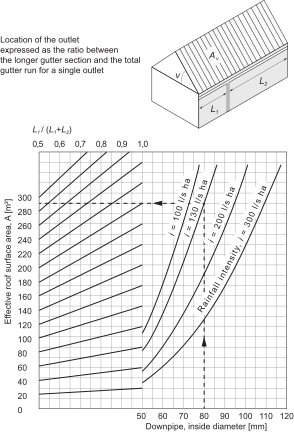
Figure 8. Downpipe capacity relative to rainfall intensity, dimension, and location of downpipe (Brandt & Faldager, 2015).
2.2.4 Draining Flat Roofs
Roof Rainwater Outlets
On flat roofs, rainwater will slowly flow towards the outlets which are normally installed to feed from all sides (see Figure 9). For roofs covered with roofing felt, stainless steel outlets are normally used, while plastic outlets can be used for foil-covered roofs. The drainage capacity of roof outlets for flat roofs is relative to the size of the pipe as well as the design of the outlet and grating. The drainage capacity will vary considerably from below 1 l/s to almost 20 l/s.
The design rainfall intensity should correspond to overload once every 5–10 years.
Care must be taken to thermally insulate discharge pipes, if required, to avoid condensate build-up.
More examples of roof outlets in flat roofs with roofing membranes are shown in Section 7.3.3, Flashings Roof Outlets.
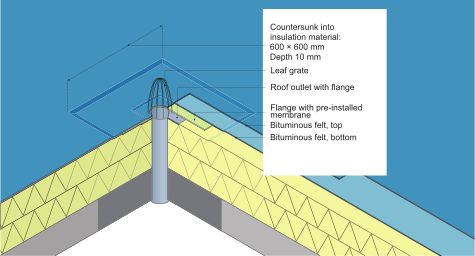
Figure 9. Example of a stainless-steel roof outlet countersunk into the roof (shown here with 2 layers of bituminous felt). The countersinking ensures that water can be discharged to the outlet. The roof outlet comes with a layer of pre-installed bituminous felt to ensure effective adhesion between the outlet and bituminous felt layer. The intersection between the outlet penetration and the vapour barrier must be sealed to avoid warm indoor air from entering the roof assembly.
Due to slow inflow from minor depressions in the roof, there will be a risk of ice dams forming near the roof outlets and blocking them during winter. Therefore, it is preferable to install interior outlets, as these are kept frost-free by building heating. If placed in an eave overhang , or a similar exterior location, outlets must be heated using trace heating. Trace heating is commonly used in places where there is a risk of ice forming such as in box-receivers and side outlets.
The distance between roof outlets should not exceed 14.4 metres and the distance from the gable should not exceed 7.2 metres. Assuming that there is an unbroken fall of at least 1:40 across the roof, a greater distance is acceptable (see Section 5.7.3, Roof Slope for Membrane Roofs).
Roof outlets supplied with pre-installed membranes ensure effective adhesion between outlet and roof covering.
Roof outlets may also be supplied with side outlets to a box-receiver (see Figure 10). The capacity of roof outlets with side outlets is substantially lower than that of roof outlets with vertical outlets. For the sizing of these outlets, please see manufacturer’s instructions. Outlets to exterior box-receivers must be installed with a fall towards the box-receiver. Pointing around the outlet will prevent moisture absorption in the wall. Box-receivers must be installed with overflow protection below the inlet level.
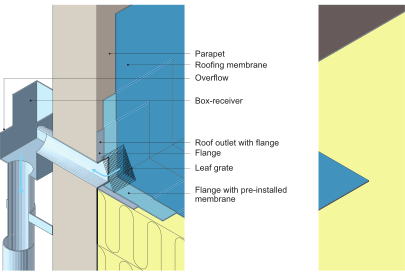
Figure 10. çThe roof outlet flange has a pre-installed membrane to ensure effective adhesion between outlet and membrane. The inflow to the roof outlet must be placed above the outlet to the box-receiver.
On flat roofs, flashings surrounding chimney stacks, roof vent cowls, and roof lights are vulnerable. To protect flashings (and the supporting roof structures) against excessive stress load it will be necessary to do the following:
- Roof outlets should be placed at the lowest points in the roof. Allowances must be made for any deflection and setting of the structure.
- A minimum of two roof outlets should be installed irrespective of sizing outcome.
- A grate should be fitted to the outlet. Please note that the design of the grating may seriously affect the flow capacity of the outlet. For the grating to enhance capacity, however, regular maintenance is necessary, especially where considerable leaf-fall is expected.
- Roof outlets should be placed far enough away from flashings (usually 0.5 metres as a minimum) to allow the flashings around the roof drain hopper and other flashings to be adequately executed.
If concealed joints are necessary inside the structure through which the outflow from roof outlets is drained, these must be welded.
The draining of flat roofs is sometimes affected via box gutters. Like the roof surface itself, these must be installed with a well-defined fall towards an outlet. The fall should be a minimum of 1:100 (i.e., 10 mm per m). Box gutters should also be robust and capable of resisting impact from ice during winter. They should have an emergency outlet, such as a pipe with a minimum diameter of 75 mm at either end, or be fitted with overflow protection so that the water will never flow over the top of the box gutter. If U-bends are used, they must be placed in a frost-free position and the roof outlets require careful cleaning and extra maintenance to avoid blockage.
Roof outlets are connected to downpipes installed as ordinary vertical waterpipes. The interface between the roof drain hopper and the inside downpipe must comply with tightness requirements for rainwater pipes in DS 432, Code of Practice for Sanitary Drainage – Wastewater Installations (Danish Standards, 2009). After renovation when replacing roof outlets for example, the discharge systems will quite often prove not to be tight if debris damming occurs. This should be factored in when sizing the drainage system, using grated outlets and by establishing an emergency overflow for example.
In combined systems (i.e., discharge systems where wastewater, rainwater, and drainage water converge into the same rainwater pipe) run-off from flat roofs can be connected to the existing discharge system in the following ways:
- It can be connected to a closed rainwater pipe via a roof outlet measuring, as a minimum, 0.2 metres.
- It can be connected directly to the property’s discharge pipes without passing through a U-bend. This method is restricted to flat roofs not intended for occupancy (due to odour nuisance) and where the position of the roof outlet relative to the ventilation stack of the discharge pipe is constructed as shown in Figure 11.
Connecting roof run-off to a vertical vented combined rainwater pipe must be executed as shown in Figure 11.
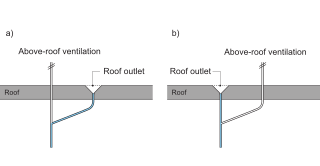
Figure 11. When connecting a roof outlet to a vertical vented combined rainwater discharge pipe, care must be taken to ensure that ventilation can also take place in rainy weather. The connection must be carried out using one of the two solutions shown in the drawing so that the rainwater discharge pipe can be sized as vented.
Roof run-off can be led directly to a discharge system without passing through a grit trap if it can be ascertained that the inlet area is free of twigs, leaves, or similar debris common in multi-storey buildings. Nevertheless, the inlet should be protected by a grating or a similar filter.
Special Roof Drainage Systems
Special types of roof outlets capable of draining sufficient rainwater and air to provide full-bore flow in the connecting waterpipes have been developed. Drainage systems of this type are known as ’UV-systems’. Full-bore flow enhances the utilisation of pipes, which can be executed in smaller dimensions and be installed horizontally across long distances.
These drainage systems are installed and sized according to specific methods relative to the design of the roof outlet and the degree of ponding occurring on the roof. If possible, UV-outlets with vertical outlets should be used. The outlet should intersect the roof structure and the horizontal pipe-run be installed below the roof.
It is now common practice to run pipes inside the insulation layer, therefore roof outlets with horizontal discharge are often used. However, horizontal pipe runs should be avoided as far as possible as there will always be a risk of undetected leakage in concealed pipes. If necessary, the waterpipes (and roof outlet) inside the structure should be compression-tested before sealing the roof.
UV-systems should be supplied with a pre-installed membrane, ensuring adequate adhesion between the outlet and the membrane.
The actual roof outlet should also be included in the leaktightness test.
For renovations, roof outlets with a side outlet may be used in some cases.
The discharge system can be exposed to both positive and negative pressure and must therefore be capable of resisting stress loads comparable to at least ± 300 kPa in relation to atmospheric pressure. It is common practice to test the systems for leaktightness before they are put into operation. UV-systems are developed and tested as systems solutions (i.e., using the same brand of components throughout the system). When installing UV-systems typically the manufacturer will specify the sizing, will determine the detail design required, and will supply the relevant components.
Emergency Overflow from Flat Roofs
For flat roofs with a parapet, an emergency overflow independent of the normal discharge system should be installed to prevent any damage to the fabric of adjoining building components in the event of ponding on the roof. The emergency overflow system must kick into action in the event of ponding due to blockage of the roof drain hoppers caused by ice, twigs, or leaves, or if the entire discharge system is blocked due to extreme rainfall events.
The overflow can be installed as a roof outlet fitted with raising rings to lead the water away via a separate drainage pipe or as openings in, or outlets from, the parapet (see Figure 12). The emergency overflow must be positioned below exhaust and intake vents, with its lower edge positioned 50–70 mm above the upper edge of the roof outlet (See Figure 13). An emergency overflow with a diameter of approx. 80% of the capacity of ordinary outlets should, as a minimum, be installed for every second roof outlet. The emergency overflows ensure that the water will never pool higher than the roof flashings – typically 150 mm above the finished roof surface. Emergency overflows should be installed so that the water is drained away from the façade, using chutes for example.
Examples of how to position emergency overflows on flat roofs are shown in Section 5.7.3, Roof Slope for Membrane Roofs.
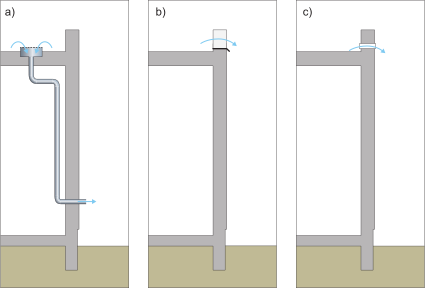
Figure 12. Techniques for installing emergency overflows to flat roofs.
- Roof outlet with raising rings and separate discharge pipe
- Aperture or opening in parapet
- Parapet outlet (see Figure 13).
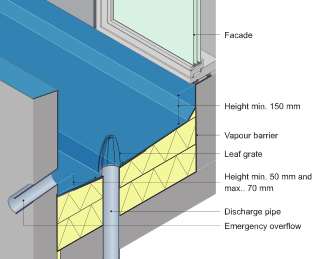
Figure 13. For roof surfaces between a building and a parapet, overflows are installed in the form of apertures, overflow outlets, or large parapet outlets to mitigate ponding, which may damage the fabric of the building. There must be no junctions on the section of the emergency overflow extending through building parts. Please note that for large roof surfaces, the emergency overflow must be positioned so that its lower edge is placed at least 50 mm below the flashing height (min. 150 mm).
2.2.5 Draining Green Roofs
The run-off factor from green roofs is significantly lower than for ordinary flat roofs, a factor that should be considered when sizing the system. On an annual basis, approx. 50% of the water ends up in the discharge system only.
Nevertheless, green roofs have a limited mitigating effect in extreme rainfall events and the discharge system must therefore be sized like that of other flat roofs (enabling them to handle extreme rainfall loads) and emergency outlets must be installed.
Valleys and the areas around roof outlets should normally be kept free of vegetation to avoid blockages.
Roof outlets must be cleanable and should be cleaned and checked twice a year.
UV-systems should not be used for green roofs, as there will rarely be sufficient water available to flush the pipes.
Guidelines for water discharge from green roofs are also provided in Section 5.11, Green Roofs.
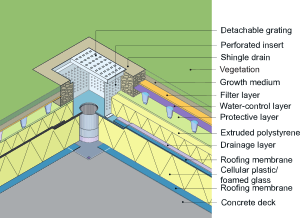
Figure 14. Basic diagram of integrated roof outlet in a green roof constructed as a duo-roof. The discharge from the membrane’s upper side has been lowered approx. 10 mm to allow free discharge from the membrane (see Figure 9).
2.2.6 Special Outlets
Discharge onto underlying roof surface
For buildings with multi-level roofs, it is often desirable to discharge run-off from higher-level roofs to lower-level roofs, using downpipes to discharge water freely onto the lower-level roof surfaces. This free discharge onto a roof surface may cause mechanical wear and tear to the roofing materials exposed to the streaming water, and so-called deflector plates made of strong and corrosion-proof materials should therefore be fitted. For roofing made of bituminous felt or membranes, an extra membrane layer should be fitted below the downpipe nozzle.
Chutes should not be fitted above circulation areas.
Outlets From Roof Terraces
Rainwater must be drained away from roof terraces and similar areas to prevent nuisance and damage. Therefore, outlets or chutes will normally be fitted.
Outlets on roof terraces must be positioned at the lowest level of the roof. When determining this position, due consideration must be given to any expected deflections of the deck.
Connecting outlets from roof terraces to the general discharge system must be carried out as specified for roof outlets. Outlets on roof terraces must be checkable and cleanable. Roof outlets should be designed to drain all levels in a terrace assembly.
Figure 15 shows an example of an integrated outlet in a roof terrace on a thermally insulated roof.
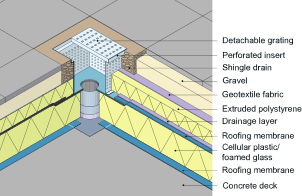
Figure 15. Basic diagram of integrated roof outlet in roof terrace constructed as a duo-roof. The discharge from the membrane’s upper side has been lowered approx. 10 mm to allow free discharge from the membrane (see Figure 9).
Parking Deck Outlets
Roof outlets in parking decks must be capable of resisting vehicular traffic loads. Therefore, they are often made of cast iron and a roofing membrane fixed with a clamping ring to create a robust joint. Roof outlets must be securely fixed, for example by concreting them in to avoid them being moved by braking and accelerating cars (see Figure 16).
In certain cases, such as in large parking facilities, local authorities may stipulate that rainwater discharge from parking decks be led through grit and oil traps.
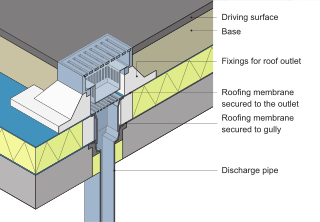
Figure 16. Schematic of outlet on thermally insulated parking deck in a warm roof installation. The membrane is mechanically secured to the outlet using a clamping ring.
2.3 Roof Ventilation
The small amounts of moisture which will inevitably migrate into the roof structures must be removed to avoid the harmful accumulation of moisture in the roof structure over time. In many roof structures, moisture is traditionally removed through ventilation. Cold roofs, for example, are installed as vented assemblies where the ventilation air removes moisture which has either migrated into the structure form the inside or has penetrated the structure from above.
However, this is not the case with all assembly types, and it is essential to know the preconditions for other solutions (cf. Section 1.3.1, Cold Roofs).
2.3.1 Preconditions for Removing Moisture by Ventilation
For a vented roof structure to function, a typical precondition is that it is sufficiently vapour-impermeable and airtight. If large amounts of moisture migrate into the roof structure, due to leaking joints or penetrations in the vapour barrier for example, even powerful ventilation will not always be capable of removing the moisture.
The roof structure is ventilated with ‘vent openings’, at eaves, ridges, in gable ends, and elsewhere. Inside the roof structure, air will flow through ‘vent spaces’, or ‘spaces’ (loft spaces, apexes, and crawl spaces). Differences in wind pressure and temperature (the stack effect), cause air to flow through the structure, removing moisture.
Ventilation systems must include;
- unutilised loft spaces (including crawl spaces and apexes),
- vent space between thermal insulation and (usually vapour-impermeable) roofing underlayment in couple roofs,
- a gap between thermal insulation and roof covering in cases where no underlayment is used,
- a cavity space between roof covering and underlayment (regardless of whether the roofing underlayment is vapour-permeable or vapour-impermeable).
Figure 17 is a schematic diagram of the venting within a collar roof with a cold crawl space, apex, and vapour-impermeable roofing underlayment.
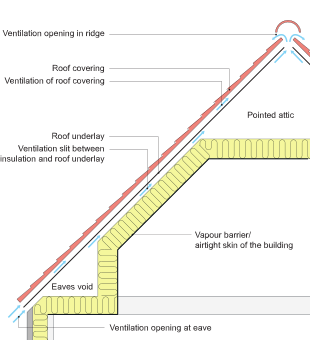
Figure 17. Schematic of vented collar roof with vapour-impermeable roofing underlayment. The ventilation system includes the crawl space and vent spaces between the thermal insulation and roofing underlayment, and apex. Besides venting below the roofing underlayment, the space between underlayment and roof covering must also be vented. Eaves-to-ridge ventilation occurs via openings at the eaves and ridge (as shown), where thermal uplift (the stack effect) drives the vent air through the roof structure. A precondition for this to function is that the vapour barrier is tight.
Periodically, moisture from the outside air briefly enters vented roof structures (e.g., when the structures are colder than the dew point temperature of the outside air). This moisture is removed by venting when the relative air humidity is reduced once again.
For roof coverings with a low heat capacity and low or no moisture absorption capacity (e.g., steel sheets), the added moisture may lead to the precipitation of condensate on the underside, which must be removed by roofing underlayment or temporarily removed by a condensate absorber for example (see Section 5.5, Metal Sheets). Special provisions apply to the removal of condensate on the underside of zinc and copper roofs (see Section 5.6, Zinc and Copper (and Aluminium)).
For certain overlapping types of roof covering (such as roof tiles), small quantities of water can penetrate the roof from the outside and cause moisture absorption. Under-roof venting ensures quick drying and thus protects spacer bars, roof battens, and roof coverings. The need for ventilation is greater during winter when moisture levels in roof structures peak (see Section 5.2, Roof Tiles).
2.3.2 General Ventilation Guidelines
To avoid moisture problems, ventilation must be effective, and the following general guidelines must be complied with:
- The area of vent openings must be designed according to Table 7 or have a combined size corresponding to 1/500 of the built area.
- Ventilation air must be evenly distributed. Vent openings should therefore be positioned to avoid any unvented areas. The roof must be vented where the hip, valley, roof lights, chimney, etc., block normal ventilation (see Figure 18). For pitched roofs, this can be achieved using roof vent tiles. For roofs fitted with roofing underlayment, supplementary roof vents should be fitted to the underlayment.
- Vent openings are normally fitted with a mesh to avoid ingress of birds, insects, or drifting snow. The insect mesh will reduce the airflow by approx. one half and the meshed vent openings must therefore be double the required net area. If an insect mesh is used, the height of the vent openings in the eaves must be 30 mm while, if the insect mesh is omitted, the required (net) height is only 15 mm. The size of the required vent openings in Table 7 includes insect mesh. The net area can be used in rare cases when an insect mesh is omitted.
Table 7. The required size of vent openings or number of roof vents per roof truss for buildings with a building depth of up to 16 metres (the distance between facades). The table applies to a roof truss spacing of up to 1.2 metres. For roofs without roofing underlayment, the table applies to vent openings in the space between thermal insulation and roof covering. For roofs with underlayment, the table applies to vent openings in the space between thermal insulation and underlayment. For roofs with underlayment, it will usually be necessary to also ventilate the space between underlayment and roof covering.
The table specifies two figures indicating the size of the required vent openings: 1) gross area of the overall required size with insect mesh/bird grating in all vent openings and, 2) net areas of the overall required size without insect mesh or bird grating. The figures in front of the slash indicate the gross height/area while the figures after the slash indicate the net height/area.
Manufacturers of roof vents or insect meshes must declare the reduction of airflow caused by the mesh if the airflow reduction is less than half of what it would be in a vent opening or roof vent without a mesh.
There must always be vent openings at the eaves. For shallow roof pitches (slopes <10 °), ridge ventilation should be avoided to mitigate negative pressure in the roof assembly. Discontinued roofing includes roof tiles and roofing sheets, while continuous roofing will usually consist of roofing membranes (cf. Section 5.1, Types of Roof Covering).
House depth | Vent opening at* the base of each rafter | Total ridge vent opening | Type of roof covering | |||
|---|---|---|---|---|---|---|
Roof vents | Spaces | |||||
Roof type | m | Height in mm (Height with/without insect mesh | cm2 (Area with/without insect mesh) | Height in mm (Height with/without insect mesh) | Discontinuous roof coverings | Continuous roof coverings |
Gable roof ≥10 ° slope | ≤ 16 | 30/15 | 200/100 | 20/10 | x | x |
Mono-pitch roof or lean-to roof ≥10 ° slope | ≤ 8 | 30/15 | 100/50 | 20/10 | x | x |
≤ 16 | 30/15 | 200/100 | 20/10 | x | x | |
Flat roof <10 ° slope | ≤ 16 | 30/15 | No openings at the ridge and no roof vent cowls | x | ||
*) In areas subject to requirements to safeguard against flame spread, the height of vent openings at the eaves in certain building types must be max.
30 mm, and the length must be min. 300 mm (DBI Fire and Security, 2007).
30 mm, and the length must be min. 300 mm (DBI Fire and Security, 2007).
Other general guidelines for roof ventilation:
- At the eaves level, where vents are behind the gutter, there must be free air access to the vent opening, including at least 20 mm of clear space between the gutter and the vent opening or wall.
- For house depths exceeding 16 metres, the ventilation design should be based on a moisture calculation. In this case, it would be advantageous if cross ventilation could be established so that the building is also vented in a lengthwise direction.
- The size and number of vent openings is relative to the size and geometric design of the roof (see Table 7). Alternatively, the roof can be vented at a rate corresponding to 1/500 of the built area.
2.3.3 Guidelines for Ventilation of Pitched Roofs
To provide sufficient venting of pitched roofs (slope ≥10 °), the general guidelines in Section 2.3.2, General Ventilation Guidelines must be complied with. Further, the following guidelines must be met:
- Ventilation should be driven by both wind pressure and the stack effect. Therefore, eaves-to-ridge ventilation should be installed.
- For renovations where airtightness is believed to be poor, unvented roofing underlayment should not be used.
- Where normal eaves-to-ridge ventilation is blocked (at valleys, dormers, roof lights, hips, and chimneys), alternative methods of venting the roof must be used (see Figure 18).
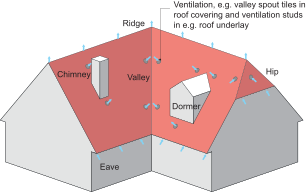
Figure 18. Where normal eaves-to-ridge ventilation is blocked (at valleys, dormers, roof lights, hips, and chimneys, etc.), alternative methods of venting the roof must be used such as roof vents in the roofing underlayment and vent tiles in the roof covering.
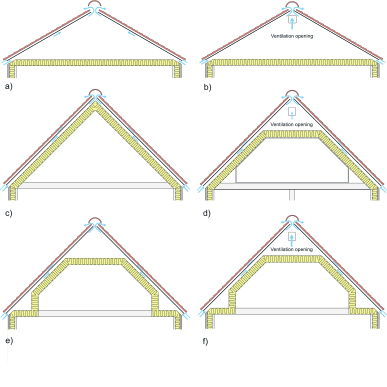
Figure 19. In all roofs fitted with roofing underlayment, the space between underlayment and roof covering must be vented and, in vapour-impermeable underlayment, the space between underlayment and thermal insulation must also be vented. This figure relates to buildings with a building depth or length of max. 16 metres.
a. The most effective ventilation method for open loft spaces is eaves-to-ridge.
c. Couple roofs and collar roofs are vented using eaves-to-ridge venting.
e. For collar roofs in short buildings (less than 16 metres long), ventilation at the gable-end apex may supplement or replace part of the ridge venting.
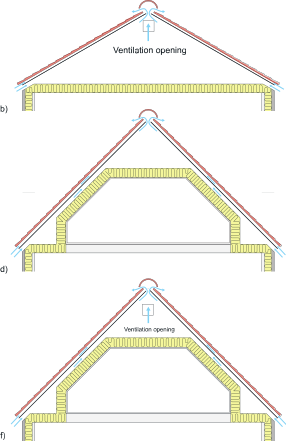
b. In open loft spaces in short buildings (less than 16 metres long), ventilation at the top of the gable ends can supplement or replace part of the ridge venting.
d. Couple roofs and collar roofs are vented using eaves-to-ridge venting.
f. For collar roofs in short buildings (less than 16 metres long), ventilation at the gable-end apex may supplement or replace part of the ridge venting.
2.3.4 Guidelines for Ventilation of Flat Roofs
To ensure adequate venting of flat roofs, the general guidelines in Section 2.3.2, General Ventilation Guidelines, must complied with. Furthermore, the following guidelines must be met:
- For shallow roof pitches (slope < 10 °), ventilation is exclusively wind-driven, and it must be guaranteed. Therefore, the wind must have free access to the vent openings.
- For building depths up to 16 metres, ventilation is affected exclusively via openings in the eaves.
- Vent openings are usually established at the eaves (e.g., in the soffit or parapet). The optimal conditions for ventilation airflow are achieved using eaves-to-eaves ventilation.
- There will normally be a permanent negative pressure across the whole roof surface. Consequently, roof vent cowls must not be used, because the negative pressure will be transmitted to the vent space where it may cause moist air to be drawn into the roof assembly.
- For ventilation through masonry in a parapet, ventilation air is supplied via openings with an area corresponding to the guidelines for flat roofs in Table 7.
- The empirical effective height of the vent space above the thermal insulation in a flat roof assembly must be at least 45 mm. This can be achieved by specifying that the thermal insulation height be secured by metal wire, for example.
- If eaves adjoin a wall, a covered vent opening may be fitted (see Figure 20). This solution must not be used in both sides of a vented cavity space, as differences in pressure generated by the wind will not be able to draw air through the vent space, because negative pressure will form across the whole roof.
- When vent spaces become blocked (e.g., in large roof lights and in L-shaped buildings), openings may be made from a blocked vent space to the vent spaces in the neighbouring sets of roof trusses. If the openings are made by drilling holes or by chiselling them out in rafters or other loadbearing timber elements, documentation is required to prove that the static conditions remain satisfactory.
Table 8. Specification of gross area or height of vent openings at the base of the roof and eaves for vented roofs with a slope of less than 10 ° and a building depth of max. 16 metres. The table indicates two figures specifying the size of the required vent openings: 1) gross areas for the overall required size, including insect mesh or bird grating in all vent openings and 2) net areas for the overall opening without insect mesh or bird grating. The figures in front of the slash are gross heights and the figures after the slash are net areas. The ventilation type must be eaves-to-eaves (via vent openings in the parapet). The vent openings must be distributed evenly and be sized in compliance with the guidelines for flat roofs in Table 7. Roof vent cowls on the exposed roof area must not be fitted, as they will generate negative pressure in the vent space.
Roof type | Gross area/net area of vent space |
|---|---|
 | Gross area/net area of vent opening in parapet: 300/150 cm2 per m |
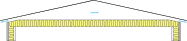 | Height of vent opening at eaves: 30/15 mm |
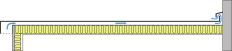 | Height of vent opening at eaves: 30/15 mm Vent opening facing wall: 30/15 mm (see Figure 20) |
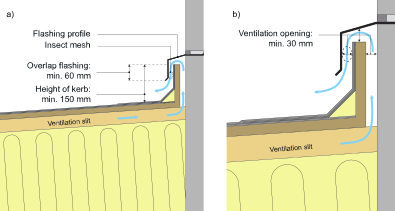
Figur 20. A covered vent opening on a roof adjoining an exterior wall which renders normal eave-to-eave ventilation impossible. This solution must only be used on one side of a roof assembly. There must be an opening measuring min. 30 mm around the entirety of the vent opening.
2.3.5 Unvented Assemblies
Roofs not requiring ventilation (unvented assemblies), include the following roof types:
- Warm roofs where the underside and sides of the thermal insulation and the top of the roof covering are sealed by a vapour barrier. It is a precondition that the roof covering and vapour barrier are joined tightly so that moisture cannot migrate into the thermal insulation. The supporting structure is completely covered by thermal insulation.
- Cold roofs with a moisture-adaptive vapour barrier in which moisture that migrates into the assembly in cold weather will be removed by downward diffusion in warm weather. It is a precondition that the roof covering is warmed during summer through exposure to direct sunlight, so that the moisture that migrates into the structure during the winter can be removed during the summer. Special preconditions apply to the design of such assemblies which are available from the manufacturer of the moisture-adaptive vapour barrier.
- Cold roof assemblies constructed using composite roofing slabs with supporting parts in timber or steel. The slabs have integral vapour barriers (which should be moisture-adaptive to avoid moisture being absorbed by the assembly) and a membrane roof. It is a precondition that the vapour barrier is completely airtight. This places especially tough demands on the joints between the composite roofing slabs in the finished building. Likewise, it is a precondition that the composite roofing slabs are prevented from absorbing moisture during transport and the building phase.
- Cold couple roofs with an unvented roofing underlayment where moisture from the inside is removed by diffusion via the underlayment material. A precondition for using unvented underlayment is that the vapour barrier is airtight so that only modest quantities of moisture require removal. Venting the space between roofing underlayment and roof covering is necessary to remove moisture. Please note that open loft spaces, large crawl spaces, and apexes will require modest venting although a vapour-permeable roofing underlayment is used (cf. Section 3.2.2, Unvented Roofing Underlayment).
Examples of cold and warm roofs are shown in Section 1.3, Warm and Cold Roofs.
2.4 Heat Loss
2.4.1 Building Regulations – Energy Provisions
The roof assembly must be designed, constructed, converted, and maintained to avoid unnecessary energy consumption for heating and cooling purposes. This should, along with the remaining building parts in the building envelope, contribute to satisfying the provisions for thermal insulation in applicable Building Regulations (BR18, § 250–298) (The Danish Transport, Construction and Housing Authority, 2017). These energy provisions may also be met by applying the optional low-energy class (BR18, § 473–484).
Documentation showing that the energy provisions specified by the Building Regulations have been met must be done using the SBi Guidelines 213, Bygningers energibehov (Energy Requirement in Buildings) (Aggerholm & Grau, 2018) (BR18, § 251).
When calculating transmission areas, transmission loss, etc., DS 418, Calculation of heat loss from buildings (Danish Standards, 2011), must be used (BR18, § 256).
The Building Regulations specify various energy provisions which apply in different scenarios, for example, whether the construction is a new build, conversion, or renovation. For new builds, the provisions distinguish between residential housing or other types of building. Moreover, there are separate energy provisions for extensions and holiday homes, for example.
The Building Regulations’ provisions for airtightness are outlined in Section 2.4.3, Airtightness.
New Builds
The Building Regulation energy provisions for new builds are formulated as an overall performance requirement. Whole buildings must meet thresholds within an energy performance framework, which depend on whether the building is residential housing or another type of building. The energy performance framework specifies a building’s maximum permissible energy demand (e.g., for heating). The energy performance framework is supplemented by provisions for specific building parts. These supplements are for the thermal insulation of the building envelope as a whole (design transmission loss) and, for the minimum thermal insulation of building parts and linear thermal transmittance in joints (thermal bridges) (max. U-value and Ψ-value). These measures prevent unnecessary heat loss and condensation caused by thermal bridges and enhance comfort.
The U-value for a roof should be max. 0.20 W/m2K (BR18, § 257). This corresponds to a thermal insulation thickness of approx. 200 mm mineral wool, depending on the type of thermal insulation chosen and the quantity of wood in the thermal insulation layer for example. To meet the Building Regulations’ combined provisions for energy requirements, the typical U-values for new roofs will be between 0.08 and 0.12 W/m2K. The thickness is calculated using lambda-values (see Section 2.4.2, Thermal Insulation of Roofs). The U-value requirements correspond to thermal insulation thicknesses of approx. 300-400 mm when using mineral wool with a λ-value of 37 and a wood percentage of approx. 6%.
There are requirements regulating the linear thermal transmittance in the joints between roof assembly and roof lights or domes, as the linear thermal transmittance must be max. 0.20 W/mK (BR18, § 257). By reducing the linear thermal transmittance, the thermal bridge around roof lights and domes will also be reduced (see Figure 21). Conversely, there are no requirements regulating the linear thermal transmittance around interfaces between roof assemblies and exterior walls, as this is compensated for by the heat loss of the exterior surface area of the building (cf. DS 418, Calculation of heat loss from buildings (Danish Standards, 2011)). However, major thermal bridges should still be avoided.
Minimum requirements for building parts and linear thermal transmittance in interfaces between building parts in roofs are shown in Table 9.
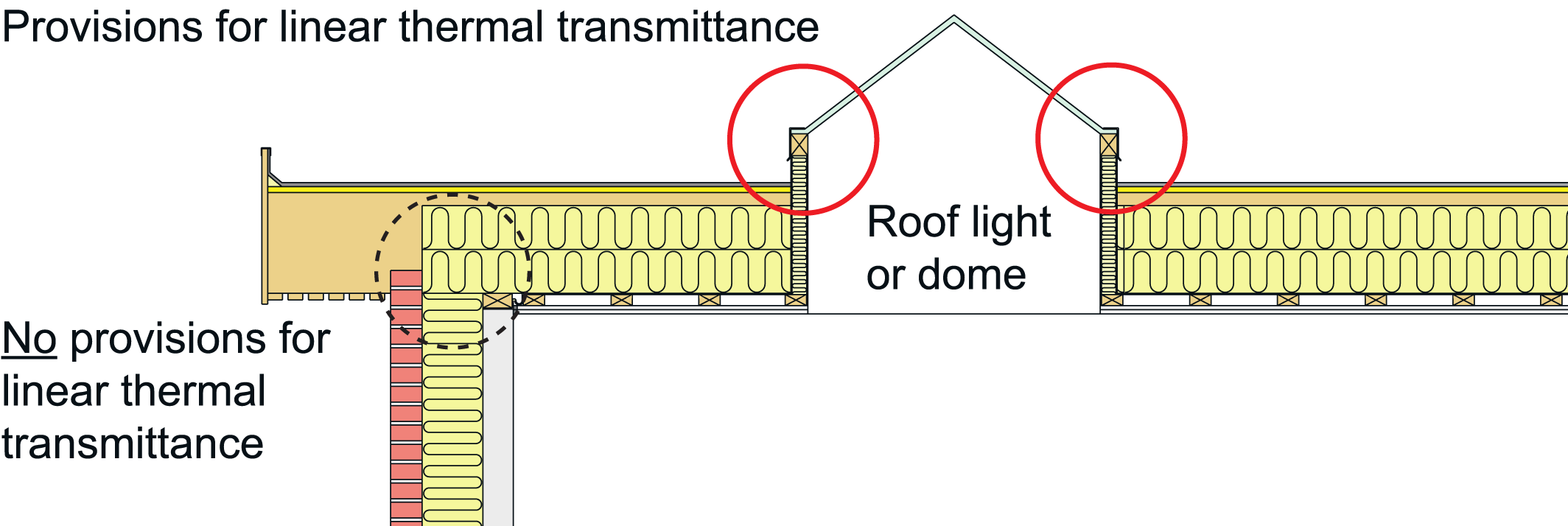
Figure 21. Provisions for linear thermal transmittance in roof assemblies at the interface with roof lights and domes (red circle) while no provisions exist for the interface between roof assemblies and exterior walls (dotted circle).
Table 9. Minimum requirements for thermal transmittance (U-value) and thermal bridges in interfaces (linear thermal transmittance) for building parts used in roofs (BR18, § 257). In addition to the requirements regulating the actual loft and roof assembly, there are requirements for trapdoors to unheated spaces such as loft spaces.
Building Part | U-value [W/m²K] |
|---|---|
Loft and roof assemblies, including crawl spaces walls, flat roofs, and sloping walls which are parallel to the roof surface | 0.20 |
Gates or trapdoors to outdoor areas or unheated spaces, and glass walls and windows facing rooms heated to higher temperatures (where the difference in the ambient temperatures between these rooms is 5 °C or more) | 1.80 |
Domes | 1.40 |
Sun tunnels (or similar structures) | 2.0 |
Building part | Linear thermal transmittance [W/mK] |
Interface between exterior wall and windows or exterior doors, gates, and trapdoors | 0.06 |
Interface between roof assembly and roof lights or domes | 0.20 |
Renovations
In roof renovations, special energy provisions for thermal transmittance in roof assemblies apply. Re-insulation must typically be carried out to the standard required in new builds if this is financially viable and does not involve a risk of moisture-induced damage (BR18, § 274–279).
According to applicable regulations, renovated roof assemblies must therefore be thermally insulated with a U-value of 0.12 W/m2K and there must be a linear thermal transmittance around roof lights and domes of below 0.10 W/mK (BR18, § 279). When renovating buildings, it is possible to satisfy the provisions in the form of an energy performance framework using the renovation classes for existing buildings (BR18, § 280–282) as an alternative to these component requirements.
The specific provisions for energy saving measures in roof renovation depend on whether the renovation is classed as repair, conversion, or replacement.
Table 10. Minimum requirements for thermal insulation (U-value) and thermal bridges in interfaces (linear thermal transmittance) for building parts used in roofs (BR18, § 279). In addition to requirements for the loft and roof assembly, requirements for trapdoors leading to unheated spaces (e.g., loft spaces) are also listed.
Building Part | U-value [W/m²K] |
|---|---|
Loft and roof assemblies, including crawl space walls, flat roofs, and sloping walls parallel to the roof | 0.12 |
Gates or trapdoors to outdoor areas or unheated spaces, and glass walls and windows facing heated rooms (where the difference in the ambient temperatures between these rooms is 5 °C or more) | 1.80 |
Domes | 1.40 |
Sun tunnels (or similar structures) | 2.0 |
Building part | Linear thermal transmittance [W/mK] |
Interface between exterior wall and windows or exterior doors, gates, and trapdoors | 0.06 |
Interface between roof assembly and roof lights or domes | 0.10 |
Repairs
Repair involves minor alterations, specifically to less than 50% of the total area. Repairs are not subject to provisions for implementing viable energy savings (e.g., replacing a few roof tiles or repairing flashings around penetrations) (cf. Section 4.0, Ombygninger og udskiftninger af bygningsdele (Conversions and Replacement of Building Parts) in: Bygningsreglementets vejledning om energiforbrug (Guidelines in the Building Regulations on Energy Consumption) (The Danish Transport, Construction and Housing Authority, 2018a)).
Conversions
Conversion describes circumstances in which a building part is renovated or altered (e.g., when the roof covering is replaced). For conversions or major repairs (i.e., when the work involves more than 50% of the building part and it is deemed viable), the roof must be re-insulated, if prudent to do so (i.e. if it is feasible and will not involve any risk of moisture-induced damage). According to the Danish Transport, Construction and Housing Authority, 2018a), examples of tasks requiring viable insulation include:
- New tiled roofs (or similar structures)
- New roof coverings (new top-layer bituminous felt or roofing foil on existing roofs)
Viable energy savings relative to re-insulation, for example, means that the annual energy savings multiplied by lifespan, divided by the investment should be larger than 1.33 (BR18, § 274).
The investment is the extra cost incurred for wages and materials (e.g., when extending rafters, installing new fascia, new flashings, raising roof lights and dormers, added brickwork, installing vapour barriers and thermal insulation resulting from increased thermal insulation thickness).
No re-insulation is required if it would pose a risk of moisture-induced damage (BR18, § 274).
If it is not viable to re-insulate to comply with current insulation requirements (a U-value of 0.12 W/m2K) re-insulation using smaller thicknesses must be used providing this is viable. A calculation to assess the viability of further re-insulation is based on an assembly where the additional insulation in the hollow space has already been performed (cf. Section 4.0 in the Bygningsreglementets vejledning om energiforbrug (Guidelines in the Building Regulations on Energy Consumption) (the Danish Transport, Construction and Housing Authority, 2018a)).
Typically, it would be viable to re-insulate accessible horizontal loft spaces in lattice-trussed roof assemblies, while it will not always be viable to re-insulate when renovating couple roof assemblies. Information on energy provisions and examples of solutions that would normally be viable are outlined in the Bygningsreglementets vejledning om ofte rentable konstruktioner (Guidelines in the Building Regulations on Assemblies Likely to be Financially Viable) (the Danish Transport, Construction and Housing Authority, 2019).
Replacement
Replacement is the term used when building parts are replaced. This may be an entire roof assembly, inclusive of roof covering, rafters, thermal insulation, and loft (cf. Section 4.0 of the Bygningsreglementets vejledning om energiforbrug (Guidelines in the Building Regulations on Energy Consumption) (the Danish Transport, Construction and Housing Authority, 2018a)). For replacement work, the U-value of the assembly must be max. 0.12 W/m2K and the linear thermal transmittance around skylights and roof lights must be max. 0.10 W/mK (BR18, § 279). When replacing or adding dormers, for example, it may not always be possible to meet applicable requirements for components, but this can be compensated for by increasing thermal insulation elsewhere, for example.
Issues concerning airtightness in connection with renovation are outlined in Section 8, Roof Renovation.
2.4.2 Thermal Insulation of Roofs
Various types of thermal insulation can be used for thermal insulation, including:
- Mineral wool produced from glass or rock
- Cellular plastic
- Organic materials (e.g., hemp, flax, paper, or wood fibre)
- Foamed glass
A material’s thermal insulation capacity is indicated by their thermal conductivity or lambda value (λ-value). The thermal conductivity of thermal insulation materials is determined through testing according to a series of coordinated European product standards. The lower the lambda value of a given material the better the insulation capacity.
Cellular plastic thermal insulation material includes polyisocyanurate (PIR), polyurethane (PUR), polystyrene (EPS and XPS), and phenolic foam. Cellular plastic insulation may have lambda values as low as approx. 0.020 W/mK. The lambda values of mineral wool insulation typically range between 0.030 and 0.040 W/mK while the lambda values of organic thermal insulation materials made of paper or cellulose fibres typically range from 0.035 to 0.045 W/mK.
In timber assemblies where the thermal insulation is installed between the timber elements, soft mineral wool insulation mats or blown-in loose-fill thermal insulation (of mineral wool or paper for example) is used. Adjusting inflexible rigid-foam insulation boards such as PIR, PUR, EPS, or XPS is difficult, because the insulation is incapable of absorbing the tolerances which exist in timber assemblies.
For warm roofs, a rigid walk-proof thermal mineral wool, foamed glass, polystyrene, PIR, or PUR is used.
Which specific type of thermal insulation to use in a given roof assembly depends on the fire safety regulations which apply to the building in question (see Section 2.5, Fire Safety Regulations for Roofs).
2.4.3 Airtightness
As part of the energy provisions specified in the Building Regulations, there are requirements governing the airtightness of buildings (BR18, § 263). These requirements were introduced to avoid draft problems and unnecessary heat loss due to air leakage in the building envelope. A tight building envelope can be achieved by ensuring a continuous airtight enclosure (see Figure 22). The airtight enclosure is often achieved with a vapour barrier, which (in addition to being vapour-impermeable) must be installed with tight joints, penetrations, and intersections (see Section 2.1, Water and Moisture Tightness).
The provisions in the Building Regulations for airtightness specify a maximum value for airflows through a building envelope at a pressure difference of 50 Pa between the indoor and outdoor environment. Whether or not these requirements are met is documented by testing both positive and negative pressure compared to the outdoor pressure according to DS/EN ISO 9972 (Danish Standards, 2015a). The result is specified as the mean value of these two results.
In new builds, the airflow at a pressure difference of 50 Pa (w50) must be below 1.0 litres/second per m2. The area is calculated as the building’s heated gross area. For buildings with high-ceilinged rooms where the surface of the building envelope divided by the floor area is greater than 3, the airflow must not exceed 0.3 litres/second per m2 (BR18, § 263).
For the optional low-energy class (BR18, § 481), the airflow is required to be below 0.7 litres/second per m2 of the floor area. For buildings with high-ceilinged rooms where the surface of the building envelope divided by the floor area is greater than 3, the flow rate through air leakages must not exceed 0.21 litres/second per m2 of the building envelope.
Issues concerning airtightness relative to renovation are outlined in Section 8, Roof Renovation.
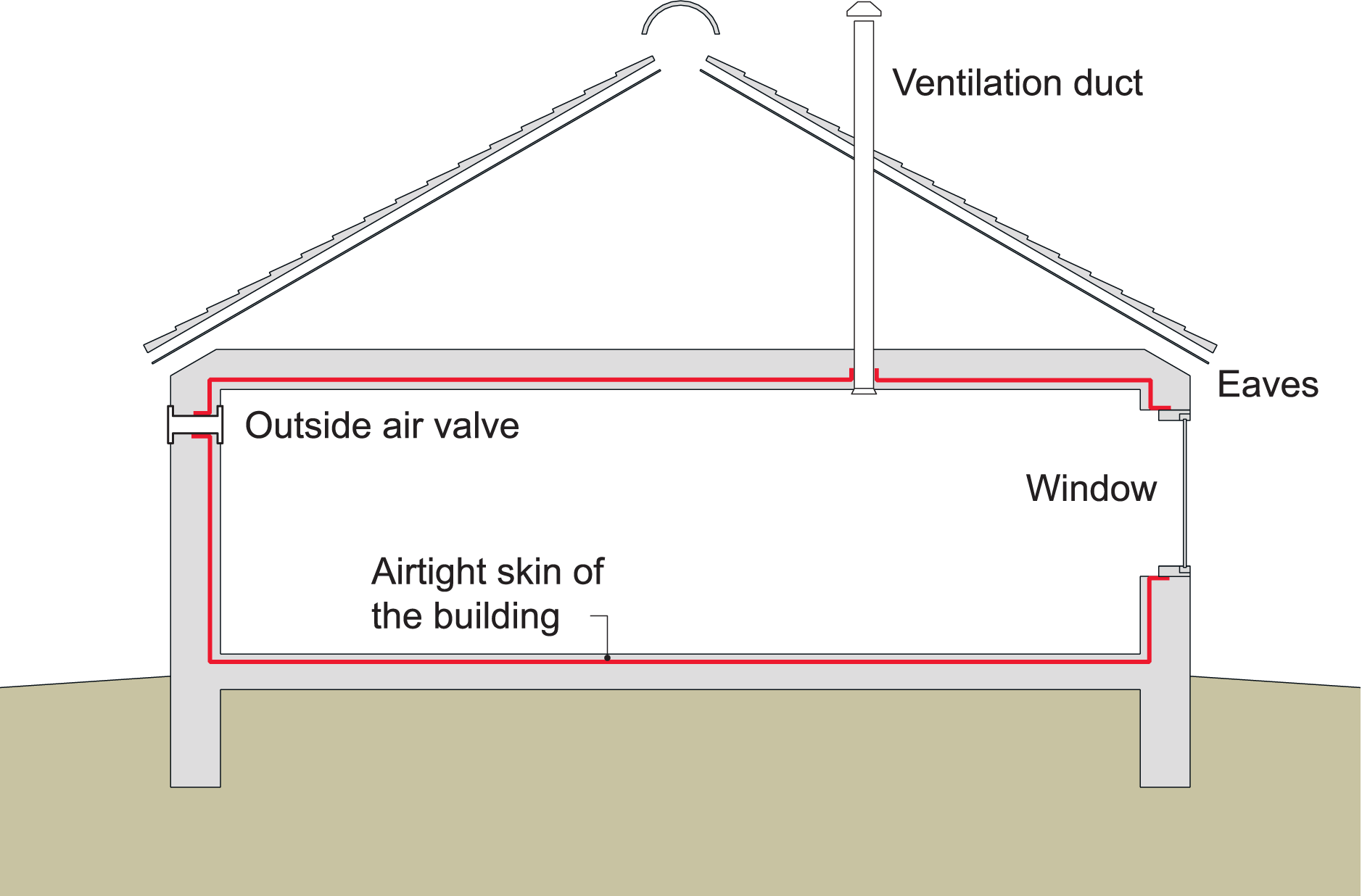
Figure 22. To ensure airtightness, the airtight enclosure (indicated by a red line) must be continuous and tight (i.e., there must be no possibility of cold outside air migrating into the building nor warm and moist air migrating into the structures).
Leakages
Requirements for airtightness also impact significantly on the moisture conditions in the roof assembly, since effective tightness inside the roof assembly reduces the risk of airflow into the assembly and hence of moisture-induced damage.
Even buildings which meet airtightness requirements will always have minor air leakages, which means that the building will never be absolutely airtight. The leakages should be evenly distributed, avoiding a predominance of air leakages in the roof assembly, which may lead to moisture issues.
The design and location of the airtight enclosure is of major significance for the overall airtightness, especially the joints between the individual parts of the airtight enclosure (e.g., between vapour barriers in the walls and roof as well as penetrations (see Figure 23)).
The location of the airtight enclosure and the airtightness of all details should therefore be an integral part of the design from the early stages. To achieve optimal airtightness, details should be designed to be buildable. Joints and penetrations in the vapour barrier must always be made on a firm underlay, for example, one made of plywood (see Section 2.1.2, Vapour Barriers in Roofs).
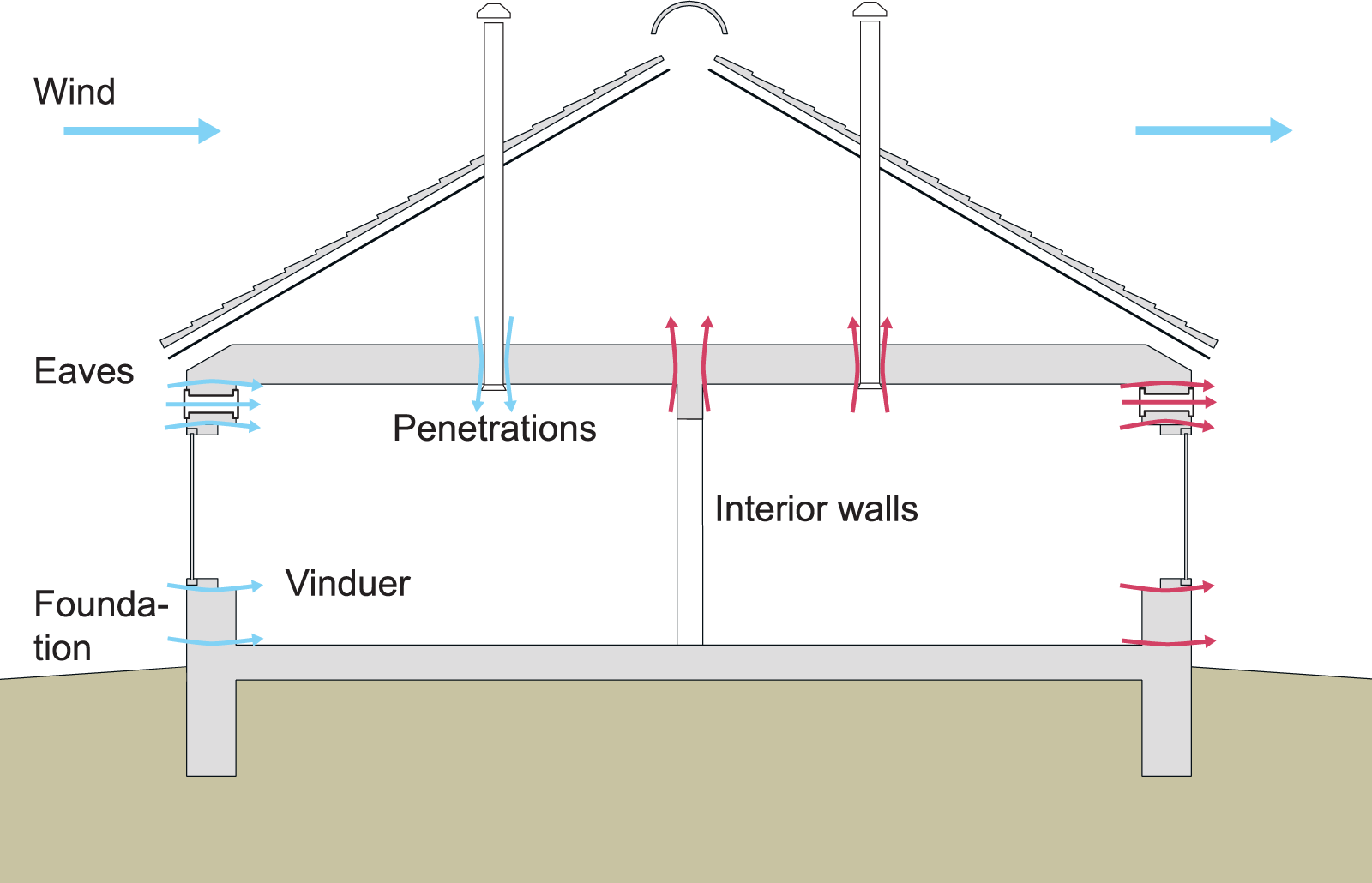
Figure 23. In the past, many new buildings were relatively draughty. The figure shows wind action and airflow through a building, with draft problems in the windward side (blue arrows indicate cold air streaming into the building) and heat loss through random air leakage paths in the building envelope in the leeward side (red arrows indicate leakages where warm air flows out of the building or into the roof assembly).
Materials Used for the Airtight Enclosure
The airtight enclosure normally consists of a variety of different materials/structures with, for example, an inner leaf of aerated concrete and PE foil in the roof. Consequently, airtightness must be achieved partly through the materials themselves and partly via the joints made between different materials or building parts.
Vapor barrier materials for making airtight enclosures in roofs include the following:
- Foil vapour barriers can normally be regarded as airtight in themselves. In the case of thick foils (e.g., 0.2 mm PE foil) the rigidity may inhibit tight corner details. To ensure airtightness, special tapes, foil adhesives, pre-fabricated sleeves, etc., designed for use with a given foil should be used (these are referred to as systems solutions).
- Vapour barriers in warm roofs are often used as roofing membranes of bituminous felt or roofing foil, fixed either to firm wooden decking or concrete decking or laid loosely (with tight joints) on an underlay of thermal insulation material.
- Sheet materials such as plasterboard and plywood are usually airtight while Oriented Strand Board (OSB) materials are only considered airtight if sheets specifically designed for airtightness are used. Joint interfaces must be carefully and durably sealed.
Vented Roofs
In vented roofs, the airtight enclosure will usually be on the inside of the roof assembly (e.g., constructed by means of a vapour barrier or interior cladding) (see Figure 24). The airtightness of the roofing underlayment is not considered. Specific requirements apply to the correct choice of material as well as to design and construction details.
Please consult Bygningers lufttæthed – tæthedskrav, bygningsudformning og måling (Airtightness in Buildings – Tightness Standards, Building Design, and Measurement) (Byg-Erfa, 2013) and www.membranerfa.dk.
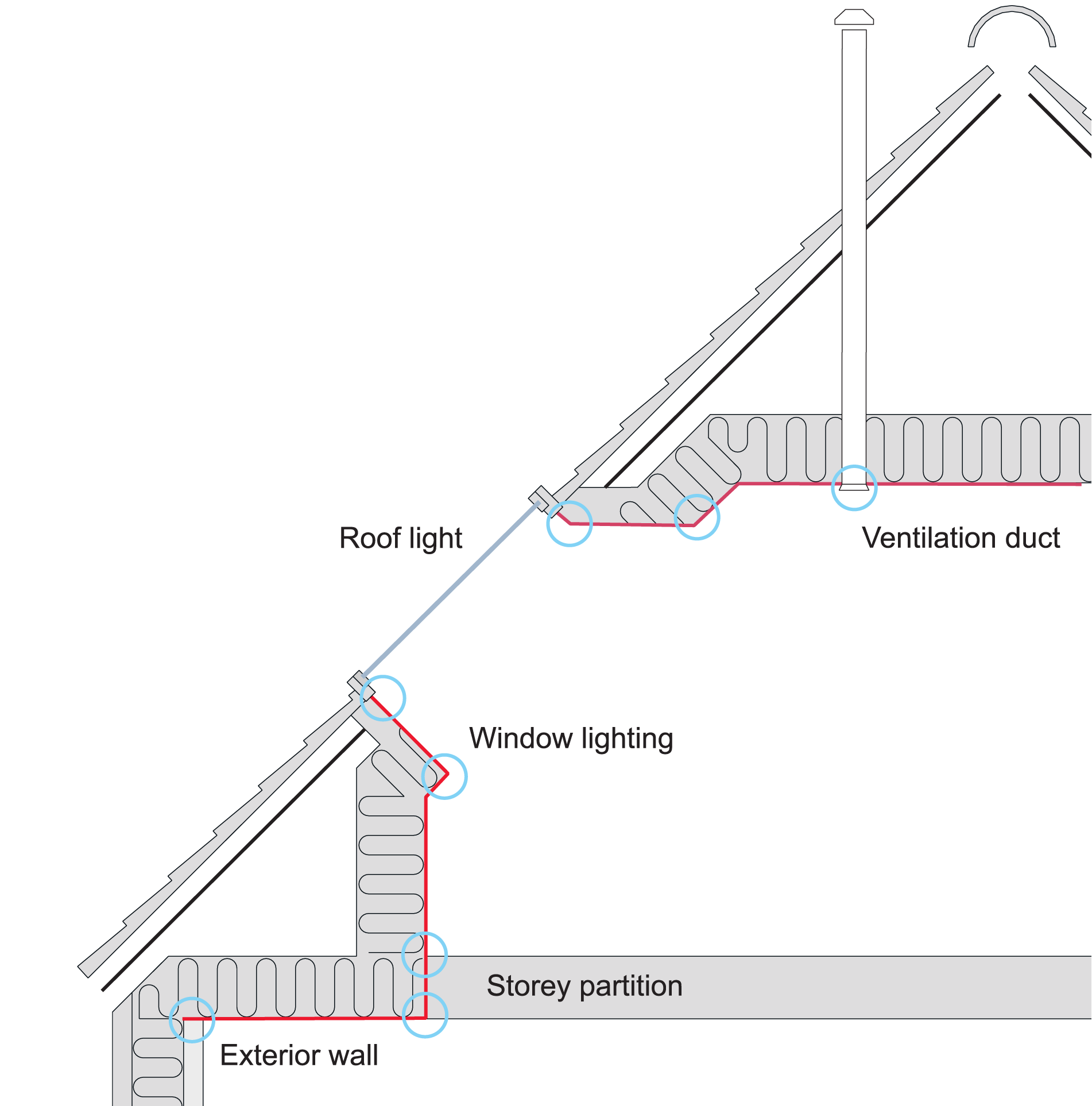
Figure 24. The airtight enclosure in a vented roof assembly (red line in cross section of collar roof) (e.g., using a vapour barrier) must be continuous to ensure an airtight roof assembly. The vapour barrier in the roof assembly must be made airtight at the exterior wall interfaces and roof lights (if there are any) to ensure a continuously airtight enclosure. Joints and intersections (blue circles) (e.g., at windows, roof lights, and ventilation ducts) require careful planning, design, and construction. Joints between, and penetrations in, vapour barriers must be executed on a firm underlay to ensure durable solutions with a high level of airtightness.
Warm Roofs
Warm roofs are chiefly constructed with a tight vapour barrier and a tight roof covering consisting of a roofing membrane. Here, too, specific requirements apply to the correct choice of materials, design, and execution of details.
Warm roofs are not vented between vapour barrier and roof covering, so the roof covering may therefore contribute to meeting the requirements regarding airtightness.
However, the roof covering cannot always be relied on to be airtight at the eaves, etc., which means that the roof assembly could be subject to pressure compensation. Furthermore, strong winds may cause movement in the roof covering (negative pressure above the roof), leading to negative pressure in the roof assembly between the vapour barrier and the roof covering. This could lead to indoor air being drawn in if there are leakages in the vapour barrier. It is therefore vital to install the vapour barrier very carefully to avoid moisture absorption.
In warm roofs with a supporting structure of profiled steel sheets where the vapour barrier is usually placed 50 mm into the thermal insulation (for reasons of fire safety), airtightness must be secured at this level.
2.5 Fire Safety Regulations for Roofs
Fire may adversely affect roofs from both the inside and the outside. Chapter 5 in the Building Regulations, Fire, contains provisions for roofing materials and structures intended to reduce the risk of flame spread on both accounts (BR18, § 82–158).
According to BR18, building parts must be classified according to categories of use, risk classes, and fire classes.
The categories of use are outlined in BR18, § 85 and the risk class is determined in accordance with BR18, § 86. Chapter 5, Fire, includes a set of guidelines specifying pre-accepted solutions for each building type. Based on the category of use, it is thus possible to find pre-accepted solutions suitable for any given construction project.
Documentation of fire safety features can be presented in various ways:
- Pre-accepted solutions
- Comparative analyses based on pre-accepted solutions
- Fire performance dimensioning
- Fire test(s)
- A combination of these four methods.
Fire class rating is performed according to BR18, § 493.
Special conditions apply to fire safety relative to roof renovations (see for example, the DBI Guidelines Gode & brandsikre tage – Vejledning om brandsikring ved renovering af tage (Sound and Fire-Safe Roofs – Guidelines on Fire Safety for Roof Renovation) (DBI Fire and Security, 2014) (www.brandsikretage.dk)).
2.5.1 Fire from the Outside
The Building Regulations specify overall functional provisions for materials, structures and building parts intended to contribute to the fire safety of the building’ (BR18, § 87).
In practice, the BR18 provisions are detailed in the Bygningsreglementets vejledning til kapitel 5 – brand (Guidelines in the Building Regulations for Chapter 5 – Fire) (The Danish Transport, Construction and Housing Authority, 2018e). This states that the standard requirements for roof coverings over a given underlay must be classified as BROOF(t2) at a minimum.
Proof of the compliance of roof coverings with this requirement is documented by testing according to method 2 in DS/CEN/TS 1187 (Danish Standards, 2012), and classification is done in accordance with DS/EN 13501-5 (Danish Standards, 2016b).
However, several roof coverings have been pre-approved as class BROOF(t2) as a consequence of 2000/553/EC: Commission Decision (The EU Commission, 2000). This means that no documentation is required for these proving their fire performance in the case of fire from the outside if they are installed on battens without direct contact to underlying materials such as insulation material or roofing underlayment (see Table 11).
However, roof coverings are also required to protect underlying materials in the roof assembly. For other applications such as roof covering installed on underlay of insulation, the manufacturer of the roof covering materials must advise on the types of underlay suitable for specific roof coverings.
Table 11. Materials used as roof covering and, without the need for testing, pre-approved as BROOF(t2) on an underlay of battens. (The EU Commission, 2000).
Roof Covering Material | Description |
|---|---|
Slates | Natural slates and stone slates |
Tiles 1) | Stone, concrete, clay, ceramic, or steel roof tiles Any external coating should be inorganic or have an (upper calorific value) of PCS ≤ 4.0 MJ/m2 or a mass ≤ 200 g/m2. |
Fibre-reinforced cement | Flat and profiled sheets, and slates 1) The materials must satisfy the provisions of the Commission Decision or have an (upper calorific value) of PCS ≤ 3.0 MJ/m2. |
Flat or profiled metal sheets 2) | Aluminium, aluminium alloys, copper, copper alloys, zinc, zinc alloys, uncoated steel, stainless steel, galvanised steel, coil-coated steel, vitreous enamel steel. Thickness ≥ 0.4 mm. Any external coating shall be inorganic or have an (upper calorific value) of PCS ≤ 4.0 MJ/m2 or a mass ≤ 200 g/m2 |
Products intended to be fully covered in normal usage by inorganic coverings 1) | Loose-laid gravel with a thickness of at least 50 mm or a mass ≥ 80 kg/m2 (minimum aggregate size of 4 mm, maximum 32 mm) Sand or cement screed with a thickness of at least 30 mm Cast stone or mineral slabs of at least 40 mm thickness |
- According to special EU-rules.
Roofing Membranes
Bituminous felt and roofing foil require documentation by testing before satisfying the provisions of class BROOF(t2). Bituminous felt and roofing foils are not subject to fire safety regulations when covered by either a 50-mm layer of loose-laid gravel, a 30-mm screed layer, or 40-mm thick slabs.
Bituminous felt and roofing foil tests are conducted according to method 2 of DS/CEN/TS 1187 (Danish Standards, 2012a), where the roof covering is tested on three standard substrates (particle board, mineral wool, or polystyrene) or on the substrate in question. At the end of test, the damage to the roof covering (one or two layers) or to the substrate, must be no more than 800 mm in length and the mean damage registered on three tests conducted at an airspeed of
2 m/s and three tests conducted at an airspeed of 4 m/s must be less than 550 mm.
2 m/s and three tests conducted at an airspeed of 4 m/s must be less than 550 mm.
If the test is successful, a classification according to DS/EN 13501-5 (Danish Standards, 2016) is issued where the roof covering is classified on the substrate used with a density of min. 75% of the one used in the test. If the product passes on a polystyrene substrate, the classification will apply to all substrates with a higher density. For renovations, special rules apply to roof covering tests (see DS/CEN/TS 16459, External fire exposure of roofs and roof coverings - Extended application of test results from CEN/TS 1187 (Danish Standards, 2014)). Bituminous felt used to renovate existing bituminous felt roof coverings must be tested on a substrate of roofing felt.
Green Roofs
Green roofs on a substrate of bituminous felt or roofing foil are not within the scope of the EU Commission Decision. For green roofs, therefore, a test of the green roof must be carried out or a fire performance assessment made of the actual roof. In the case of extensive green roofs, however, it is advisable that the roof covering itself satisfies the requirements of BROOF(t2) if the green roof should be removed later.
Rules for, and examples of, fire safety relative to green roofs are detailed in Section 5.11, Green Roofs.
Thatched Roofs and Shingle Roofs
Special rules apply to thatched roofs and shingle roofs (cf. the Bygningsreglementets vejledning til kapitel 5 – brand (Guidelines in the Building Regulations for Chapter 5 – Fire)) (see e.g., Bilag 1 – Præ-accepterede løsninger – Enfamiliehuse (Annex 1 – Pre-Accepted Solutions – Single-Family Dwellings) (The Danish Transport, Construction and Housing Authority, 2018b)). Shingle roofs can be classified according to DS/EN 13501-5 (Danish Standards, 2016b).
Roof coverings made of reeds (thatched roofs) do not satisfy the requirements of roof coverings class BROOF(t2) [class T roof covering]. Nevertheless, thatched roofs can, as a rule, be used for buildings classified in usage category 4 (e.g. detached and integrated single-family dwellings) provided that the thatched roof is made fire safe on the underside and that all vertical party walls are constructed, as a minimum, as building parts class EI 60 and extended up to be in close contact with a building part class EI 30 (cf. Bilag 1 –Præ-accepterede løsninger – Enfamiliehuse (Annex 1 – Pre-Accepted Solutions – Single Family Dwellings) (The Danish Transport, Construction and Housing Authority, 2018b)).
Rules and examples of fire safety in thatched roofs and shingle roofs are detailed in Section 5.8, Thatched Roofs, and Section 5.9, Roofing Shingles, respectively, as well as in TRÆ 71, Brandsikre bygningsdele (Fire-Safe Building Parts) (Træinformation, 2015).
Insulation Materials
Insulation material is defined as material with a density of less than 300 kg/m3.
The fire safety regulations for roofs are outlined in Annex 1–8 of the Bygningsreglementets vejledning til kapitel 5 – brand (Guidelines in the Building Regulations for Chapter 5 – Fire) including pre-accepted solutions. The requirements are based on the usage category of the building, its fire class, and risk class (e.g., determined by the height of the building).
Furthermore, fire protection requirements apply to the insulation material below.
The information to follow is based on Annexes 1–8 listing pre-accepted solutions for the most common building types. Requirements for other building types in the remaining annexes are expected to be identical.
Materials classed at minimum A2-s1,d0 (non-flammable insulation materials) can be used in buildings where the floor of the top storey is a minimum of 22 metres above ground level and may be put to unlimited use in buildings where the floor of the top storey is a maximum of 45 metres above ground level. This includes soft mineral wool, mineral wool roof insulation, and foamed glass.
Materials classed at minimum B-s1,d0 (class A materials) can be put to unlimited use in roof assemblies in buildings where the floor of the top storey is a maximum of 22 metres above ground level. Materials of this type include certain types of phenolic foam, for example.
Materials classed at minimum D-s2,d2 (class B materials) can be used with the generally applicable restrictions which are outlined below:
- If the floor of the top storey is more than 5.1 metres above ground level, the supporting structural building parts must be constructed using non-flammable materials (at minimum class A2-s1,d0).
- If the building has a roof covering which does not at minimum comply with BROOF(t2), then insulation material class B-s1,d0 (class A materials) must be used. This applies to thatched roofs, for example.
- If the roof covering at minimum complies with BROOF(t2), insulation material class D-s2,d2 (class B material) can be used in buildings where the floor of the top storey is max. 22 metres above ground level. This applies to certain types of PIR products.
Material below class D-s2,d2 (class B materials) can be used in buildings where the floor of the top storey is a maximum of 22 metres above ground level. However, restrictions to height, supporting structure, and fire-safe segregation apply. This group of insulation materials include EPS, XPS, certain types of PIR and PUR, and paper and cellulose loose-fill insulation.
- For buildings where the top storey floor is more than 5.1 metres above ground level, the supporting structures must be constructed of non-flammable materials (at least class A2-s1,d0).
- The roof covering must be at least BROOF(t2) for all buildings where the top storey floor is max. 22 metres above ground level.
- Where the top storey floor is max. 9.6 metres above ground level, the insulation facing the underlying occupancy space must be protected by at least class K1 10/B-s1,d0 (class 1 cladding) or by building parts class EI 30.
- If the top storey floor is maximum 22 metres above ground level, the protection must consist of building parts classed at least EI 30.
- In buildings where the top storey floor is more than 22 metres above ground level, all insulation materials must at a minimum satisfy the requirements for A2-s1,d0 (non-flammable material).
Special requirements for roof insulation apply to roof terraces which must be constructed as storey partitions. If the insulation material is not at least class D-s2,d2 (class B material), it must be installed on top of building part REI 60/A2-s1,d0 (fire-safe building part 60) (i.e., typically a concrete deck, classed as REI 60).
Classifying insulation material by testing may be conducted under special conditions. If that is the case, the material must be used as tested for the classification to be valid.
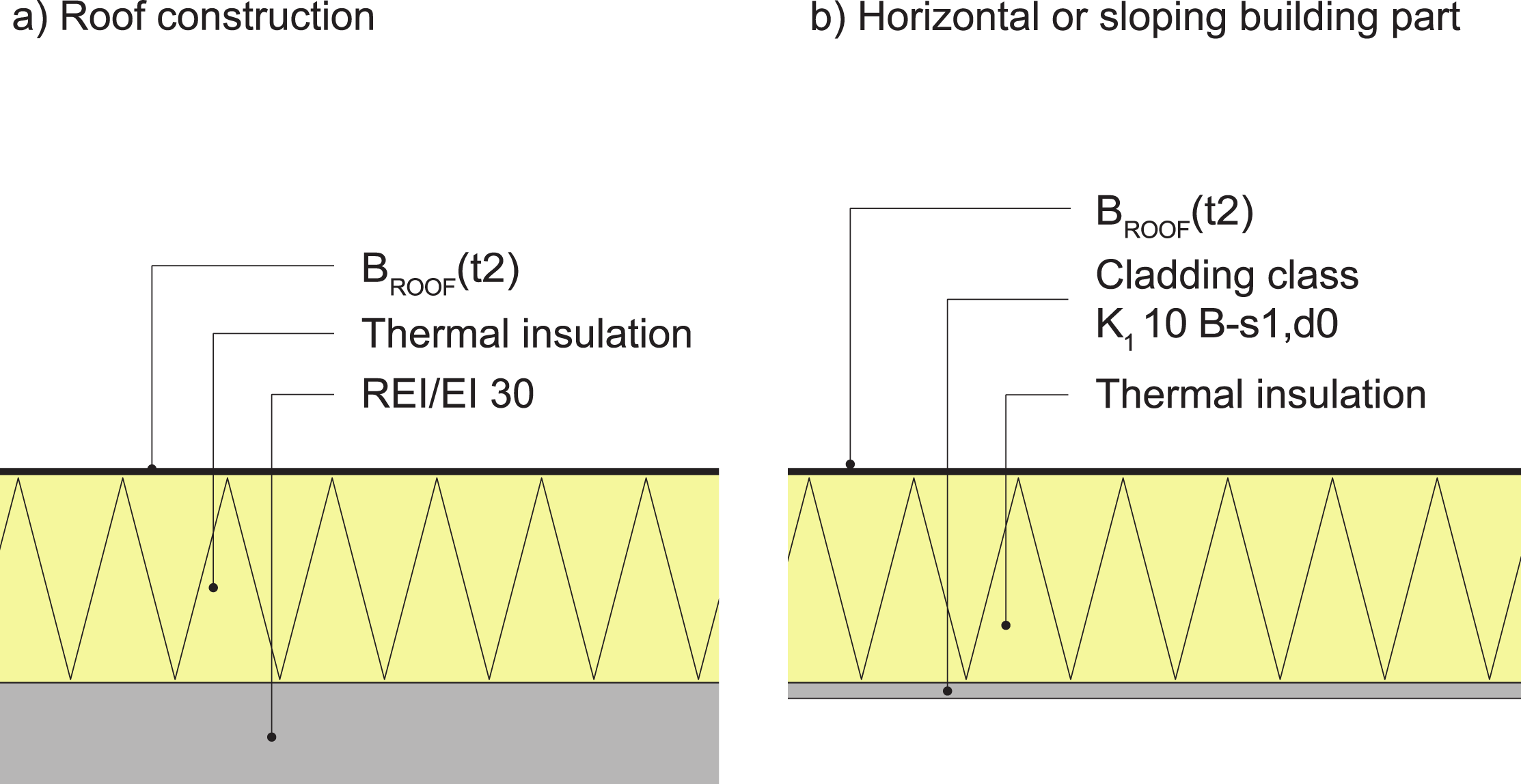
Figure 25. Schematic examples of roof assemblies with thermal insulation that is not non-flammable (materials up to but excluding class B-s1,d0 material). The roof assembly must be protected from fire from the inside, either by making it an REI/EI 30 assembly or by using interior cladding classed at a minimum K1 10 B-s1,d0 (class 1) (The Danish Transport, Construction and Housing Authority, 2018e.
2.5.2 Fire from the Inside
Surface Requirements Applicable to the Loft Cladding or Roof Underside
There are general provisions in the Building Regulations mandating loft cladding so that it does not to contribute materially to flame and smoke development while occupants leave the room. This means that the loft cladding will often be required at a minimum to satisfy class K1 10 B-s1,d0 (class 1 cladding). In some cases or categories of use this requirement is relaxed to a minimum class of K1 10 D-s2,d2 (class 2 cladding). Please consult Bygningsreglementets vejledning til kapitel 5 – brand (Guidelines in the Building Regulations for Chapter 5 – Fire) (The Danish Transport, Construction and Housing Authority, 2018e).
Please note that a distinction is made between ’utilisable’ and ’un-utilisable’ loft spaces. If a loft space in a multi-storey building can be utilised as a box room, or similar, the loft cladding will typically be required to comply with class K1 10 B-s1,d0 (class 1 cladding).
When using fire-retardant pressure-impregnated timbers, the risk of corrosion and mould fungus attack should be kept in mind, particularly if timbers are salt-impregnated.
2.5.3 Fire Compartment Walls
A fire compartment wall must extend to the roof covering. However, this would normally lead to the formation of unacceptable thermal bridges. It is therefore usually deemed acceptable to only build concrete property-dividing walls approx. 1/3 into the depth of the assembly (at least 100 mm) and for the interface between the concrete and underside of the roof covering to be made of fixed, non-flammable insulation material (e.g., mineral wool, with a density ≥ 30 kg/m3). Walls acting as compartmental sections must also be extended to connect with the roof covering.
2.5.4 Firewall Parapets and Firewall Parapet Replacements
In integrated roof assemblies with self-contained fire compartments, firewall parapets or firewall parapet replacements must be extended into the roof assembly to safeguard against flame spread.
The choice of firewall parapet or a replacement depends on the area of the fire compartment and on the fire class and use category designated to the building. The size of fire compartment units typically ranges from 600 to 1000 m2 and is outlined in the Bygningsreglementets vejledning til kapitel 5 – brand (Guidelines in the Building Regulations for Chapter 5 – Fire) (The Danish Transport, Construction and Housing Authority, 2018e).
In integrated single family dwellings (terraced housing) of up to two storeys, vertical flame spread can be prevented by constructing vertical property-dividing walls for every 1200 m2 of gross floor space using materials of building part class REI 60 A2-s1,d0, integrated tightly into the outside roof covering (see Bilag 1 – Præ-accepterede løsninger – Enfamiliehuse (Annex 1 – Pre-Accepted Solutions – Single Family Dwellings) (The Danish Transport, Construction and Housing Authority, 2018b) in the Bygningsreglementets vejledning til kapitel 5 – brand (Guidelines in the Building Regulations to Chapter 5 – Fire)).
Firewall parapets and firewall parapet replacements are used, for example, in roof assemblies in large blocks of flats or properties adjacent to, and integrated with, blocks of flats or offices (see Figure 26).
Examples of firewall parapet replacements are shown in Figures 61 and 27. Further information on firewall parapet replacements is available from Undertage – Sikring mod brand (Roofing Underlayment – Fire Safety) (DBI Fire and Security, 2007) (see Section 4, Composite Roofing Slabs).
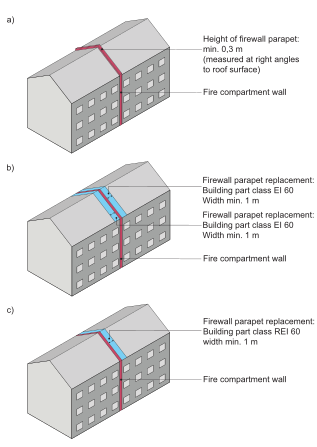
Figure 26. Examples of initiatives to reduce the risk of horizontal flame spread across the roof between neighbouring properties (fire compartments).
- Construction of a firewall parapet where the construction of the fire compartment wall extending up through the roof is identical to the underlying wall to a height of 0.3 metres measured at right angles to the roof surface.
- Firewall parapet replacement to both sides in class EI 60.
- Firewall parapet replacement to one side in class REI 60.
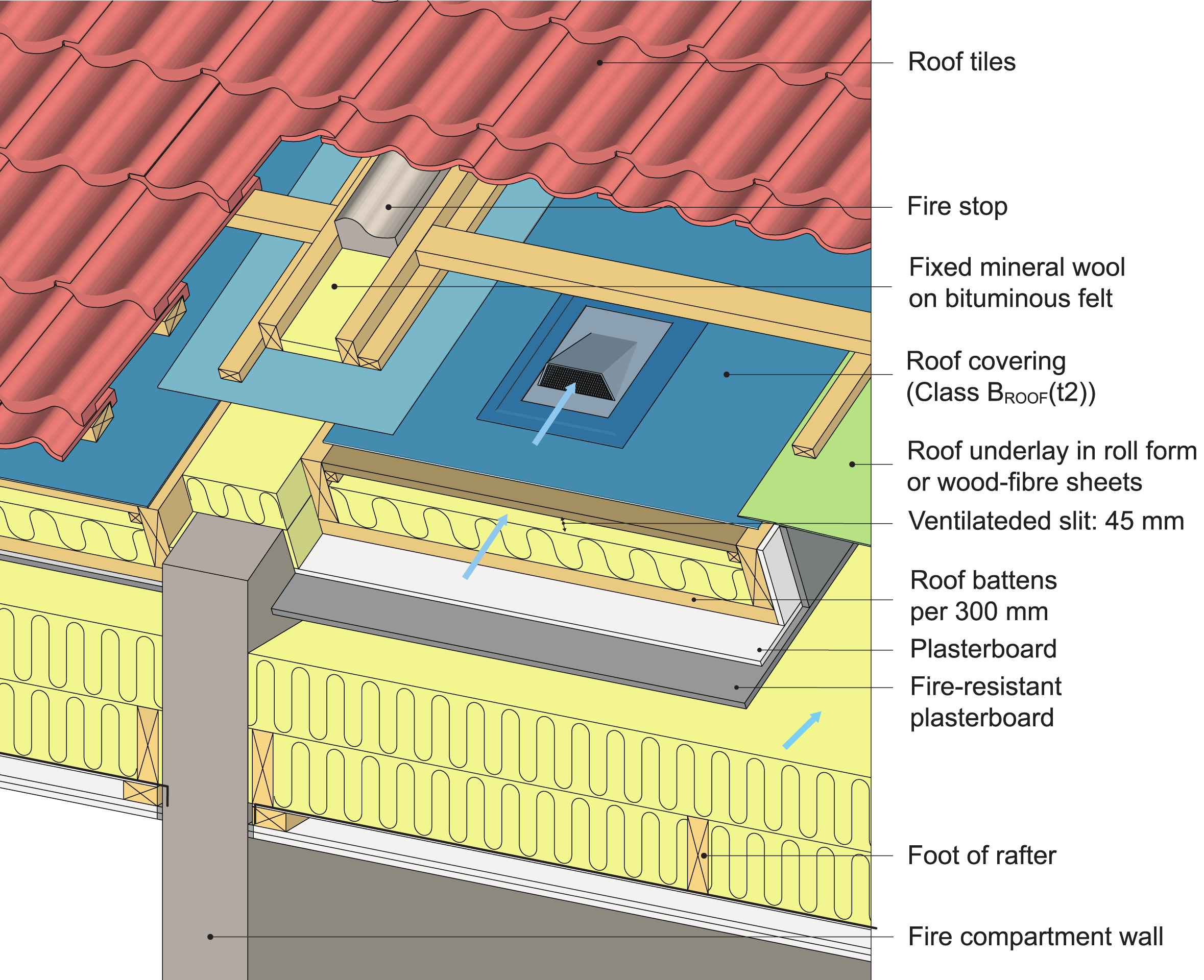
Figure 27. Example of firewall parapet replacement in vented roof with roofing underlayment of roll material and unutilised loft space. The replacement is constructed using fixed, non-flammable insulation material (such as mineral wool), with a density exceeding 30 kg/m3, above the fire compartment wall. Venting is secured, for example, via roof vents or via venting from the neighbouring bay (DBI Fire and Security, 2007).
2.6 Load-Bearing Capacity and Stability
The roof assembly must be constructed with sufficient load-bearing capacity to absorb its own dead load, snow load, wind load. Load-bearing capacity and stability will only be treated superficially here. Issues concerning design of the supporting part of the roof structure (i.e., bracing of the roof structure, sizing of rafters, purlins, battens, etc.) are outside the scope of this book.
Apart from the correct sizing of rafters, lengthwise bracing of the roof structure is required. This is necessary for the roof to be able to absorb wind load along the side of the building and because, in practice, sizing the rafters requires them to be transversely fixed. In the construction phase, special consideration must be given to wind load, which can be heavy when rafters are uncovered.
Supporting roof structures are usually constructed as decks and trussed rafters of various designs and in various materials, usually including timber, steel, and concrete (see Section 1.1, Roof Design).
For roofs with timber roof structures, see SBi Guidelines 254, Småhuse – styrke og stabilitet (Small Houses – Strength and Stability) (Cornelius, 2015) and publications and calculation methods from Træinformation. The general calculation assumptions for sizing roof structures with large-scale timber roof trusses are outlined in TRÆ 73, Tagkonstruktioner med store spær (Roof Structures Using Large-Scale Roof Trusses) (Træinformation, 2017). Since the bracing of roof structures with timber roof trusses is often inadequately executed, see especially TRÆ 58, Træspær 2 – Valg, opstilling og afstivning (Timber Roof Trusses 2 – Choice, Construction, and Bracing) (Træinformation, 2009b). For bracing using timber sheets, see TRÆ 60, Træplader (Timber Sheets) (Træinformation, 2012). Timber roof trusses not supplied by roof truss manufacturers can be erected as shown in TRÆ 59, for example (Træspær 1 – Spær med hulplader (Timber Roof Trusses 1 – Roof Trusses with Metal Gusset Plates)) (Træinformation, 2009a).
For concrete roof structures, see Betonelementer (Concrete Slabs) (Betonelement-Foreningen & Frøbert Jensen, 1991). For steel roof structures, see Stålkonstruktioner efter DS/EN 1993 (Steel Constructions According to DS/EN 1993) (Bonnerup, Jensen & Plum, 2015).
For further checks and assessments of the load-bearing capacity of existing structures, information is available in Er din bygning snesikker? (Is Your Building Snow Safe?) (The Danish Enterprise and Construction Authority, 2010a), Forebyg sneskader på haller og store spær (Prevent Snow Damage to Halls and Large-Scale Timber Trusses) (The Danish Enterprise and Construction Authority, 2011), and TRÆ 73, Tagkonstruktioner med store spær (Roof Structures with Large-Scale Trusses) (Træinformation, 2017). For information on precautionary measures for snow-clearing, see Hvordan rydder jeg mit tag for sne? (How Do I Clear Snow from my Roof?) (The Danish Enterprise and Construction Authority, 2010b).
2.6.1 Roof Battens
For timber-trussed roof structures, roof battens are often used to fix the roof covering material. Roof battens are also sometimes used as part of the system to stabilise the roof structure and ensure that work and traffic can take place on the roof without the risk of falling.
For the sake of the strength and rigidity of the roof structure and to avoid falling hazards during work, strength-graded battens (labelled strength grade C18) must be used in accordance with DS/EN 14081-1 (Danish Standards, 2016c), (cf. Brancheaftale om taglægter 2011 (Trade Agreement on Roof Battens)) (Træinformation, 2011a). The minimum dimensions for roof battens must be 38 × 73 mm and this dimension can be used for rafter spacing of up to 1000 mm and batten spacing of up to 550 mm. Batten dimensions required for spacing other than this are outlined in ‘Lægtetabel 2005’ (Batten Table 2005) in TRÆ 65, Taglægter (Roof Battens) (Træinformation 2011b), which also includes overhang and fixing.
For roof repairs and renovation, existing roof battens may sometimes be reused. A trade agreement exists between actors in the construction industry, specifying the conditions (cf. TRÆ 65).
Precautionary measures concerning work and traffic on roofs are also outlined in Section 10, Health and Safety Issues When Working on Roofs.
2.6.2 Moisture Deformation in Vented Couple Roofs
In well-insulated couple roofs where the roof assembly includes rafters, moisture conditions in the upper and lower side of the rafters will differ widely during winter. In this assembly the upper side of the rafters may be cold, and the relative humidity (RH) may be high (potentially 90%). The underside of the rafters will, by contrast, be exposed to a warm indoor climate where the RH can be around 35%. Although the lengthwise moisture expansion for ordinary construction timber is only approx. 0.1‰ per 1% change in timber moisture, this will lead to the upper side of the rafters expanding more than the underside. As a result, the roof will warp during winter (see Figure 28).
In ordinary small houses, this may be up to approx. 20 mm depending on the effective span. This means that a visible gap may appear above the interior walls unless some form of anchorage or flexible joints are installed, conversely, the gap may be concealed behind cover strips mounted on the ceiling. The movement is reversible, and timbers will therefore return to their normal position during summer (Møller, 2012b).
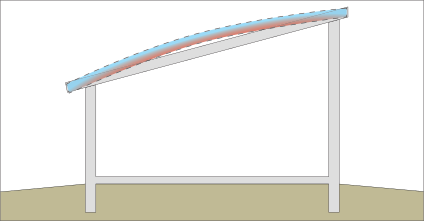
Figure 28. During winter, couple roofs may warp, because the upper side of the roof assembly/timber rafters contain more moisture than the underside. This means that the upper side expands and the inside-facing warm side contracts, resulting in the whole structure warping outwards. The deformation is reversed during summer.
2.7 Noise
New residential housing must satisfy the provisions in the 2018 Building Regulations concerning indoor noise levels as well as applicable provisions relative to the environment and planning legislation (BR18, § 368–§ 376). Particularly in areas where outdoor noise levels are higher than the environment legislation threshold value (Lden) of 58 dB for road noise, or 64 dB for railways (the Environmental Protection Agency, 2007a & 2007b), steps must be taken to ensure that the acoustic insulation of the building envelope, including that of the roof, is sufficient to satisfy these requirements. Furthermore, existing buildings should be retrofitted with acoustic insulation during renovation or conversion.
For a detailed review of issues relating to soundproofing of roof structures (see for example, SBi Guidelines 244, Lydisolering af klimaskærmen (Soundproofing the Building Envelope) (Rasmussen & Petersen, 2014)).
2.7.1 Sound Transmission Paths
Sound insulation of roofs depends on the structure of the roof assembly, including the weight of the materials used, the airtightness of the construction, and the airtightness of interfaces with other building parts (especially windows). Sound transmission through the roof is typically far less important for the overall soundproofing of the building than sound transmission through windows, exterior doors, and outside air vents. However, due to the roof’s extensive area, it may have a bearing on the total soundproofing of the building. The roof structure is of special importance in buildings with dwelling space on the top floor. Particularly if the roof is lower than the noise source (for example, due to level differences in the landscape) providing a direct path from the source of the noise to the roof surface.
In buildings with couple roofs, it may be essential to calculate and optimise the roof insulation (Rasmussen & Petersen, 2014).
2.7.2 Acoustic Performance
In heavy roof assemblies, such as supporting concrete structures, the acoustic performance of the roof will be determined by the total weight and the tightness of the structure. In light roofs on timber rafters, an assembly of several tight layers interposed by thermal insulation layers will determine the level of acoustic insulation. Heavy concrete roof assemblies as supporting structures will perform better than light roof assemblies on timber rafters.
Thermal insulation materials have a relatively low density. The primary acoustic function of thermal insulation in roofs is to soundproof cavity spaces, which will also ultimately enhance the acoustic insulation.
Roof coverings in vented assemblies will not make a significant contribution to the acoustic insulation (e.g., a roof with a roofing membrane on timber decking will not contribute significantly to the acoustic insulation), as it is vented from the underside. However, tiled roofs can enhance acoustic insulation by 2–4 dB compared to roofs with roofing membranes.
Roofs with vented loft spaces will have better acoustic insulation than vented couple roofs, because the loft space acts as one big, soundproofed cavity between the roof covering and the ceiling surface. For the same reason, crawl spaces and apexes provide better acoustic insulation than couple roofs (Rasmussen & Petersen, 2014).
Examples of the acoustic performance of typical roof assemblies in new residential housing are outlined in Table 12. Detailed acoustic data for several example roof assemblies are outlined in the report Lydmåling i laboratorium av vinduer, yttervegger, tak og ytterveggventiler (Acoustic Measurement of Windows, Exterior Walls, Roofs, and Exterior Wall Vents) (Homb, Hveem & Høilund-Kaupang, 2012).
Table 12. Examples of levels of acoustic insulation for heavy and light roof assemblies for new builds (Rasmussen & Petersen, 2014).
Roof Assembly | Roof Assembly | Weighted Reduction Factor (Building), R'w [dB] | Weighted Reduction Factor (Building) with Spectral Correction for Traffic, R'w + Ctr |
|---|---|---|---|
 | Light-weight couple roof assembly, for example, timber composite roofing slab with roofing membrane, min. 300 mm thermal insulation, and a double-layer plasterboard ceiling | 45-50 | 35-40 |
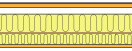 | Light-weight couple roof assembly, for example, timber composite roofing slab with roofing membrane), min. 300 mm thermal insulation, inserted plasterboard sheet, and a double-layer plasterboard ceiling | 45-50 | 40-45 |
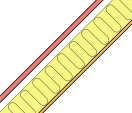 | Couple roof with vented covering on light-weight assembly, for example, roof tiles on attic trusses, roll-material underlayment, min. 300 mm thermal insulation, and a double-layer plasterboard ceiling | 45-50 | 35-40 |
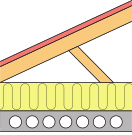 | Roof with vented loft space on light-weight assembly, for example, corrugated fibre-cement sheets on lattice trusses w/thermal insulation and a double-layer plasterboard ceiling | 45-55 | 40-50 |
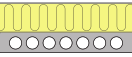 | Warm roof on heavy assembly of 220 mm concrete or expanded aggregate concrete deck slab w/ polystyrene or mineral wool insulation and roofing membrane | 50-55 | 45-50 |
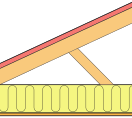 | Roof with a vented loft space on heavy assembly of corrugated fibre-cement sheets on timber rafters w/thermal insulation on a 220 mm hollow-core concrete deck, for example. | 45-55 | 40-50 |
Note: Det vægtede reduktionstal, R'w, angiver bygningsdeles evne til at isolere mod luftlydtransmission mellem det fri og et rum i en
bygning og kan angives med eller uden spektral korrektion for trafik, Ctr. Begge er udtrykt i enheden decibel, (dB).
bygning og kan angives med eller uden spektral korrektion for trafik, Ctr. Begge er udtrykt i enheden decibel, (dB).
2.7.3 Light-Weight Couple Roof
Particularly in buildings with couple roofs and a light-weight timber-trussed assembly, it is important to calculate and optimise the roof’s acoustic insulation capacity. The acoustic insulation capacity of light-weight timber-trussed assemblies can primarily be enhanced by fitting several layers of sheeting on a separate skeleton structure with cavity spaces that are soundproofed using mineral wool (see Figure 29).
Roof assemblies should also be soundproofed against noise from driving rain and hailstones. The use of light-weight roofing materials such as steel sheets should be given careful consideration in view of the associated noise nuisance. If steel sheets are used, short sheets with a soundproofed backing have the best soundproofing capacity.
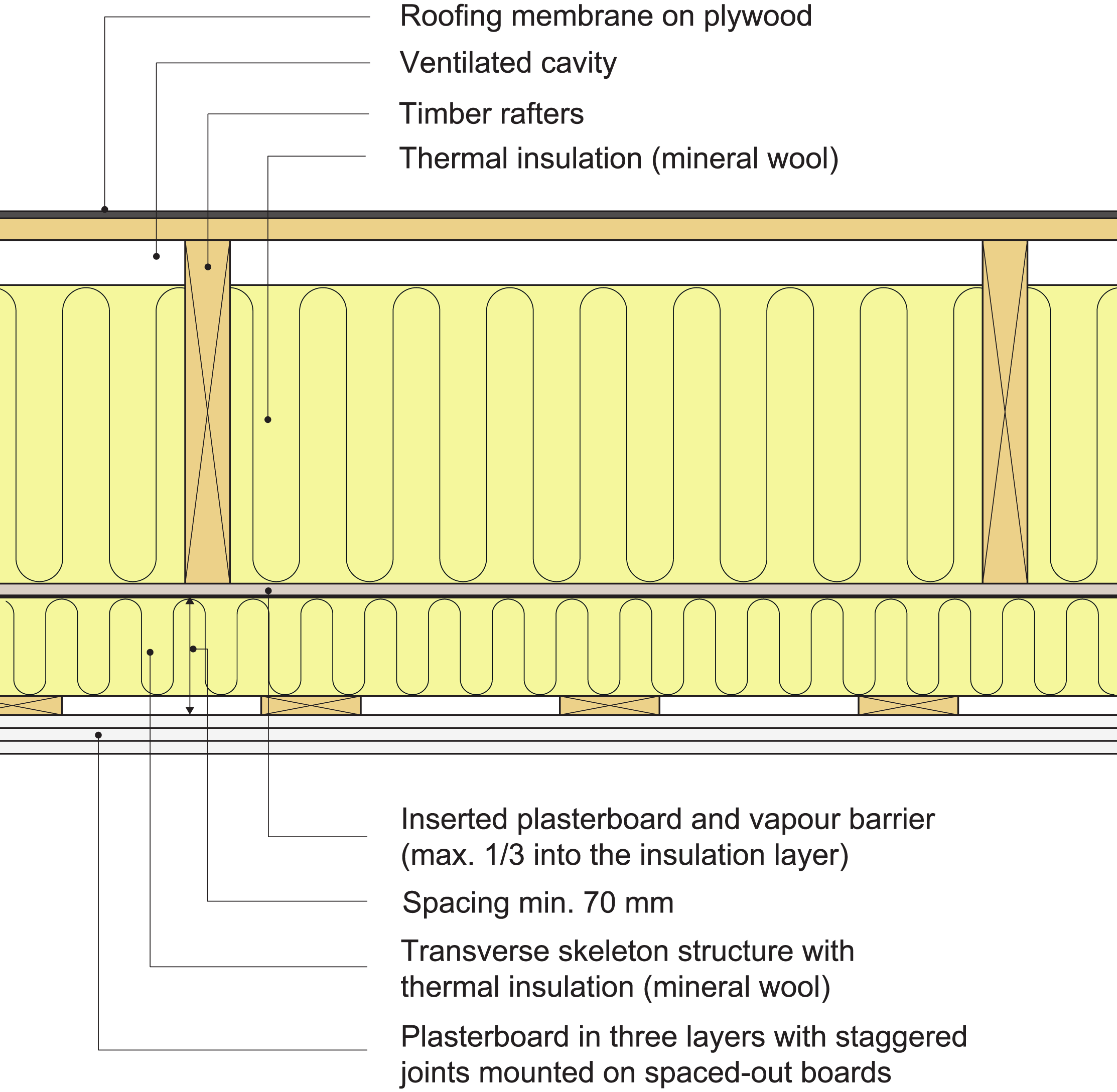
Figure 29. Horizontal basic diagram of vented couple roof with a roofing membrane on plywood in residential housing. The assembly is acoustically enhanced with an inserted layer of sheeting, transverse skeleton structure with mineral wool and an inside cladding of three layers of plasterboard with staggered joints. Alternatively, for inside cladding, two layers of sheeting can be used which can be mounted in resilient fixtures or sound insulation clips (Rasmussen & Petersen, 2014).
2.7.4 Skylights and Roof Lights
The sound insulation of skylights and domed roof lights will often be the least soundproof element of the roof. If specific requirements apply to the soundproofing of a specific roof assembly, it is important to obtain the relevant product data from the window manufacturer or supplier at the design stage of a particular project. The R'w-values correspond to a predicted field value used for the design process which is typically estimated to be 3 dB below the lab value (Rw). Product data from manufacturers are normally stated as reference variables and it is necessary, therefore, to allow for corrections (reduced capacity) for large-size windows.
For detailed information concerning the sound insulation of skylights and domed roof lights, see SBi Guidelines 244, Lydisolering af klimaskærmen (Soundproofing the Building Envelope) (Rasmussen & Petersen, 2014).
Examples of acoustic data for skylights and roof lights are listed in Table 13.
Table 13. Examples of soundproofing for skylights and roof lights (Rasmussen & Petersen, 2014).
Type of Skylight | Weighted Reduction Factor (Building), R'w | Weighted Reduction Factor (Building) with Spectral Correction for Traffic, R'w + Ctr |
|---|---|---|
Roof light (plastic-based) | 15-20 | 10-15 |
Roof light (plastic-based) with extra sealed glazing | 25-30 | 20-25 |
Skylight/glass roof with ordinary sealed glazing | 25-30 | 20-25 |
Skylight/glass roof with laminated noise reduction glass | 28-35 | 23-32 |
Skylight/glass roof with ordinary sealed glazing with | 35-40 | 30-35 |
Note: The weighted reduction factor (R'w) indicates the capacity of building parts to insulate against airborne sound transmission between the outside and a room in a building and can be stated with or without spectral correction for traffic (Ctr). Both are expressed in decibel units (dB).
Examples of assemblies including roof lights with energy-efficient glazing are shown in Figure 181 (Section 6.1.1, Types of Roof Light for Flat Roofs).
The construction around the window (reveal) can be a weak point in terms of soundproofing. It is crucial, therefore, to comply with the manufacturer’s installation instructions, as these are no standardized window seals.
When installing skylights and roof lights in light-weight roof assemblies, the most efficient soundproofing is achieved by minimising the distance between the window and the supporting rafter structure and using double-sheet reveals and seals that ensure optimal soundproofing of the joints.
Soundproofing a roof assembly may be relevant in connection with changes or renovation of the roof assembly, or where there are extensive changes of the building’s surrounding environment (e.g., a reorganisation of traffic routes), which might create a direct path from noise source to roof surface. In such cases, it is a good idea to focus on those parts of the roof with the most inefficient soundproofing or which cover a relatively large area. This typically includes roof lights and skylights with ordinary sealed glazing and roofs with light-weight rafter assemblies.
2.7.5 Enhancing Acoustic Performance
Enhancing the soundproofing of existing light-weight roof assemblies can be performed by adding soundproofing secondary structure (cf. Table 14). This is usually achieved from the inside with a soundproofing secondary ceiling, but in principle, it is equally possible from the outside (for example, when replacing the roof covering).
Table 14. Soundproofing estimates for existing light-weight roof assemblies enhanced by a supplementary soundproofing secondary structure on the inside (Rasmussen & Petersen, 2014).
Roof Assembly (Schematics) | Description | Weighted reduction factor (building) R'w [dB] | Weighted reduction factor (building) with spectral correction for traffic, R'w + Ctr [dB] |
|---|---|---|---|
 | Couple roof with roofing membrane on a light-weight assembly, enhanced with a suspended tight sheet ceiling with partially insulated cavity space | 45-55 | 40-50 |
 | Couple roof with roof tiles on a light-weight assembly, enhanced with a suspended tight soundproofed sheet ceiling with partially insulated cavity space | 45-55 | 40-50 |
Note: The weighted reduction factor (R'w) indicates the capacity of building parts to insulate against airborne sound transmission between the outside and a room in a building and can be stated with or without spectral correction for traffic (Ctr). Both are expressed in decibel units (dB).
Inside Secondary Structures
A soundproofing secondary structure is constructed with a skeleton structure of timber or steel battens with adequate clearance (preferably100 mm) between the existing loft surface and the reverse side of the new cladding, and with at least 2/3 of the cavity space filled with thermal insulation material. The best sound absorption potential is achieved through large cavity spaces and few points of contact between the new and existing assembly (e.g., by using resilient hangers or counter-battens for the skeleton structure). The enhancement potential of suspended acoustic ceiling systems is 5–15 dB, depending on the number of sheeting layers, the suspension system, and cavity space thickness as outlined in Table 14.
Prior to installing a new skeleton structure, existing seals between adjoining building parts must be repaired by filling in and sealing with an elastic joint sealant. Similarly, joints in the new loft lining must be sealed with acoustic sealant between adjoining building parts.
Figure 30 shows a basic diagram of a soundproofing secondary structure from the inside with a triple layer of sheeting fixed rigidly to the firring. Alternatively, a double layer of sheeting can be used which would be mounted with resilient fixtures or sound insulation clips (Rasmussen & Petersen, 2014).
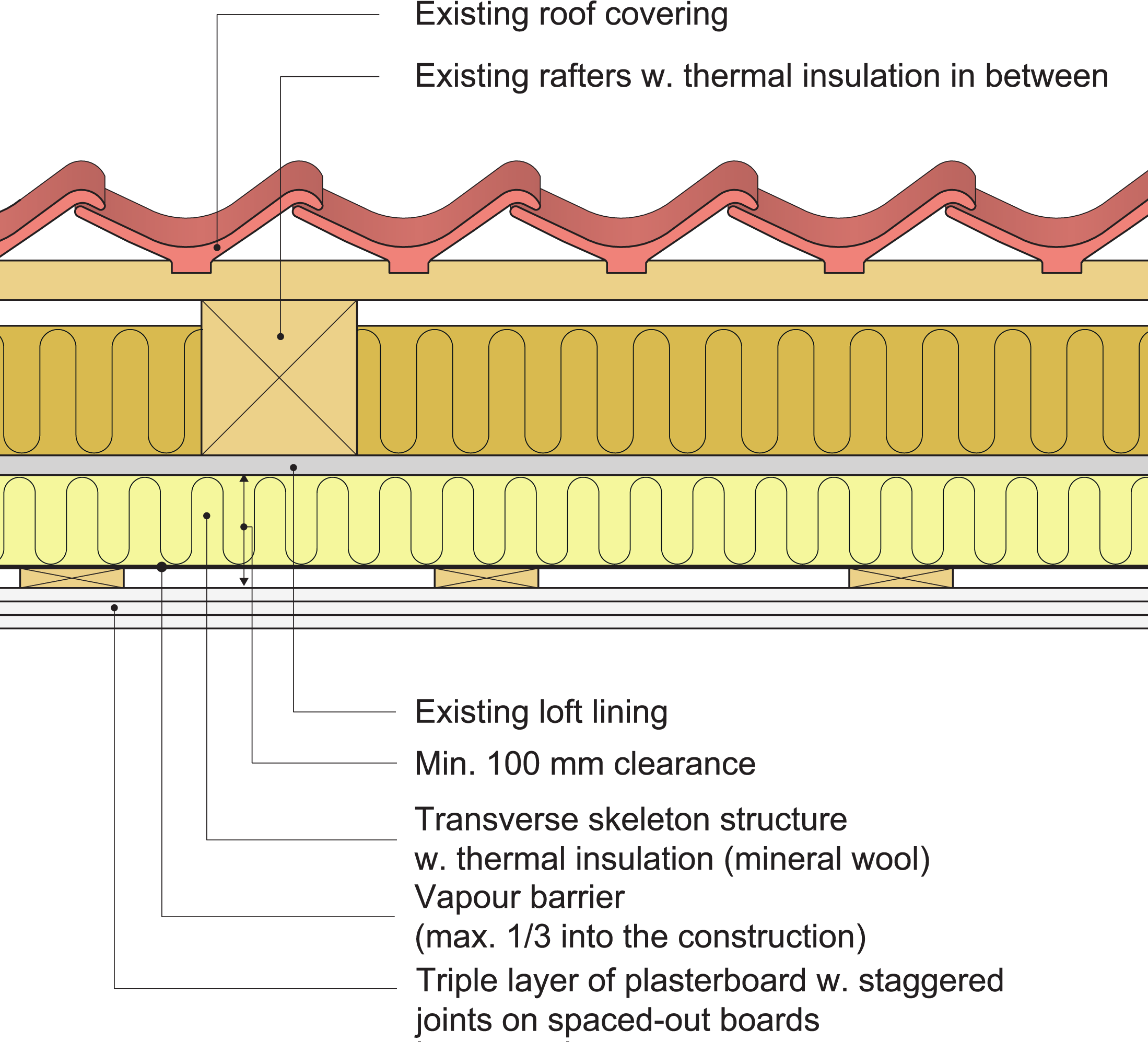
Figure 30. Horizontal basic diagram showing existing old roof in residential housing where the soundproofing has been enhanced from the inside by installing a skeleton structure with partially filled cavity spaces and a triple layer of plasterboard sheets with staggered joints. Alternatively, a double layer of sheeting suspended on resilient fixtures or sound insulation clips can be used (Rasmussen & Petersen, 2014).
2.8 Snow and Ice on Roofs
2.8.1 Snow
Snow settles on roofs as it does on the ground. Densities may vary from 20 kg/m3 to 400 kg/m3. Light-weight snow occurs in very cold weather with little wind while heavy-weight snow (wet snow) occurs at higher temperatures.
Rules governing snow loads are specified in Eurocode 1, Parts 1–3 (Danish Standards, 2007a). Snow loads are relative to roof pitch and will typically be 0.8 kN/m2 for flat roofs and less for sloping roofs. Special rules apply for snow loads in integrated housing and houses with split-level roofs.
Snow acts as an extra layer of heat insulation on the roof. The thermal conductivity of light-weight snow with a density of 100 kg/m3 is less than 0.06 W/mK. In time, the density of snow and ice on a roof will increase when the snow consolidates, compacts, and partly starts to melt.
Snow exerts an extra load on the roof and, in conjunction with wind, this load may be uneven, eventually leading to the collapse of the structure if it is not sized and constructed correctly. Particularly in the cases of large-scale halls or similar buildings with large roof spans, special attention should be paid to the risks associated with snow-loads on roofs.
2.8.2 Icicles
Icicles typically form along gutters and rainwater downpipes. Icicles are formed when running water freezes, which occurs when snow or ice melts due to solar radiation or heat loss through the roof. When the melted water meets the icicle, a moisture film is formed which will refreeze under the right conditions. The accretion of ice will increase the thickness and length of the icicle. For the icicle to accrete, the ambient air temperature must be below 0 °C. Icicles will not form if the outside air temperature is above 0 °C. If the air temperature is between 0 and –5 °C, the icicle will slowly increase. At lower temperatures, icicles will accrete faster and will grow according to the relative temperature and snow melt.
The thermal balance between surface and surroundings determines how fast an icicle will grow. In cold weather, the accretion will be fast, but air humidity, wind speed, and solar aspects are important factors for the accretion of icicles.
In theory, the length of an icicle could increase by 100–400 mm/hour at –10 °C and a 500-mm icicle weighing 2 kg can be formed over a period of approx. 5 hours.
A skylight will usually be poorly insulated compared to the rest of the roof and snow will therefore melt faster on the window. Hence there is an increased risk of the snow melt freezing below the window, potentially accreting icicles here sooner than on the rest of the roof.
Steps should be taken to avoid people or objects occupying sites where icicles may form and later drop, for example, by installing an overhang above a door or establishing a flowerbed or garden feature along the façade (see Figure 31).
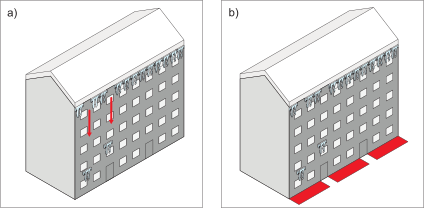
Figure 31. S Horizontal basic diagram showing existing old roof in residential housing where the soundproofing has been enhanced from the inside by installing a skeleton structure with partially filled cavity spaces and a triple layer of plasterboard sheets with staggered joints. The risk associated with occupancy can be reduced by establishing flowerbeds or garden features in areas with a potential risk of dropping icicles.
Snow melts if the temperature exceeds 0 °C. Equally, snow could melt if the roof is exposed to solar radiation (even though most of the solar radiation is reflected) or as a result of heat loss from the building via the roof.
For newly fallen snow with a density of approx. 100 kg/m3 and at an outside temperature of −10 °C, snow melt from a roof with a U-value of 0.15 W/m2K will not occur until the snow depth reaches a minimum of 160 mm. Vented roofs will be less prone to icicles forming as the roof surface remains cold. For a roof with a U-value of 0.3 W/m2K, snow melt will set in already at a snow depth of 80 mm. For roofs with poor thermal insulation, the thickness will be even less. Consequently, icicles will rarely form in new buildings with well-insulated roofs while they will be more common in old buildings where the roofs are normally poorly insulated.
For glass roofs, the snow melt may begin at a low snow thickness if the U-value is poor. Since these roofs typically have a steep slope, snow will often slide down the roof once the snow increases in thickness. Even if it is highly insulated, glazing must be sized to withstand a full snow load (cf. SBi Guidelines 215, Dimensionering af glas I klimaskærmen (Sizing the Glass in a Building Envelope)) (Munch-Andersen and Pedersen, 2018).
In practice, many glass roofs are constructed above rooms that are only slightly heated or only heated by adjoining buildings and the indoor temperature may be below 20 °C. In such cases, the snow thickness will be greater before the snow slides off the roof. Similarly, attention must be given to glazed structures in saw-tooth roofs where there is a risk of snow accumulating.
Dropping Icicles
Icicles will start to melt and thaw, and they will drop off when the strength or bonding is reduced to a degree when it can no longer carry the weight of the icicle. Icicles can also drop off in frosty weather, provided the outside temperature rises or the roof is exposed to solar radiation causing the snow to melt. The increased amount of snow melt may cause the icicle to drop off.
Often, it is possible to predict where icicles are likely to form by looking at the drainage route taken by the water. There will often be much snow melt at an inward corner where a downpipe is placed and where the likelihood of icicles forming is great.
To avoid risks and damage, the Building Regulations guidelines on the use of glass must always be complied with (BR18, § 196–§ 241) (The Danish Transport, Construction and Housing Authority, 2018d). One should consider whether icicles could form on adjoining taller buildings, as this can lead to a risk of large-size icicles smashing the glass and dropping on the people below.
2.8.3 Roof Types
Pitched Roofs
For roofs with an overhang, snow melt will run to the overhang where the temperature will typically be lower than on the rest of the roof. This will cause a partial freeze of the snow melt where some of it is likely to freeze at the eave or gutter level resulting in icicles. Gutters should be able to withstand icicle loads and snow loads from snow sliding down the roof.
The likelihood of icicles forming can be avoided or reduced using heater cables so that the snow melt can be led away without freezing. The heat effect of the cables should be controllable, as the use of heater cables without regulation can result in a significant increase in energy consumption.
If the roof is ventilated, the temperature in the vent space should be kept low to prevent snow on the roof melting and forming icicles. This also applies to unutilised loft and crawl spaces. Installation rooms and heating and ventilation equipment in loft spaces must be thermally insulated as heat dissipation might otherwise increase the snow melt and hence the risk of icicles forming.
In old houses where icicles cause problems, conditions can be improved by installing thermal insulation in the storey partition between the building and the loft space. This will also save energy.
Roofing Materials
In the case of smooth roofing materials (of metal, for example), the snow will very likely slide off the roof all at once when the snow reaches a certain thickness and the snow melts due to heat rising from below or due to solar radiation, see Figure 32. Steps should be taken, therefore, to ensure that the snow can slide off without harming persons or objects (for example, where there is a risk of snow from high-level roof surfaces falling on pathways, pavements, etc).
The risk of falling snow is partly dependent on the roof pitch and structure of the roof covering surface. The need for snow guards on roofs relative to roof pitch and the structure of the roof surface is shown in Table 15.
Alternatively, snow guards sized for great loads and designed to prevent the snow sliding over or under the guard could be installed on such roofs. If snow guards work, they can retain the snow, but the risk of icicles forming remains. Normally, snow guards will not be necessary for roof surfaces where the overhang is less than 5 metres above ground level.
Figures 33 and 34 show examples of the design and installation of snow guards
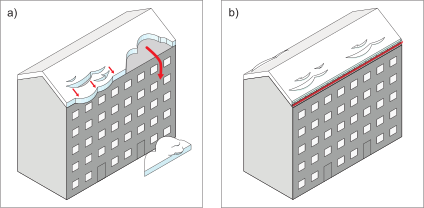
Figure 32. a) The risk of snow slides depends on the roof pitch and structure of the roof covering surface. The risks of snow sliding off the roof are particularly great in old buildings with poor thermal insulation.
b) Snow guards sized to withstand the specific load can be installed and designed to prevent snow slide over or under the guard.
b) Snow guards sized to withstand the specific load can be installed and designed to prevent snow slide over or under the guard.
Table 15. The necessity of snow guards depends on the roof pitch and structure of the roof covering surface.
Roof Covering Surface | Roof Slopes | Examples of Roof Covering | ||
|---|---|---|---|---|
≤ 15o | 15-30o | > 30o | ||
Smooth | X | X | X | Metal roofs Roofing foils |
Medium | X | X | Slate roof Bituminous felt roof | |
Rough | X | Clay roof tiles Concrete roof tiles | ||
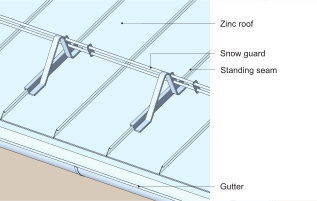
Figure 33. Example of snow guard fixed to the standing seams of a zinc roof.
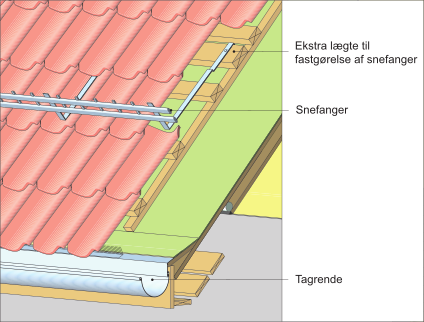
Figure 34. Example of snow guard fixed to an extra batten inserted in tiled roof.
Flat Roofs
Flat roofs with a parapet will typically have interior downpipes and so there is no risk of icicles forming.
Instead, the snow can melt around the roof outlet, forming ice dams around it when it freezes. This means that water may pond on the roof, increasing the risk of water getting through especially at penetrations in the roof surface. Besides, ice can lead to significant mechanical strain of roofing membranes and penetrations.
Precautionary measures against damage caused by roof drains on flat roofs freezing up are outlined in Section 2.2, Roof Drainage
2.9 Lifespan
Lifespan means the time a material or building part has been installed until the time when this material or building part is replaced (BUR, 1985). The Building Regulations lay down general rules specifying that materials and assemblies must be durable and appropriate for their intended purpose (BR18, § 340–§ 357).
A roof is a complex part of the building consisting of several elements. The roof may be built using sheet cladding, a vapour barrier, rafters, thermal insulation, roofing underlayment, spacer bars, battens, and roof covering (seen from the inside outwards). Over and above this, various ancillary materials such as tape, caulking compound, and clamps as well as roof lights, vent ducts, etc., are used in or fitted to the roof.
Therefore, for a building part as complex as a roof, it is not usually possible to determine an overall lifespan. The lifespan of each of the constituent building parts and materials must be assessed separately.
Factors Affecting Lifespan
Various factors determine the lifespan of materials and assemblies. Often, a distinction is made between the various types of lifespan outlined below, each of which may be the reason why the material no longer meets the requirements of users:
- Technical lifespan: the time following the installation of the material or building part, for which it can serve its original function, technically and physically.
- Functional lifespan: the time following the installation of the building part for which the original function of the building part is required. The functional lifespan is determined by changes in performance requirements, for example, new specifications for energy consumption.
- Economic lifespan: the time from the installation of the building part for which it is considered prudent, in overall economic terms, to maintain and replace elements of the building part.
- Aesthetic lifespan: the time from the installation of the building part for which the aesthetic standard of the building part can be sustained.
Lifespan depends on several factors, including the quality of the material, design, installation, impact, maintenance, social change, technological development, market trends, labour and building material costs, lifestyle, and fashion trends, etc.
The lifespan of a specific building part is, in practice, dependant to so many factors that putting a fixed value on it would rarely be accurate, while the use of probability models facilitates a more realistic description of the lifespan of a building part as they include a spread of possible outcomes and a description of the distribution.
The statistic variation of lifespans can be described in distribution curves as shown in Figure 35. For each of the lifespan types mentioned, a median lifespan of the given type can be specified, illustrated as vertical lines in the figure.
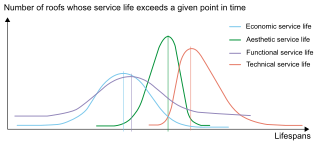
Figure 35. Example of the distribution of lifespans for a given building part. The number indicates how many building parts have exceeded their lifespan at a given point in time.
The lifespan of roofs is complex due to the great variety of materials used in their assemblies. The total lifespan of the overall structure is therefore, not only dependent on a single material, but on all of the materials, inclusive of joints and penetrations which form part of the overall structure.
Where roofs are concerned, the technical lifespan will be the primary factor, since roofs are rarely renovated for functional, aesthetic, or economic reasons.
The technical lifespan of a given building type is likely to vary, because of the differences in several factors (Hovde, 2005 & ISO, 2008):
- Material quality
- Design and construction
- Execution
- Interior impact
- Exterior impact
- Usage
- Maintenance
The lifespan of a specific building part is calculated by multiplying the median reference lifespan data with factors allowing for the above issues (cf. ISO 15686–8 (ISO, 2008)). Therefore, it is possible to estimate a reference lifespan for roofs. The reference lifespan is corrected relative to the quality of materials, design, workmanship, roof pitch, moisture load class, and maintenance for example. Factor 1 normally corresponds to ’standard conditions’ whereas a value of 0.8 would result in a shorter lifespan, and 1.2 would result in an extended lifespan.
The lifespan of a roof structure can also be divided into lifespans of some of the principal components.
The supporting structure is normally estimated to have a long lifespan: the lifespan of a rafter structure, for example, is estimated at more than 100 years.
The lifespans of vapour barriers and underlayment materials are far shorter than and wholly dependent on the material used. Thus far, it is only possible to estimate the lifespan of these types of material based on accelerated ageing experiments, as no time-honoured experience exists yet. To ensure the longest possible lifespan, materials should be used which have documented lifespans, such as materials covered by DUKO (Vapour Barrier and Roofing Underlayment Classification Scheme) (www.duko.dk). As far as possible, systems solutions are recommended (i.e., where all products, including the vapour barrier, tape, foil adhesive, etc., come from the same manufacturer). This is the best way to ensure that products are compatible. Ancillary materials should, at a minimum, have the same lifespan as membrane materials.
Although they are required to fulfil the same basic functions, the lifespans of roof coverings vary considerably. For example, the lifespans of thatched roofs, roofing membranes, and roof tiles can differ greatly. Apart from the material, the lifespan depends on the roof pitch and the exposure of the roof. There may be significant differences in impact during use. Flat roofs can, for example, be exposed to additional impact from water and ice. This is because ponding water on the surface tends to be tolerated to a degree while pitched roofs are not exposed to this kind of water load. Warm roofs will achieve a far higher temperature on the outside of the roof covering than cold roofs. These Guidelines do not indicate estimated median lifespans for roof coverings.
Thermal insulation materials are normally estimated to have long lifespans.
Ancillary materials including tapes, adhesives, flashing materials, and mechanical fixings should carry identical lifespan documentation, as the failure of ancillary materials often will mean failure of the structure as a whole.
New Products
To avoid problems with new products (or change of usage), it is important to assess the kinds of impacts likely to affect the given material and structure. Long lifespans can only be achieved when the product qualities match the impact they are likely to be exposed to.
When assessing new products, it is important that the manufacturer’s information about the relevant properties of the application in question is documented (e.g., via test reports from impartial test institutes).
Parallel Lifespans
A special problem of composite structures is that not all materials or products deteriorate at the same rate. If the roof is constructed so that materials with a short lifespan cannot be replaced without a destructive dismantling of parts with long lifespans, the lifespan of the structure will often be determined by the materials with the shortest lifespan. The lifespan of a roof with roofing underlayment can, for example, be determined by the lifespan of the underlayment, because this will need replacing long before the active service life of the roof covering expires. In some cases, an underlying building part can be replaced by the non-destructive dismantling of superficial parts (e.g., by replacing roofing underlayment with a short lifespan under a clay tile roof with a long lifespan). In such cases, roof tiles and flashings can be dismantled and refitted. However, this will not be possible without incurring considerable extra costs, which may be of decisive importance (i.e., from an overall economic perspective). If the lifespan of a product means that it needs replacing, it should preferably happen without affecting other materials or, alternatively, the two products affected should have so-called ’parallel lifespans’ (i.e., similar, lifespans).
Design, Execution, and Buildability
With roofs as with many other building parts, the lifespan is often dependent on the roof being designed and constructed correctly. All details must be carefully designed and specified with due consideration given to the buildability. Special attention should be paid to the fact that roof damage often occurs near specific details such as penetrations and intersections. The number of critical details should be reduced to an absolute minimum and flat roofs should not be used as a convenient site for placing installations without having first explored other options.
Guarantee and Lifespan
The guarantee regarding a roof product has usually nothing to do with the lifespan of the material, rather it is an expression of what is expedient from a marketing point of view. Roofing membranes have typically had ten- or fifteen-year guarantees, but this does not indicate the lifespan of the membrane. Currently, membrane lifespans are likely to be considerably longer given the materials now used.
2.10 Environmental Issues
When choosing and designing a roof assembly, materials and structures which do not place unnecessary burdens on the environment should be preferred.
Due consideration must be given to:
- Using materials which are not harmful, including materials which can only be used when adding biocides
- Using renewable materials such as wood
- Designing assemblies using a minimal amount of materials
- Ensuring that materials and structures have long lifespans
- Ensuring that all materials in the building envelope have parallel lifespans or, alternatively, are easy to replace separately
- Ensuring that materials and assemblies are reusable
At present, there are no requirements for roofs concerning environmentally dangerous substances, but future provisions to regulate the leaching of substances into rainwater are expected. Some local authorities have already implemented provisions to regulate leaching from roof coverings if rainwater is drained into sensitive recipients.
A European standardisation is underway to determine standards for leaching and preliminary standards are now in place.
2.11 Break-Ins
The roof must be designed to mitigate break-ins via the roof or its constituent parts. If a trapdoor is placed with access from the outside (e.g., in an integral carport), it should be secured or locked, barring free access to the house via the loft. Buildings containing valuables should be secured by opting for roof assemblies which are difficult to force.