5 ROOF COVERINGS
The roof covering is the de facto rain shield of the roof assembly and may consist of many types of materials. The following are guidelines on how to install several commonly used roofing materials. The guidelines are not exhaustively detailed and manufacturer instructions must always be consulted.
5.1 Types of Roof Covering
Roof coverings are generally classified into two main types, each with a different method of ensuring weathertightness:
- Continuous roof coverings
- Discontinuous roof coverings.
5.1.1 Continuous Roof Coverings
Continuous roof coverings are supplied in rolls which are welded or glued to form a watertight finish on the building site or they are supplied as prefabricated linings. This type of roof covering will provide a watertight roof even at shallow pitches.
Continuous roof coverings include roofing membranes (bituminous felt and roofing foil). Both bituminous felt and roofing foil are available in several material combinations (e.g., APP- or SBS-modified bituminous felt or roofing foil made of EPDM, PIB, PVC, or TPO).
Metal roof coverings such as zinc and copper which are joined mechanically (e.g., with seamed joints) are also continuous roof coverings. Seamed joints are not as watertight as welding or gluing membranes. Therefore, metal roof coverings require a slightly steeper pitch than roofing membranes.
A roof designed with a continuous covering can be constructed with a shallow pitch if water is discharged efficiently, usually to gutters or roof outlets (cf. Building Regulations provisions (BR18, § 328)). Water is typically discharged efficiently if the roof pitch is steeper than 1:40 (cf. Section 1.4 i Bygningsreglementets vejledning om fugt og vådrum (Building Regulations Guidelines for Moisture and Wet Rooms) (Ministry of Transport, Building and Housing, 2018c)).
Continuous roof coverings are typically installed on a continuous decking of thermal insulation material, plywood sheets, or planed boards.
5.1.2 Discontinuous Roof Coverings – Roof Tiles, Roof Sheets, and Other Materials
Discontinuous roof coverings include clay or concrete roof tiles, cement-based corrugated sheets, slate (cement-based and natural slate), and metal roof coverings where watertightness is achieved with lap joints.
In this type of roof covering, watertightness is chiefly secured with lap joints or overlap between individual tiles or sheets. Mechanical joints are also used, including seamed joints or click seams. Overlaps and joints can differ in size and geometric design.
In certain types of discontinuous roof coverings with steep-pitched roofs and large overlaps, the roof can only be made watertight with lap joints. Other types require roofing underlayment or other supplementary measures to ensure watertightness.
To a certain extent, underlayment can compensate for openings in the actual roof covering and must be specified to suit the type of roof covering and roof pitch (see Section 3, Roofing Underlayment).
Discontinuous roof coverings are only suitable for relatively steep-pitched roofs and should only be installed on shallow-pitched roofs when appropriate steps have been taken to ensure that the assembly is watertight, using firm underlayment or by following manufacturer’s instructions. A steeper pitch and larger overlaps will generally improve watertightness.
Please note that the shallowest roof pitch of this type of roof usually occurs at the eaves and therefore this pitch determines the type of underlayment that must be used.
Discontinuous roof coverings are usually installed on batten or purlin decking.
5.1.3 Roof Pitch and Areal Weight
Roofs are classed in three types relative to their weight:
- Light-weight roofs
- Heavy-weight roofs
- Extra heavy roofs
In renovations where a heavy-weight roof covering is changed to a lighter covering, care must be taken to ensure that the roof assembly is adequately anchored to secure the lighter roof covering. Conversely, if a light-weight roof covering is replaced with a heavier one, care must be taken to ensure that the structural load-bearing capacity of the assembly is adequate.
Table 16 are examples of light-weight, heavy-weight, and extra heavy roofs and their properties.
Table 16. Examples of roofs classed as light-weight, heavy-weight, and extra heavy (cf. TRÆ 59 (Træinformation, 2009) and TRÆ 65 (Træinformation, 2011)).
Roof Type | Dead Load | Examples |
|---|---|---|
Light-weight roof | 0.25 kN/m² (incl. battens and underlayment) | Roofing membrane on plywood or wood boards Metal sheets on battens, plywood, or wood boards Cement-based corrugated sheets on battens |
Heavy-weight roof | 0.55 kN/m² (incl. battens and underlayment) | Roof tiles on battens (all types) Thatched roofs (unless gypsum-based sheets are used as underlayment, in which case the factor is 750 N/m2) |
Extra heavy roof | 0.80 kN/m² (incl. battens and firm underlayment) | Turves where the thickness or weight must be stated (spacing between rafters is often less than 1.0 metre). |
When selecting a roof covering, consideration must be given to the minimum requirements for roof pitch to ensure that the roof is watertight.
Examples of roof covering materials with indications of min. roof pitch and areal weight are shown in Table 17. In some cases, shallower roof pitches than those stated may be acceptable. However, to ensure a watertight assembly, this should only be executed with prior agreement from the manufacturer.
Table 17. Examples of roof coverings with their minimum roof pitch and approx. areal weight. In each case, manufacturer literature and guidelines concerning minimum roof pitch must be followed. For a conversion table for roof specifications, see Annex C.
Roof covering material | Min. roof pitch [ ° ] | Approx. areal weight [N/m2] |
|---|---|---|
Clay roof tiles – pantile with mortar bedding Clay roof tiles – pantile with underlayment | 40 20 | 450 450 |
Clay roof tiles – interlocking with mortar bedding Clay roof tiles – interlocking with underlayment | 35 15 | 450 450 |
Concrete roof tiles Concrete roof tiles with underlayment Concrete roof tiles with interlocking sealing strips | 45 15 20 | 300 300 380 |
Slate (cement-based) with slate sealant Slate (cement-based) with underlayment Slate (cement-based) laid diagonally with underlayment Slate (natural) with underlayment | 34 18 18 20 | 200 200 200 400 |
Corrugated sheets (cement-based) with sealing strips in horizontal lap joints Corrugated sheets (cement-based) with underlayment Bituminous felt Roofing foil Metal (lengths which are joined on-site, e.g., zinc and copper) with sealant in grooves Metal sheets (prefabricated, factory-coated sheets) | 14 8 | 180 180 |
1.4 1.4 | 100 20-30 | |
3 10 | 20-100 20-100 | |
Reeds Wood shingles Green roofs Glass | 45 45 1.4 2 | 50-100 25-35 500-2000 400-600 |
Roof covering material | Min. roof pitch [ ° ] | Approx. areal weight [N/m2] |
Clay roof tiles – pantile with mortar bedding Clay roof tiles – pantile with underlayment | 40 20 | 450 450 |
Clay roof tiles – interlocking with mortar bedding Clay roof tiles – interlocking with underlayment | 35 15 | 450 450 |
Concrete roof tiles Concrete roof tiles with underlayment Concrete roof tiles with interlocking sealing strips | 45 15 20 | 300 300 380 |
Slate (cement-based) with slate sealant Slate (cement-based) with underlayment Slate (cement-based) laid diagonally with underlayment Slate (natural) with underlayment | 34 18 18 20 | 200 200 200 400 |
Corrugated sheets (cement-based) with sealing strips in horizontal lap joints Corrugated sheets (cement-based) with underlayment Bituminous felt Roofing foil Metal (lengths which are joined on-site, e.g., zinc and copper) with sealant in grooves Metal sheets (prefabricated, factory-coated sheets) | 14 8 | 180 180 |
1.4 1.4 | 100 20-30 | |
3 10 | 20-100 20-100 | |
Reeds Wood shingles Green roofs Glass | 45 45 1.4 2 | 50-100 25-35 500-2000 400-600 |
Roof covering material | Min. roof pitch [ ° ] | Approx. areal weight [N/m2] |
Clay roof tiles – pantile with mortar bedding Clay roof tiles – pantile with underlayment | 40 20 | 450 450 |
Clay roof tiles – interlocking with mortar bedding Clay roof tiles – interlocking with underlayment | 35 15 | 450 450 |
Concrete roof tiles Concrete roof tiles with underlayment Concrete roof tiles with interlocking sealing strips | 45 15 20 | 300 300 380 |
5.2 Roof Tiles
Roof tiles are made of clay or concrete. Several types of roof tile exist, of which pantiles and interlocking tiles are the most common. Other, less common tiles exist such as shingles, Roman tiles, and convex and concave tiles.
There are several subtypes within each tile type and specially made tiles are available for each category, including ridge tiles, double pantiles, verge tiles, and vent tiles. There is a wide array of accessories in the form of clips, eave tiles, roll-fix ridge or hip ventilation strips, etc.
Tightness in tiled roofs is achieved with simple lap joints or overlaps between individual tiles. To ensure watertightness, an underlayment is typically fitted, supplemented by mortar bedding or sealing strips in the lap joints (see Table 17).
Tiled roofs are usually classed as heavy-weight roofs (see Section 5.1.3, Roof Pitch and Areal Weight).
Fire-Rating Roof Tiles
In terms of fire performance, roof tiles of both clay and concrete are pre-approved as BROOF(t2) (i.e., they do not contribute to fire) (The Commission, 2000) (see Section 2.5.1, Fire from the Outside).
5.2.1 Clay Roof Tiles
Clay roof tiles are shaped by pugged clay which is then dried and fired at approx. 1000 ° C. This gives a robust and frost-resistant tile.
Pantiles are traditional clay roof tiles. They have a simple smooth shape with mitred corners and lugs on the underside for hooking the tile to an underlay of roof battens (see Figure 64).
Pantiles are manufactured by extrusion, where the clay is pushed out through a nozzle whose opening is shaped like the cross section of the pantile. The clay is then cut to lengths corresponding to a tile and the corners are mitred.

Figur 64. Example of clay pantile where watertightness is secured with a simple lap joint.
Interlocking roof tiles are produced in a roof tile press where the clay is placed between two semi-moulds and pressed together until the desired shape is produced. Interlocking ribs along the top and side are used to install the tiles in a tight fit. Interlocking roof tiles are produced with a geometry corresponding to that of concrete roof tiles (see Figure 65).
Clay roof tiles are produced in a variety of colours, commonly red, black, yellow, greyish-blue, and brown, and have many types of coating. The colours are the result of the chemical composition of the clay but can also be altered by different manufacturing methods (e.g., by firing the clay tiles without oxygen supply).
A clay roof tile without surface treatment is water-permeable with a matt appearance.
The surface of clay roof tiles is usually coated with coloured or colourless engobe or glaze, giving the roof tile a denser and smoother surface.
The process of engobing allows finely grained clay minerals to be fixed to the surface during firing.
Engobed roof tiles are available in a variety of finishes, from a relatively water-permeable dull finish to a less water-permeable silky finish.
The process of glazing allows a mixture of quartz to be fixed to the surface during firing. Glazed roof tiles have a water-impermeable lustrous finish.
Applicable Standards for Clay Roof Tiles
Table 18 lists the standards applicable to clay roof tiles. The test results must comply with the requirements of DS/EN 1304, Clay roofing tiles and fittings – Product definitions and specifications (Danish Standards, 2013l). A newer version of this standard appeared in 2013, but has not yet been harmonised (Danish Standards, 2013d).
Clay roof tile tolerances are assessed based on the measurements of ten tiles. The mean value of the length and width of the tiles must be within ± 2% of the declared value. As for torsion, the mean value must be within ± 1.5% of the total length plus width.
Table 18. Overview of test standards for clay roof tiles.
Parameter | No. | Standard |
|---|---|---|
Flexural strength | DS/EN 538 | Clay roofing tiles for discontinuous laying - Flexural strength test (Danish Standards, 1994) |
Water-permeability | DS/EN 539-1 | Clay roofing tiles for discontinuous laying - Determination of physical characteristics - Part 1: Impermeability test (Danish Standards, 2006) |
Frost-resistance | DS/EN 539-2 | Clay roofing tiles for discontinuous laying - Determination of physical characteristics - Part 2: Test for frost resistance (Danish Standards, 2006) (Danish Standards, 2013e) |
Geometric characteristics | DS/EN 1024 | Clay roofing tiles for discontinuous laying - Determination of geometric characteristics (Danish Standards, 2012b) |
5.2.2 Concrete Roof Tiles
Concrete roof tiles are made of concrete with and admixture of sifted aggregate. The tiles are cast in metal moulds and are uniform and dimensionally stable.
The dimension and shape of concrete roof tiles are roughly the same as clay tiles and they are often produced as interlocking tiles. Contrary to interlocking clay tiles, interlocking concrete tiles do not have top and bottom ribs. Concrete roof tiles are often colour-through and surface-treated. They are typically black, slate, coral, and brown in colour.
Concrete roof tiles are installed in the same way as clay tiles (i.e., usually with an underlayment). As concrete roof tiles are relatively dimensionally stable, the specifications for batten spacing supplied by the manufacturer are extremely reliable
Applicable Standards for Concrete Roof Tiles
Concrete roof tiles are subject to the standard DS/EN 490, Concrete roofing tiles and fittings for roof covering and wall cladding - Product specifications (Danish Standards, 2011b). The testing of flexural strength, water permeability, frost resistance, and geometric characteristics is performed according to DS/EN 491, Concrete roofing tiles and fittings for roof covering and wall cladding - Test methods (Danish Standards, 2011c).
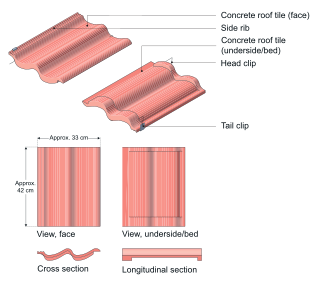
Figure 65. Example of a concrete roof tile where the ribbed profile on the long side helps to keep the structure watertight.
5.2.3 Constructing a Tiled Roof
Tiled roofs are subject to requirements regarding minimum roof pitch. This depends on the specific type of roof tile used (especially whether they are pantiles or interlocking tiles) and whether the assembly includes underlayment or not.
Tiled roofs with underlayment are suitable for roof pitches down to slopes of 15–25 ° depending on the material and design of the tiles. In each case, manufacturer instructions must be followed carefully. The max. roof slope is normally 85 °. Certain types of roof tile are suitable for use on vertical surfaces.
Tiled roofs can be constructed using mortar bedding instead of underlayment. If mortar bedding is used, interlocking roof tiles can be used for roof pitches down to 35 ° and pantiles for pitches of 40 °. Tiles are available for roofs with even shallower pitches. Some brands of concrete roof tile allow tiles to be used with mortar bedding down to a slope of 20 °. If the mortar bedding is executed carefully, it will contribute to keeping the roof watertight for many years to come. However, the mortar bedding should be checked approx. every five years to ensure adequate coverage and adhesion. For roof surfaces that are inaccessible from the inside (such as couple roofs and sloping walls in unutilised loft spaces) mortar bedding should not be used due to the difficulty of checking and maintaining it.
Concrete roof tiles with sealing strips incorporated into the joints can also be used without underlayment down to a slope of 20 °.
Table 17 provides an overview of roof tiles and min. slope requirements.
The construction of tiled roofs is, in principle, identical for clay and concrete roof tiles.
Roof tiles are typically laid on a supporting structure of timber rafters (e.g., attic or lattice trusses).
In addition to the actual roof tile, the following elements are normally used for a tiled roof:
- Underlayment
- Spacer bars
- Tile battens
- Tile clips
Figures 66 and 67 are examples of tiled roof assemblies.
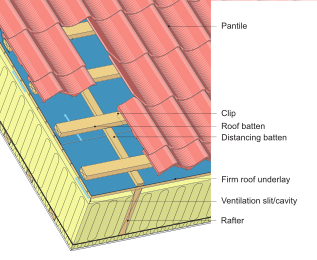
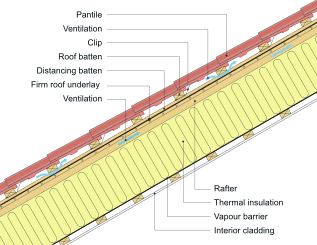
Figure 66. Example of a roof assembly with a pantile roof covering on a vented firm underlayment.
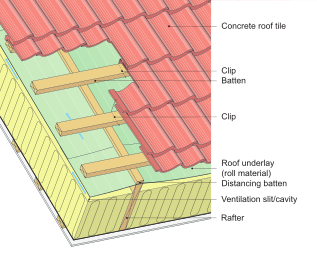
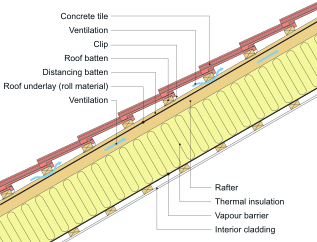
Figure 67. An example of a roof assembly with a covering of concrete roof tiles on a vented firm underlayment.
Underlayment
Requirements for underlayment (including ventilation) are outlined in Section 3, Roofing Underlayment.
Spacer Bars
Spacer bars are used in roofs with underlayment for the following purposes:
- To raise the roof battens to enable water and dirt to pass under the battens
- To ensure that the underlayment is securely fixed
- To ensure adequate ventilation on the underside of the roof covering in conjunction with air intake at eaves and exhaust at ridge.
Furthermore, the spacer bar leaves room for mechanical fixing to keep the roof tiles in place.
For a detailed description of issues concerning spacer bars, see Section 3.1.2, Spacer Bars.
Roof Battens
Rules and guidelines concerning roof battens are listed in Section 2.6.1, Roof Battens. For a detailed description, see TRÆ 65 (Træinfomation, 2011).
Most manufacturers of roof tiles will indicate the batten spacing required for specific roof tiles. Battens are usually spaced at around 300 mm. Sometimes a trial installation of the specific roof tiles is carried out to determine the batten spacing. This necessitates that all tiles be supplied from the same batch and delivered at the same time.
The battens are installed with a lathing tolerance of ± 3 mm measured across the rafters. Tolerances must not accumulate in the assembly.
Mechanical Fixings
Tile clips are used to fix tiles to the battens. Individual types of tile clips must carry a label indicating the type of tile and batten dimension they are compatible with because they are produced specifically for the combination of roof tile and batten dimensions. Tile clips are supplied with roof tiles. Clips for interlocking roof tiles are available as head clips and tail clips (see Figure 68). For pantiles, specific clips and clamps are available (see Figure 64).
Clips must be weatherproof and corrosion resistant. Tile clips are typically made from stainless steel or from aluminium and zinc alloys.
The resistance of tile clips to wind suction is tested according to DS/EN 14437, Determination of the uplift resistance of installed clay or concrete tiles for roofing - Roof system test method (Danish Standards, 2005c).
The application of mechanical fixings is also covered in Section 5.2.5, Installing a Tiled Roof.

Figure 68. Head and tail clips for hooking roof tiles to roof battens.
5.2.4 Venting Tiled Roofs
Tiled roofs must be vented on the underside of the tiles to minimise the risk of excessive moisture content in the tiles, potentially leading to frost damage. If a vented underlayment is used, additional ventilation between underlayment and thermal insulation layer must be established.
Ventilation of tiled roofs is typically achieved with vent openings at the eaves and ridges.
Tiled roofs require the size of the vent opening to be at least 200 cm2 per linear metre at the eaves and at least 100 cm2 per linear meter at the ridges, valleys, and hips to ensure adequate ventilation on the underside of the roof tiles. For houses up to 12 metres in height, there must be a continuous vent space below the roof tiles of at least 200 cm2 per linear metre.
To achieve an adequate vent space at the eaves and to prevent insects or animals from entering, an insect mesh or bird grating with an integrated ventilation unit fitted to the bottom should be installed (see Figure 69a). Special clamps for affixing bird gratings are available which avoid perforation of the underlayment during installation. Similarly a vent space area must be installed at ridges, valleys, and hips to ensure adequate venting of the underside of the roof tiles. At ridges and hips, a roll-fix ventilation strip in the form of flexible flashing material with perforations is often fitted. This prevents the ingress of vermin and rain and reduces the exposure of the underlayment to UV radiation (see Figure 69b).
Concrete roof tiles are not subject to the same under-tile ventilation required for clay tiles. At the eaves, therefore, an ordinary bird grating without a ventilation unit can be used. In each case, the manufacturer’s instructions for venting the underside of the roof tiles must be followed.
General guidelines for roof ventilation are outlined in Section 2.3, Roof Ventilation.
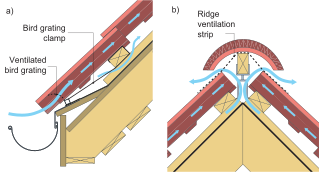
Figure 69. The underside of clay roof tiles must be vented to prevent moisture levels in the tiles from rising as this can lead to frost damage. Vermin must also be prevented from entering the roof assembly.
- Example of a vent opening at the eaves using a vented bird grating (shown here anchored by a bird grating clamp to avoid perforation of the underlayment).
- Example of vent opening at the ridge using a ridge ventilation strip (see Figures 72–74.
5.2.5 Installing a Tiled Roof
Before laying the roof tiles, attention should be given to the following special focus areas by checking the following:
- The net coverage per tile. This should be tested with a trial installation, including testing whether tile net coverage is consistent with the total width of the roof surface. It may be necessary to adjust the design by adapting the width of the overhang.
- The squareness of roof surfaces. This can be tested by plotting the angle using a 3-4-5 triangle or by examining whether the diagonals on the roof surface are consistent with the length of the roof surface at eaves and ridges.
- The spacing of battens is correct for the tiles used according to information supplied by the manufacturer (or determined through trial installation).
- The underlayment is correctly installed, is watertight, and undamaged.
- The underlayment can be carried over the full height of the barge board (if relevant).
- The spacer bars are at least 25 mm thick and made of pressure-impregnated timber (or similar).
Laying the Roof Tiles
Roof tiles are laid on roof battens, spaced according to manufacturer’s instructions or determined following a trial installation. Trial installations are recommended for clay tiles, but unnecessary for concrete tiles, as these are more dimensionally stable. The length and width of the roof surface should be adapted to fit the chosen roof tiles at the design stage to avoid cutting, if possible. For gable ends where verge tiles or double pantiles are used, cutting is not an option. If required, tiles can be adapted to the length or height of the roof surface by cutting the top layer. If the top layer of roof tiles is cut, the tiles must be fixed below the overlap with stainless steel washer-head screws.
The bottom row of battens is installed so that the roof tiles will project 30–40 mm into the gutter (measured horizontally). Based on this first row of battens, the position of the remaining battens is plotted with the spacing indicated or determined so that the distance between roof ridge and upper edge of the top batten complies with the measurement stated by the manufacturer. Further information on trial installations and positioning of battens is available in Tegl 36, Oplægning af tegltage (Installing Tiled Roofs) (MURO, 2005 [under revision, ed.]).
Before lifting the tiles onto the battens, the position of every third tile should be plotted on the battens, or as instructed by the manufacturer’s installation manual.
The tiles are laid from right to left as follows:
- Installation should start in the lower right corner and finish at the top left corner. Once the first row has been laid, the following should be checked:
- The tiles have the required overhang (for double pantiles) of approx. 30 mm at gable ends after fitting barge board
- The distance between the ‘wrap’ over the edge and gable end is approx. 10 mm if using verge tiles.
- The tiles project correctly into the gutter.
- Having laid three vertical rows of roof tiles to the ridge, check that the roof tiles are placed evenly above one another.
- The top layer should be laid along the ridge and adjusted as described for the bottom layer.
- The rest of the roof tiles should then be laid, starting from below and proceeding up the roof. Every third row should be checked with a smoothing board for example, according to the markings on the tile battens. The tolerance should be ± 2 mm measured across an average of 10 roof tiles.
For interlocking roof tiles, the grooves must click into place tightly like tongue-and-groove joints. This ensures a tight and stable roof surface. Pantiles must be placed closely together, and the mitred corners should be kept as small as possible.
Fixing Roof Tiles
Roof tiles are fixed as they are laid.
For clay roof tiles, at least every second roof tile is mechanically fixed in diagonal rows (see Figure 70). For concrete tiles, typically only every third tile is fixed. All perimeter roof tiles must be mechanically fixed, including the bottom or second lowest horizontal row, the top row (by the ridge), the perimeter row (by the gable ends), and all tiles along valleys, roof lights, and penetrations in the roof surface.
We recommend that designers assess whether to increase the extent of mechanical fixings relative to location (terrain category), the form, prevailing winds, and turbulence conditions in exposed locations. Examples of particularly exposed locations are:
- Inshore areas
- Areas classed as terrain category I and II according to Eurocode 1, Parts 1–4, General actions – Wind actions (Danish Standards, 2007c).
- Isolated tall buildings (three storeys and more)
- At the end of a street with tall buildings on either side, forming a wind tunnel (wind tunnel effect).
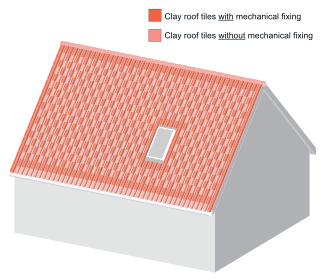
Figure 70. For clay roof tiles, at least every second tile is mechanically fixed in diagonal rows (marked in dark red) as well as all perimeter tiles (at ridges and eaves and all tiles near penetrations such as roof lights, etc.). Diagonal fixing of tiles ensures that individual tiles are fixed to the roof surface. For concrete tiles, normal practice is to fix every third tile.
For clay tile roofs in particularly exposed locations, all roof tiles must be mechanically fixed while manufacturers of concrete tiles often specify mechanical fixing of every second roof tile.
In special cases, it will not be sufficient to fix the roof tiles to the tile battens (e.g., for mansard roofs and other steep-pitched roofs of more than 60 °). In these cases all tiles must be fixed using stainless steel screws in addition to tile clips.
Special tiles are often fixed to ridges and hips is using special fixtures available from the manufacturer. Fragments of cut roof tiles from hips and valleys for example, can be bonded to the affixed neighbouring tile. For interlocking roof tiles, the groove must be fully bonded to avoid water-damming and overflow
5.2.6 Details – Roof Tiles
This section shows examples of typical detail design used in tiled roofs. See installation instructions and further details from manufacturers.
In detail design, it is necessary to take general guidelines for several issues into account (e.g., guidelines concerning ventilation and Building Regulations provisions relative to fire safety and thermal insulation). General issues concerning the choice of roof are outlined in Section 1.1, Roof Design.
For further examples of roof detail design, see Section 6, Dormers, Roof Lights, and Skylights; Section 7, Flashings – Penetrations and Intersections; and Section 9, List of Examples.
Valleys
Two types of valley constructions exist: a raised (ordinary) valley (which is mounted on top of the rafters) and a concealed valley (where the valley underlay is flush with the upper side of the rafters). The latter is usually considered the most reliable. The width of the valley is determined by the roof pitch, so that the height from the lower to the upper part of the valley is at least 100 mm (i.e., the shallower the pitch, the wider the valley).
Figure 71 shows an example of a concealed valley design in a roof with a vented loft space and a tiled roof with roll-material roofing underlayment.
For a detailed description and further examples of valley designs, see Section 7.2.4, Valleys.
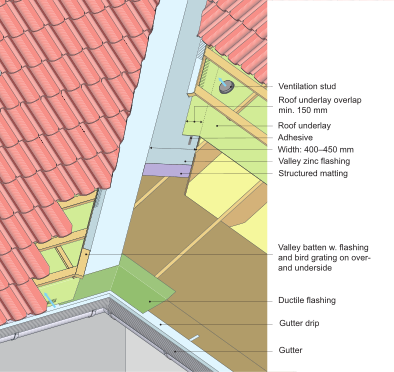
Figure 71. Example of zinc valley design in tiled roof with a vented loft space and roll-material roofing underlayment. The zinc is installed on a firm deck recessed relative to the jack rafters, so that the upper side of the decking is flush with the upper side of the rafters. The zinc extends 400-450 mm to either side relative to roof pitch. The height from the bottom of the valley to the upper edge of the zinc must be at least 100 mm (see Section 7.2.4, Valleys). The decking under the zinc is adjusted to ensure that the zinc is fully supported. If sheeting such as plywood is used, a structured mat should be fitted underneath the zinc. The underlayment and zinc overlap by at least 150 mm and is bonded to the zinc (e.g., with one, or even two, sealant strips of butyl tape).
Vented Ridge
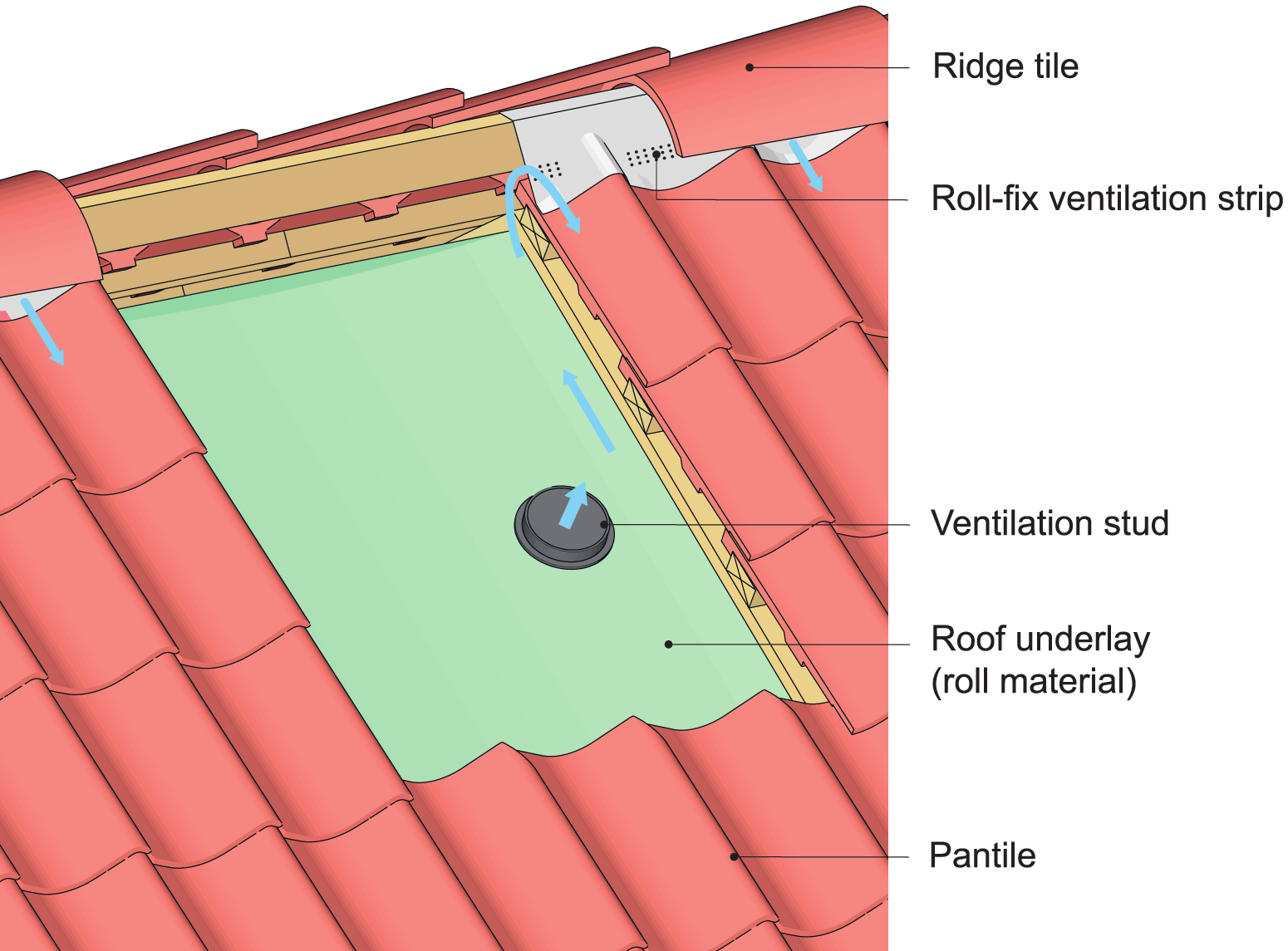
Figure 72. Example of vented ridge design in tiled roof with vented roll-material roofing underlayment. Venting the underlayment is done via roof vents for each roof truss placed close to rafters to prevent water ingress from above. The ridge is vented by a roll-fix ventilation strip under the ridge tiles (see Figure 74).
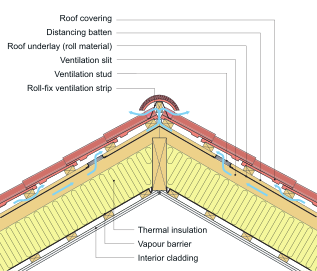
Figure 73. Example of vented ridge in a tiled roof with roll-material roofing underlayment (see Figure 72). The underlayment is vented via roof vents for each roof truss placed close to rafters to prevent water ingress from above. The ridge is vented by a roll-fix ventilation strip under the ridge tiles. The roll-fix ventilation strip also prevents ingress of birds and insects into the roof assembly.
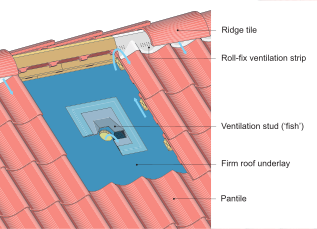
Figure 74. Example of vented ridge in tiled roof with a firm underlayment. The underlayment is vented via one roof vent placed near the ridge for each roof truss. The ridge is vented via a roll-fix ventilation strip under the ridge tiles.
Ventilation Duct Penetration
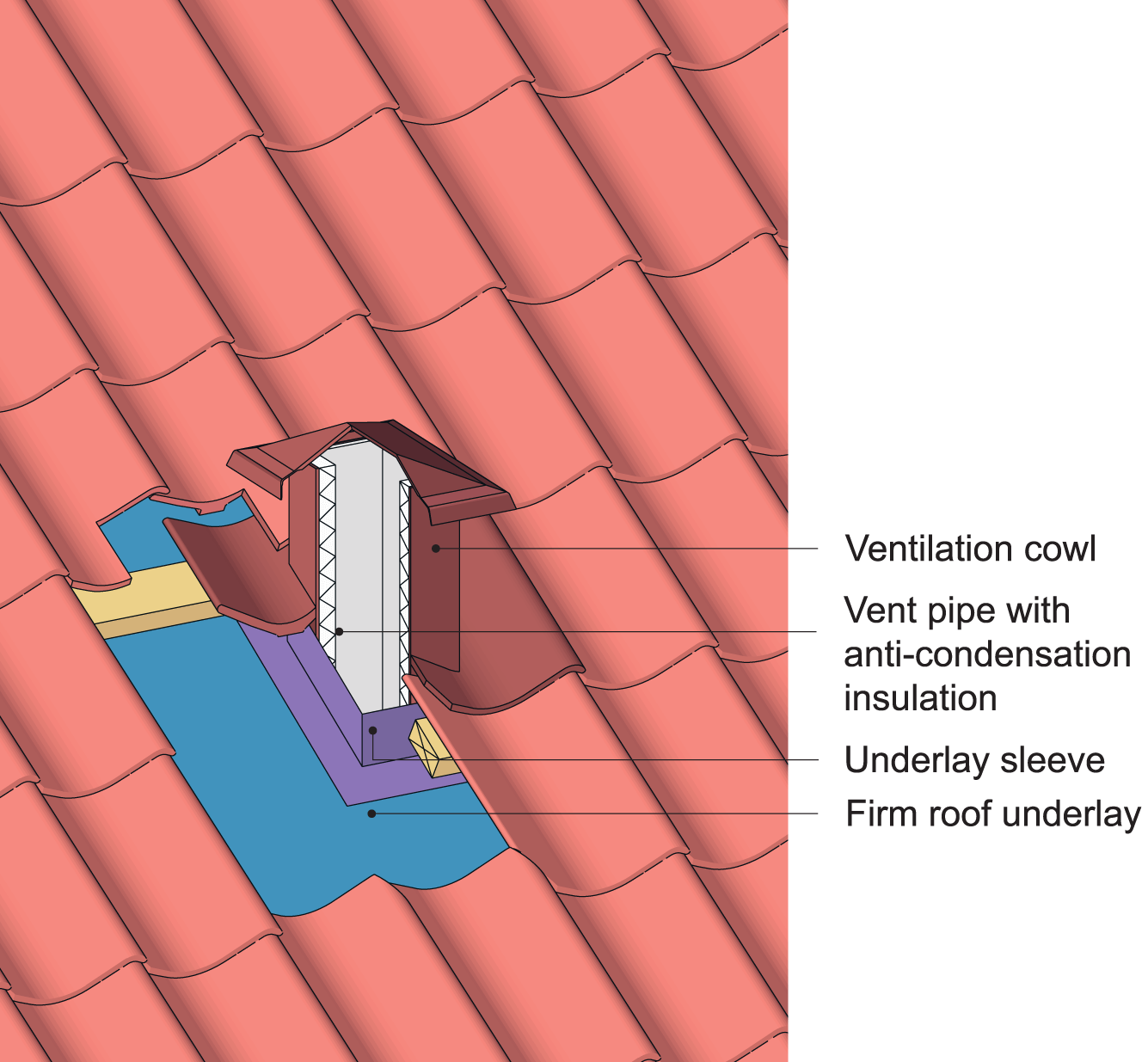
Figure 75. Example of roof vent cowl penetration with pre-mounted flange adapted to the shape of the roof tiles. It is joined to the underlayment is done on a firm underlay, in this example, firm underlayment (see Figure 198).
5.3 Roof Sheets – Corrugated Fibre-Cement Sheets
Roof sheets are usually made of cement-based materials reinforced with synthetic fibres and cellulose. The sheets are thin (approx. 6 mm) and are reinforced by their corrugated shape and the synthetic fibres. Most sheets are supplied with integral strips acting as a substitute walk-proof underlay on the finished roof covering.
The tightness of corrugated sheet roofs is achieved by simple overlap or lap joints between sheets combined with sealing strips integrated into the horizontal lap joints. Typically, no underlayment is installed.
Corrugated fibre-cement sheets belong to the category of light-weight roofs, see Section 5.1.3, Roof pitch and areal weight.
Fire-Rating Corrugated Fibre-Cement Sheets
In terms of fire performance, corrugated fibre-cement sheets are pre-approved as BROOF(t2), i.e., they do not contribute to fire (The EU Commission, 2000), see Section 2.5.1, Fire from the outside.
Applicable Standards for Corrugated fibre-Cement Sheets
Corrugated sheets are subject to the standard DS/EN 494, Fibre-cement profiled sheets and fittings - Product specification and test method (Danish Standards, 2012c).
5.3.1 Types of Corrugated Sheets
Corrugated fibre-cement sheets are available in several sizes with different profiles (see Table 19). The choice of size and profile for a specific project is determined by aesthetic or functional requirements. The roof sheets come with a wide choice of accessories, including accessories for finishes around ridges, barge boards, and roof penetrations.
The watertightness of corrugated sheets is achieved with horizontal and vertical overlaps supplemented by sealing strips. To ensure an efficient lap joint, the last corrugation crest is slightly lower than the others (see Figure 76).
Corrugated sheets are available untreated or with a coloured surface treatment (e.g., red or black).
Corrugated sheets without surface treatment are water-permeable and have a grey, matt surface.
Table 19. Typical properties of corrugated sheets in large and small formats. For large-sized sheets, one or two additional battens are often installed, but this number can be altered depending on whether a walk-proof decking or a batten dimension larger than 38 × 73 mm is used, as instructed by the manufacturer.
Type/Size | Approx. 1200 × 1000 mm | Ca. 600 × 1000 mm |
|---|---|---|
Weight/item | 14-19 kg | 8-9 kg |
Material use/m2 | Approx. 1 | Approx. 2 |
Batten spacing | 1070 mm | 460 mm |
Additional battens | 1-2 | 0 |

Figure 76. Example of fibre-cement roof sheet with a corrugated profile. Corrugated fibre-cement sheets are available both as full-edged and mitred relative to their position on the roof surface.
5.3.2 Constructing a Roof Using Corrugated Fibre-Cement Sheets
Corrugated sheets can be used for pitches down to approx. 14 °. For shallower pitches or exposed locations, joint sealant strips can be fitted horizontally and in vertical lap joints as an extra precaution.
Some manufacturers allow the use of their corrugated sheets down to an 8 ° roof pitch with underlayment. However, pitches below 14 ° can make installing effective eaves challenging (particularly water drainage from the underlayment) and can make it difficult to achieve a stack effect for sufficient ventilation. Where applicable, endorsement from the underlayment manufacturer must be sought for such shallow pitches.
Table 17 shows corrugated fibre-cement sheet types and minimum roof pitch requirements.
Corrugated sheets are laid on a supporting structure of wooden rafters or purlins.
In addition to the corrugated sheets, the following elements are used for a roof covering applications using corrugated sheets:
- Underlayment (if required)
- Spacer bars (when using underlayment)
- Battens or purlins
- Screws for fixing materials to the structure
- Sealant strips
- Walk-proof decking (if required)
Corrugated fibre-cement sheet roof coverings must be vented according to applicable guidelines (cf. Section 2.3.3, Guidelines for Ventilation of Pitched Roofs). Eave ventilation is usually achieved with vent openings, a fitted insect mesh or bird grating, and cowls or ridge solutions at ridge level with integral ventilation solutions.
Figures 77 and 78 show examples of roof covering assemblies using corrugated fibre-cement sheets.
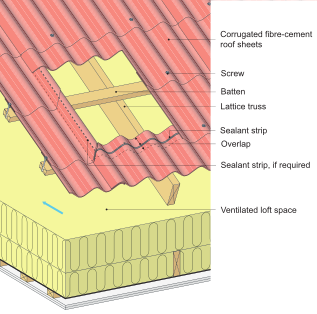
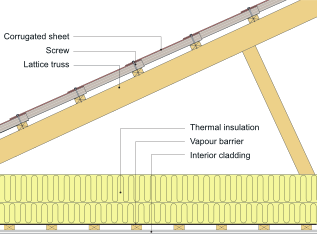
Figure 77. Example of roof covering of corrugated fibre-cement sheets on lattice-trussed roof assembly with battens and a vented loft space. For batten spacing exceeding 460 mm, a fall arrest system must be established (The Danish Work Environment Authority, 2014).
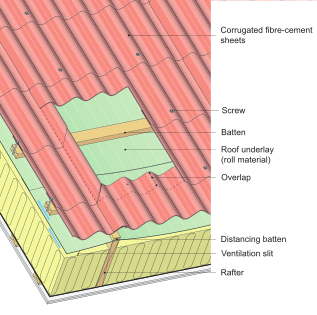
Figure 78. Example of a corrugated fibre-cement sheet roof covering on a couple roof with vented roll-material roofing underlayment.
Underlayment
Corrugated sheets can be installed with or without underlayment. If no underlayment is used, watertightness must be ensured by using sealing strips in the lap joints between sheets (see Figure 77 and the following section Sealing Strips).
Some manufacturers specify the use of underlayment for very shallow pitches. In such cases, manufacturer’s installation instructions must be carefully observed, including ensuring that it is feasible to use the underlayment for the shallow pitch required.
Issues concerning requirements relative to underlayment, including venting the underlayment, are outlined in Section 3, Roofing Underlayment.
Spacer Bars
Spacer bars are used for roofs with underlayment to:
- Raise the battens, allowing water and dirt to pass underneath
- Ensure that the underlayment is fixed securely
- Ensure adequate ventilation on the underside of the roof covering in conjunction with air-intake at the eaves and exhaust at the ridge
Issues concerning spacer bars are outlined in detail in Section 3.1.2, Spacer Bars.
Battens or Purlins
Corrugated sheets are laid and fixed to battens or purlins. To secure the strength and stability of the assembly, strength-graded battens or purlins complying with strength grade C18 must be used (cf. DS/EN 14081-1 (Danish Standards, 2016c)). Rules and guidelines for roof battens are outlined in Section 2.6.1, Roof Battens. For rafter spacing exceeding 1000 mm measured from centre-to-centre (c.t.c.), the dimension of C18-labelled battens is specified in a batten table in TRÆ 65, Taglægter (Roof Battens) (Træinformation, 2011b).
The sizing of purlins is outlined in the report TRÆ-rapport no. 05, Beregning af tagåse (Calculating Timber Purlins) (Træinformation, 2015b).
Manufacturers will state the bearing length required for their corrugated sheets. This length is relative to the type and format of the sheet.
A tolerance of ± 3 mm measured across the rafters must be allowed when installing the battens (cf. www.tolerancer.dk and Træ 65, Taglægter (Roof Battens) (Træinformation, 2011b). Tolerances must not accumulate in the assembly. For purlin constructions, deviations can exceed this without causing problems with tightness or lifespan of the sheets.
Fixing the Sheets
Screws are used to fix corrugated sheets to battens or purlins (see Figure 79). The sheets are screwed down through the top of the corrugation crest and washer-head screws appropriate to the specific sheets are used. Sheets and screws should be supplied by the same manufacturer, which is the best way of ensuring compatibility.
Usually, two screws are used per sheet. For exposed locations, three screws should be used at roof edges.
Screws must be weather resistant to avoid corrosion.
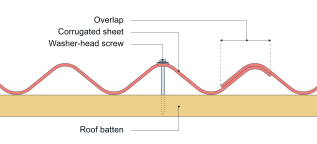
Figure 79. The sheets are installed with sideward lap joints consistent with one whole corrugation crest. Sheets are screwed down with washer-head screws. Screws are always placed at the top of corrugation crests (see Figures 77 and 78).
Sealing Strips
Sealing strips are applied in the horizontal lap joints to ensure watertightness when installing corrugated sheets without roofing underlayment. Sealing strips are fitted at the same time as the sheets are installed. In this way, sealing strips are clamped and fixed in the lap joints.
For shallow pitches or exposed locations, joint sealant strips should also be fixed to the vertical lap joints (see Figures 77 and 80).
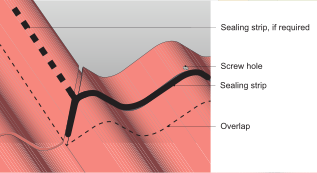
Figure 80. Corrugated sheets are usually sealed by fitting sealing strips to the horizontal lap joints. For exposed locations, additional sealing strips are fitted to the vertical joints.
Walk-Proof Underlay – Finished Roof
Where the c.t.c. spacing between battens exceeds 460 mm and the distance between roof surface and walk-proof underlay exceeds 2 metres, either a walk-proof underlay or sheets approved for use without walk-proof underlay must be installed (e.g., corrugated sheets with embedded strips) (cf. WEA Guideline 2.4.2) (Danish Working Environment Authority, 2014).
5.3.3 Installing a Roof Using Corrugated Fibre-Cement Sheets
Before installing the sheets, attention should be given to the following special focus areas by checking:
- The net coverage per tile. This can be checked with a trial installation, including whether the tile net coverage is consistent with the total width of the roof surface. Adjustments may be necessary to adapt the width of the overhang or using a verge profile
- That roof surfaces are square. This can be checked by examining whether the roof surface diagonals are consistently with the length of the roof surface at the eaves and ridge level
- That the spacing between supports is correct according to information supplied by the manufacturer
- That rafters and battens are square. When checking for this with a 2-metre smoothing board, deviations should be evenly distributed and be max. 15 mm
- That there is a space of at least 25 mm between the lower edge of the batten and the top of the insulation material, in assemblies where the thermal insulation is installed parallel to the sheets. For purlin assemblies, this is measured from the underside of the roof sheet (corrugation valley) and the upper side of the insulation material.
- That the roofing underlayment (if used) is laid correctly, tightly installed, and undamaged
- That the roofing underlayment can be brought over the full height of the barge board (if applicable)
- That spacer bars (at least 25 mm thick and made of pressure-impregnated timber) are installed between roofing underlayment and battens
Installing Corrugated Sheets
Corrugated sheets are installed on battens or purlins with the spacing specified by manufacturer or determined by a trial installation. The length and width of the roof surface should be adapted to the chosen corrugated sheets at the design stage to minimise cutting.
Sheets should be installed at right angles to the eaves. It is advisable to mark construction lines at right angles to the eaves. The first row of battens should be installed so that the roof sheets project 30–40 mm into the gutter measured horizontally and that this is consistent with the typical projection of sheets approx. 60 mm out from the underside of the lowermost batten.
Starting from the lowermost batten, the location of the rest of the battens or purlins should be marked according to the specified or determined spacing, so that the distance from the ridge to the upper side of the batten or purlin corresponds to the measurement supplied by the manufacturer.
Sheets (see Figure 81) are installed from left to right as follows:
- Laying should start at the lower left corner and finish at the top right corner. When the first row has been installed, one should check that the sheets have been positioned correctly at the gables (relative to the chosen solution) and that the sheets project out correctly in relation to the gutter.
- The remaining sheets should then be installed starting from below and moving up the roof. Check that the direction of laying is straight for every third row (for example, using a piece of string). Sheets should be installed by overlapping one corrugation crest in the vertical joints and a min. overlap of 110 mm in the horizontal joints.
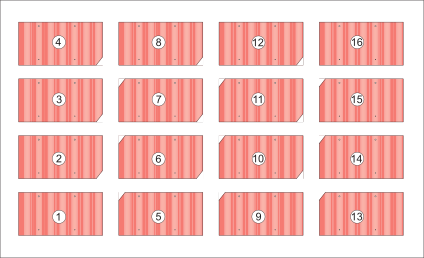
Figure 81. A diagram of the installation of corrugated sheets. Corrugated sheets are installed starting in the lower left corner of the roof assembly. It is important to install the sheets at exact right angles to the eaves and it is a good idea to mark a row of vertical construction lines along the battens or purlins. All sheets must be mechanically fixed.
5.3.4 Details – Corrugated Fibre-Cement Sheets
This section shows examples of typical detail design in roof coverings of corrugated fibre-cement sheets. Manufacturer installation instructions and product details must also be consulted.
In the design of roof details, it is necessary to take general guidelines for several issues into account, including those concerning ventilation and building regulations for fire safety and thermal insulation. General issues concerning the choice of roof are outlined in Section 1.1, Roof Design.
For further examples of roof detail design, see Section 6, Dormers, Roof Lights, and Skylights, Section 7, Flashings – Penetrations and Intersections, and Section 9, List of Examples.
Eaves
At the eaves, it is vital that water is discharged into the gutter and equally important that the required vent openings are in place to ensure roof ventilation.
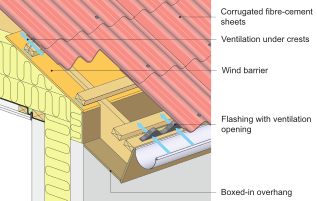
Figure 82. An example of an eave design using corrugated fibre-cement sheets without roofing underlayment. Boxed-in overhang with ventilation under the crests of fibre-cement sheets via special filler profile.
Ridge
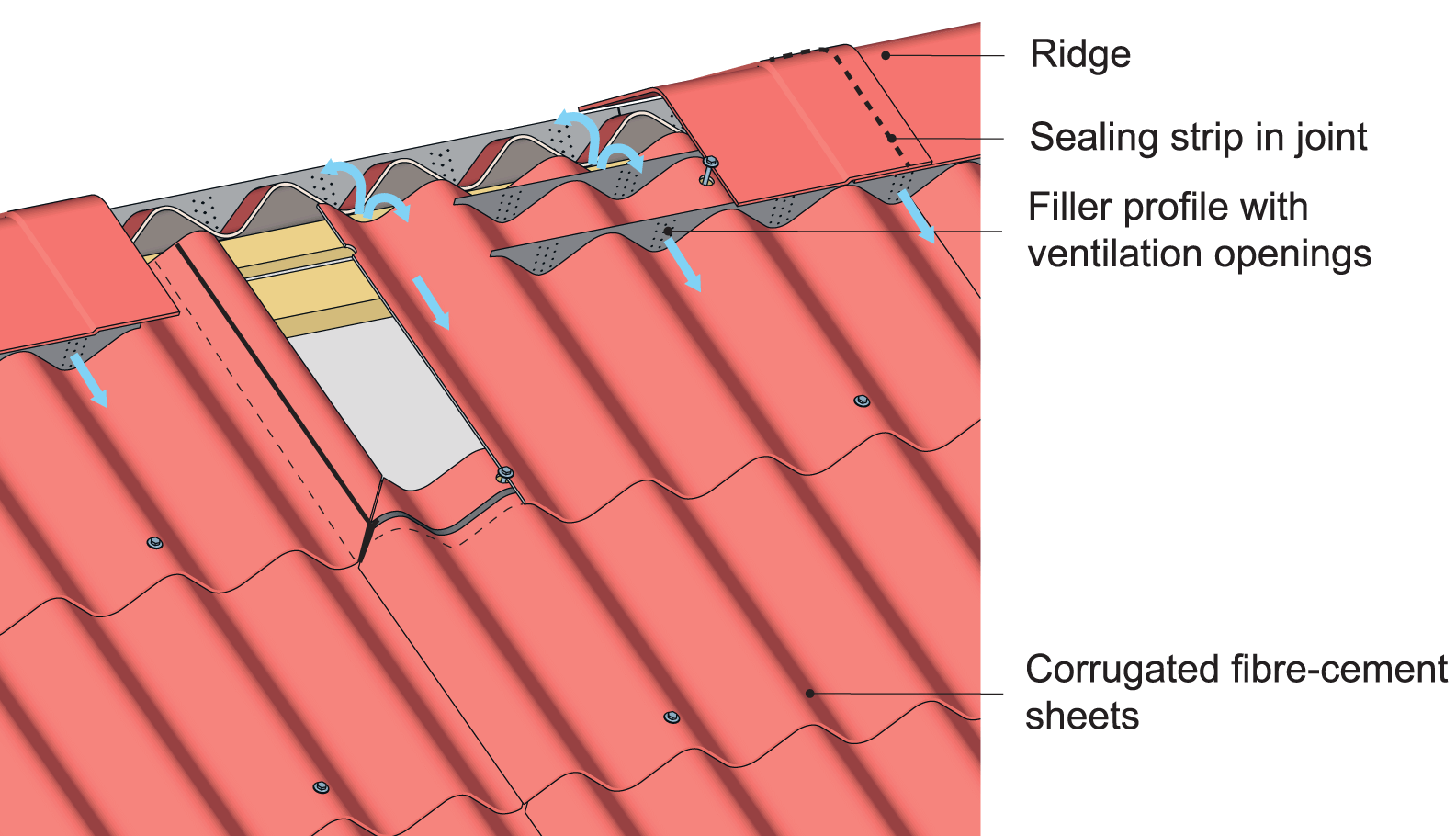
Figure 83. An example of ridge design where venting is achieved with a special filler profile across the crests of the fibre-cement sheets. Ridge corrugation overlaps must be identical to the horizontal overlaps between individual sheets.
Chimney and Ventilation Penetrations
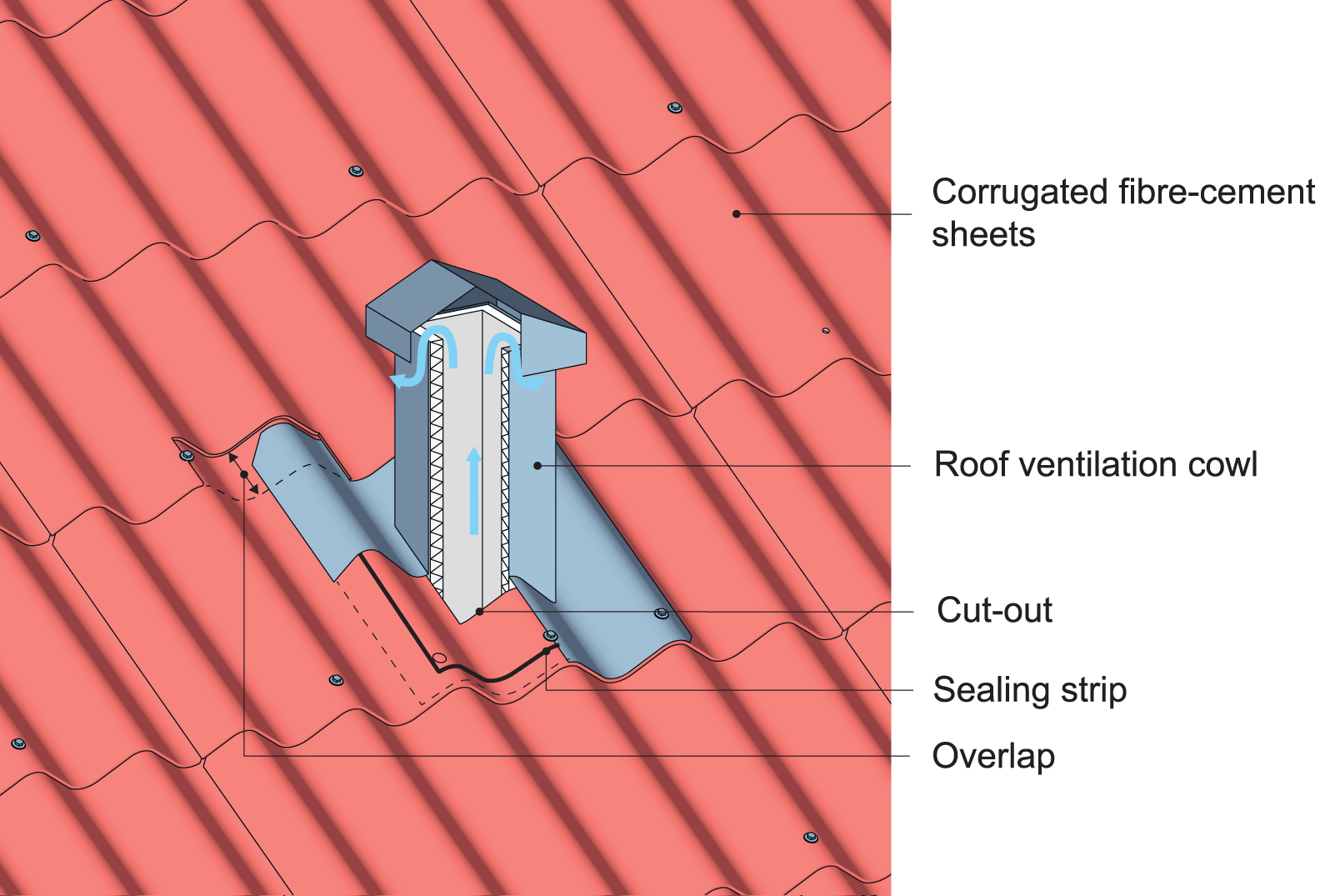
Figure 84. An example of roof vent cowl installation with pre-fitted flange. The flange is adapted to the shape of the corrugated sheets.
Valley
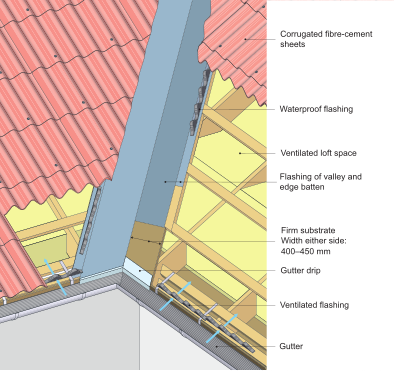
Figure 85. An example of closed valley design in corrugated fibre-cement sheets above vented loft space. The valley is installed on firm decking fitted to the rafters. The corrugated sheets should overlap the edge of the valley by at least 60 mm (see Section 7.2.4, Valleys).
5.4 Slate Roofs
Slate roofing is the term used for a roof covering of plane and thin roof tiles. The slates can either be made of natural rock (slate) or fibre-cement. Both types are available in relatively small sizes. Accessories in the form of slate hooks, nails, and vent strips are available for both types.
Slate tiles are installed by overlapping the individual slates. To ensure watertightness, a roofing underlayment is used, or the slates are sealed using slate sealant.
Roof coverings of natural slate and fibre-cement slate usually belong to the category of light-weight roofs (see Section 5.1.3, Roof Pitch and Areal Weight).
Fire-Rating Slate Roofs
In terms of fire performance, slates of both natural slate and fibre-cement are pre-approved as class BROOF(t2) as they do not contribute to fire (The EU Commission, 2000) (see Section 2.5.1, Fire from the Outside).
5.4.1 Natural Slate
Natural slate tiles are cut from a finely-stratified, layered metamorphic rock type formed by high pressures on mud deposits in static waters. The dominant elements are flaky, clay-like metamorphic rock and fragments of various minerals such as quartz, feldspar, and mica. Furthermore, varying amounts of organic material, such as lime and silicon particles, and sometime volcanic ash may be present. The composition of the slate is vital to its properties.
An important characteristic of natural slate is its cleavability, which results from the layered composition. The slate can therefore be cleaved into uniform thin layers, making it suitable for use as roof covering material. Although slate is cleaved into a somewhat uniform thickness, there will be a certain variation in the thickness of individual slate tiles. Natural slate is sorted into three thicknesses prior to installation. The thickest slates are used at the lower part of the roof and the thinnest are used at the top. Slates from different pallets should be mixed to avoid major colour differences in the roof surface.
Natural slate normally has a long lifespan. However, like other properties, it depends on the compositional mix of the slate, including its mineral content.
Natural slate comes in several colours, depending on where the slate was quarried. Natural slate can be cut into a variety of forms.
Applicable Standards for Natural Slate
Natural slate is subject to the following standards:
- DS/EN 1469, Natural stone products – Slabs for cladding – Requirements (Danish Standards, 2015b)
- DS/EN 12326-1, Slate and stone for discontinuous roofing and external cladding – Part 1: Specifications for slate and carbonate slate (Danish Standards, 2014b)
- DS/EN 12326-2, Slate and stone for discontinuous roofing and external cladding – Part 2: Methods of test for slate and carbonate slate (Danish Standards, 2011d).
Natural slate is subject to the following general requirements:
- Tiles must be free of cleavage planes and materials which may cause breakage in the surface structure.
- The surfaces must be finely stratified, smooth, and even without excessive flaking.
- Edges must be straight and corners right-angled.
- Individual slate tiles must be planed and of even thickness. A deviation of max. 1% of the length of the slate (hollow side down) is permissible.
- When striking the slate, the sound must be a clear tone, like that produced when striking porcelain.
Within Denmark, slate must meet the following requirements:
- Water absorption should average max. 0.4%.
- Tensile bending strength should average at least 70 MPa in dry conditions and 40 MPa in wet conditions. The minimum thickness of the slate to be used can be calculated on the basis of the required strength.
- Calcium carbonate content should average max. 3%. If the slate contains pyrite, which is subject to oxidisation, the calcium carbonate content must be max. 0.5% (and it must be evenly distributed).
- Slate tiles must be frost-proof.
5.4.2 Fibre-Cement Slates
Fibre-cement slates are made of cement mortar reinforced by a mix of inorganic and organic fibres. This production method means that it is possible to produce slates with an even thickness of normally approx. 4 mm.
Fibre-cement slates are produced in various dimensions, for example, 600 × 300 mm, 400 × 400 mm, or 600 × 600 mm. The slates are supplied with or without mitred corners.
Applicable Standards for Fibre-Cement Slates
Fibre-cement slates are subject to the standard: DS/EN 492, Fibre-cement slates and fittings – Product specification and test methods (Danish Standards, 2012d).
5.4.3 Constructing a Slate Roof
Minimum roof pitch requirements for slate roofs depend on the type of slate, for example, natural slate or fibre-cement slate.
Natural slates can normally be used on pitches down to 20 ° as roofing underlayment is almost always used.
Fibre-cement slates can normally be used down to 18 ° roof pitches as roofing underlayment is generally used. For fibre-cement slates measuring 600 × 300 mm, slate sealant may be used to weatherproof slates instead of roofing underlayment on pitches steeper than 34 °.
For further information, please see manufacturer installation manuals and literature. Table 17 provides an overview of different types of slate roof and requirements for minimum roof pitches.
The installations of natural slate roofs and fibre-cement slate roofs are largely identical, but the methods have slight differences.
A slate roof covering is usually installed on a supporting structure of wooden rafters (e.g., attic trusses or lattice trusses) possibly with underlayment, spacer bars, and battens. It is also possible to install a natural slate roof on firm decking (see Figure 89).
Besides the actual slate, the following elements are used in a slate roof covering:
- Underlayment (if required)
- Spacer bars (if roofing underlayment is used)
- Roof battens, and possibly a firm decking made of wood boards
- Slate nails for affixing slate tiles, and slate rivets for fibre-cement slates
- Slate sealant for weatherproofing if no underlayment is installed
The roof must be vented according to applicable guidelines (cf. Section 2.3.3, Guidelines for Ventilation of Pitched Roofs). Venting is usually installed at the eaves and openings are fitted with insect mesh or bird grating. They are also installed at the ridge level, using either vent cowls or ridge solutions with integral ventilation.
Examples of roof assemblies with fibre-cement slate and natural slate roof coverings are shown in Figures 86, 88, and 89.
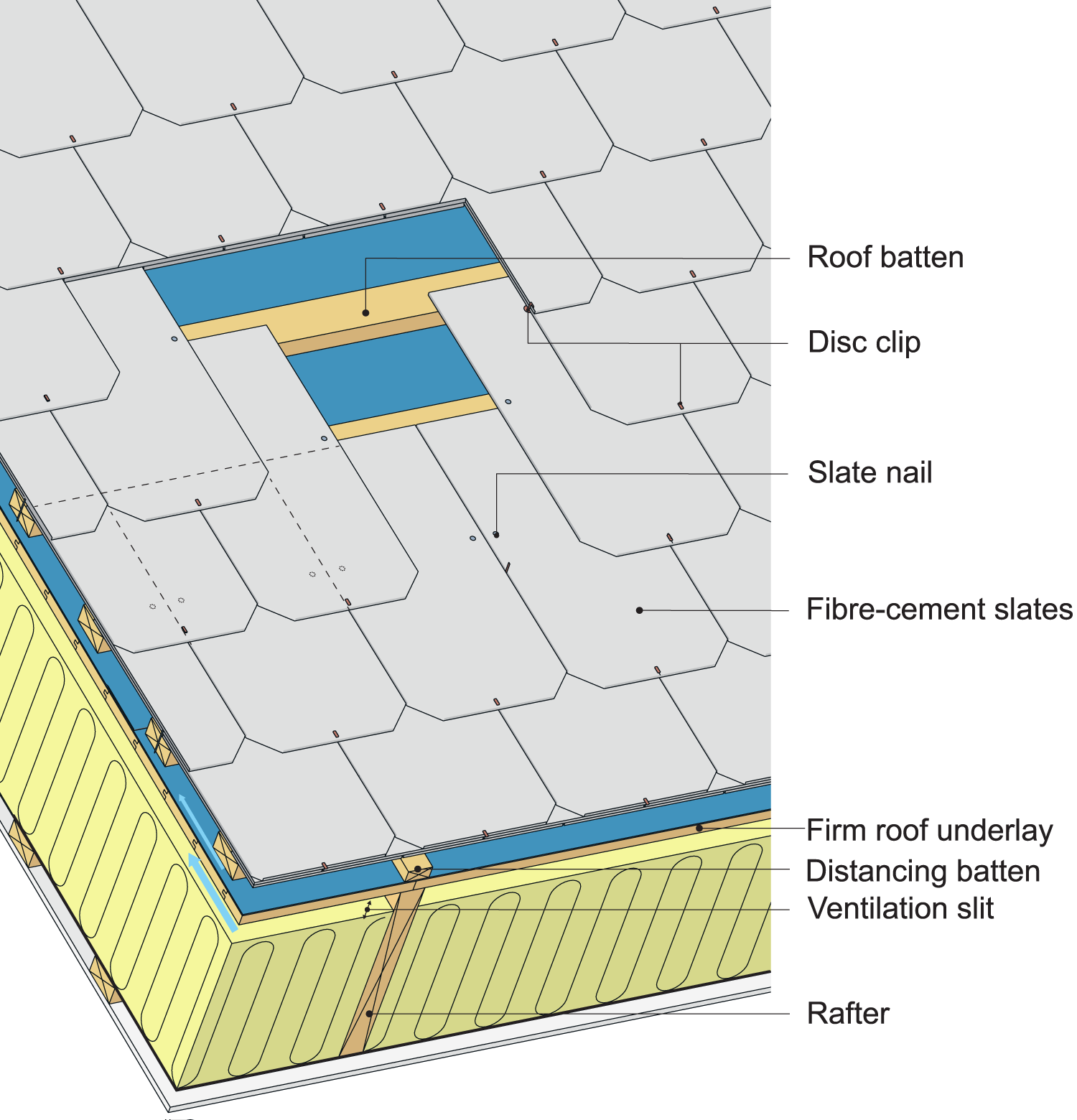
Figure 86. An example of a roof assembly with fibre-cement slates and a vented firm underlayment. The slates are fixed using nails and so-called disc rivets placed between the slates, so that the top part of the rivet fixes two slates (see Figure 87).
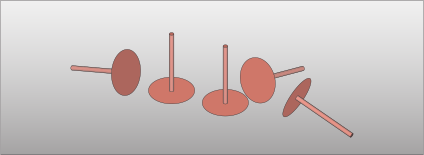
Figure 87. An visualization of disc rivets, used for affixing fibre-cement slates.
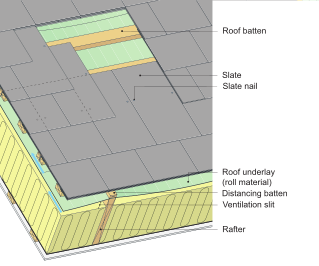
Figure 88. An example of a roof assembly using natural slates and vented roll-material underlayment.
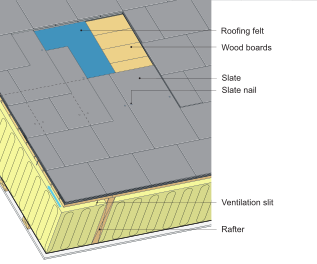
Figure 89. An example of the laying of natural slates directly on a firm underlayment supported by wood-board decking. The underlayment must be installed using ’self-healing’ materials (e.g., bituminous felt which will fit snugly around nail holes).
Roofing Underlayment
Slate roof coverings are usually laid with an underlayment, but supplementary weatherproofing for fibre-cement slates installed on roofs with a pitch above 34 ° can also be achieved using slate sealant.
Roofing underlayment issues and concerns, including the venting of underlayment, are outlined in Section 3, Roofing Underlayment.
Spacer Bars
Spacer bars are used in roofs with underlayment to:
- Raise the roof battens to enable water and dirt to pass under the battens
- Ensure that the roofing underlayment is fixed securely
- Ensure adequate ventilation on the underside of the roof covering in conjunction with eaves air-intake and ridge exhaust.
Issues concerning spacer bars are detailed in Section 3.1.2, Spacer Bars.
Battens or Purlins
Slates are laid over and affixed to roof battens. For the sake of the strength and rigidity of the structure, strength-graded roof battens or purlins labelled strength grade C18 must be used (cf. DS/EN 14081-1) (Danish Standards, 2016c). Rules and guidelines for roof battens are listed in Section 2.6.1, Roof Battens. For rafter spacing exceeding 1000 mm measured from centre-to-centre (c.t.c.), dimensions of C18-labelled battens are specified in a batten table in TRÆ 65, Taglægter (Roof Battens) (Træinformation, 2011b).
When installing roof battens, a tolerance of ± 3 mm measured across the rafters must be allowed (cf. www.tolerancer.dk and Træ 65, Taglægter (Roof Battens)) (Træinformation, 2011b). Tolerances must not be allowed to accumulate in the structure.
Issues concerning roof battens are also outlined in Section 2.6.1, Roof Battens.
Manufacturer information sheets will list the support spacing required for their products. The spacing depends on the type of slate and specific slate form.
5.4.4 Laying a Slate Roof
Before laying the tiles, the following special focus areas should be checked:
- The net coverage. This should be determined with a trial installation, including checking whether the net coverage is consistent with the total width of the roof surface. It may be necessary to adjust the assembly by adapting the width of the overhang or by changing the position of the slates on the roof.
- The squareness of roof surfaces. This can be checked by measuring the diagonals on the roof surface against the length of the roof surface at eaves and ridges.
- The bearing length should correspond to the length specified by the manufacturer.
- Rafters and roof battens should be straight. Checks made using a 2-metre smoothing board should indicate that any deviations are max. 15 mm and are evenly distributed.
- The roof underlayment should lie correctly, should be tightly installed, and should be undamaged.
- The roof underlayment can be brought over the barge board, if applicable.
- That spacer bars should be at least 25 mm thick and made of pressure-impregnated timber, and should be installed between roofing underlayment and battens.
Laying the Slates
Slates are normally laid on battens installed at the manufacturer specified spacing or the spacing determined by a trial installation. Furthermore, natural slates can be fixed directly on tongue-and-groove board decking covered with bituminous felt, or a similar ’self-healing’ material that will close snugly around nail holes made when fixing the slates. The boards are installed with a spacing of 1–2 mm. This roof structure is common among old properties in Copenhagen and is often used in other countries such as Sweden. To avoid flexion when nailing, the boards must be at least 25 mm thick but ideally 34 mm thick.
Where possible, the length and width of the roof surface should be adapted to the chosen slate type in the design phase, to avoid having to cut the slate. If cutting is unavoidable, all slates (typically at gable ends and penetration) should be cut to a size that is bigger than half of the slate’s width.
Slates are installed at right angles to the eaves, normally with a spacing of 1–5 mm. It is a good idea to mark up a construction line at right angles to the eaves. A line should typically be marked for every third slate.
The first row of battens and the (invisible) first slates are installed so that they project 30–40 mm into the gutter (measured horizontally) (which is consistent with the slates typically projecting 60–70 mm from the underside of the lowermost batten). The first batten must be blocked up by a thickness consistent with a slate, so that the bottom row of slates will have the same pitch as the rest. Care should be taken to establish the required air gap between the batten’s lower edge and the cleat edge flashing, if installed. This should also be established at the ridge.
Starting with the bottom batten, the position of the rest of the battens should be marked with the applicable spacing, observing the measurements specified by the manufacturer.
The slates should then be installed beginning from the reference line towards the gable ends. This will ensure that the outermost slates at both gable ends will have identical widths if the roof surface area is not divisible by a whole number of slates.
Eave slates are adapted to fit the chosen installation method. Similarly, it will be necessary to adapt slates at penetrations and ridges.
When installing fibre-cement slates diagonally, the first slates are adapted in a similar way. The slates are laid so that their top points align with the upper edge of the batten with a slight spacing between the slates, allowing disc rivets to be fitted. The slates are staggered by half a width between rows.
Fixing the Slates
Slate nails and disc rivets are used to fix slates to the roof battens. Nails must be weatherproof and non-corrosive (e.g., hot-galvanised or copper nails).
Fibre-cement slates are usually supplied with pre-punched holes to facilitate installation. In natural slates, fixing holes are typically pre-punched from the backside of the tiles. This results in cone-shaped holes for countersinking the slate nails.
The bottom edge of the fibre-cement slates is fixed using disc rivets fitted between the two slates below with its point directed upwards (see Figure 86). When installing, the point of the disc rivet should be inserted through the pre-punched hole. The point will bend down.
For connections and penetrations (e.g., roof lights) slates are fixed using rust-resistant screws with EPDM washers.
5.4.4 Details – Slates
This section describes examples of typical detail design for roofs with slate coverings. See manufacturer installation instructions and further details.
In the design of roof details, it is necessary to take general guidelines for several issues into account (e.g., guidelines concerning ventilation and Building Regulations provisions relative to fire safety and thermal insulation). General issues concerning the choice of roof are outlined in Section 1.1, Roof Design.
For further examples of roof detail design, please see Section 6, Dormers, Roof Lights, and Skylights, Section 7, Flashings – Penetrations and Intersections, and Section 9, List of Examples.
Ridge Solutions
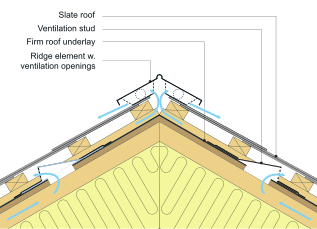
Figure 90. . An example of a slate roof with a firm underlayment and a vented ridge. Ventilation is achieved via roof vents in the underlayment and via ridge elements with integral vent openings.

Figure 91. An example of ridge ventilation design in a slate roof under blocked-up ridge boards with zinc flashing. The blocking is achieved using spacer bars spaced at least 600 mm from each other (and max. 250 mm long).
Eaves

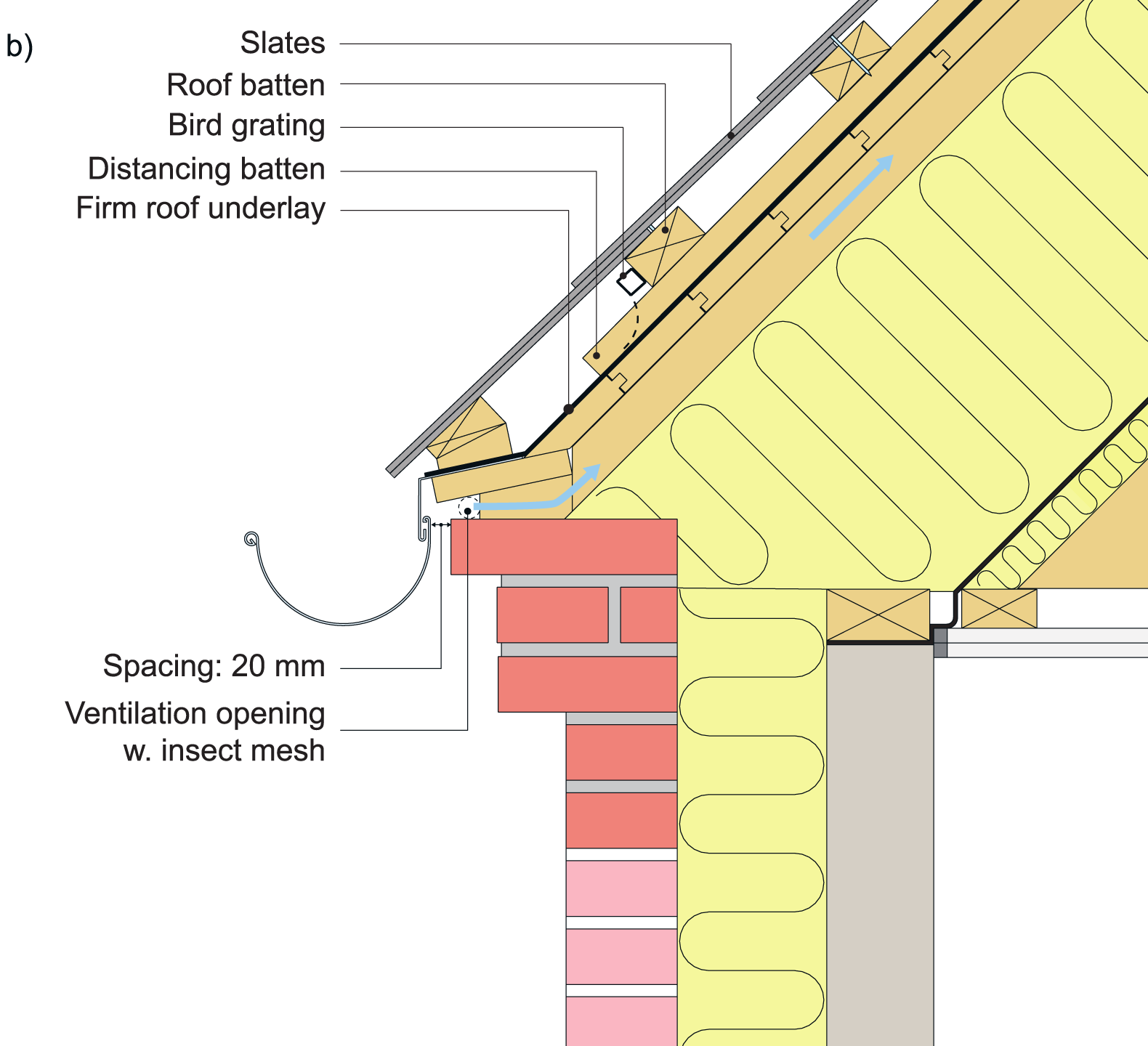
Figure 92. Examples of eaves for slate roofs with a firm underlayment. For solution a), the insect mesh can also be placed above the soffit boards. For solution b), there must be spacing of at least 20 mm between the gutter and the wall, ensuring the free flow of ventilation air.
5.5 Metal Sheets
In this book, metal sheets are used to denote a roof covering constructed using plane and thin prefabricated metal sheets or roof tiles with different profiles. Roof coverings using roll-formed zinc, copper, or aluminium sheets are outlined in Section 5.6, Zinc and Copper (and Aluminium).
Prefabricated, profiled metal sheet roof coverings are often systems solutions with various types of special sheets for different roof details (e.g., eaves, overhang, ridges, and gable ends). Similarly, the method of fixing and joining the sheets is often specific to the sheet system used. Manufacturers’ installation manuals must always be followed to ensure a satisfactory result.
The max. span of profiled sheets is relative to the specific profiling. For long sheets, it is sometimes possible to use a batten spacing of up to 2 metres approximately.
The weathertightness of metal sheet roofing is achieved with overlaps or lap joints between individual metal sheets held in place by screws or clicked into place (with click seams). To ensure watertightness or to collect condensate on the underside, metal roofs should be constructed using roofing underlayment.
Metal roof sheets are vapour-impermeable and are normally used in vented roof assemblies only (see Section 1.2, Vented and Unvented Assemblies).
Roofs with a metal sheet covering belong to the category of light-weight roofs (see Section 5.1.3, Roof Pitch and Areal Weight).
The lifespan of metal sheets is relative to the metal used as well as to surface treatment or coating.
Fire-Rating Metal Sheet Roofing
Metal roofing with a thickness of at least 0.4 mm laid on battens are pre-approved as BROOF(t2) as they do not contribute to fire (The EU Commission, 2000) (see Section 2.5.1, Fire from the Outside). For other applications such as installing a roof covering on a thermal insulation underlay, the manufacturer is obliged to advise on the types of underlay suitable for the specific roof covering to protect underlying materials in the roof assembly.
Applicable Standards for Metal Roofing Sheets
Metal sheets used as roof covering are subject to DS/EN 508, Roofing and cladding products from metal sheet – Specification for self-supporting of steel, aluminium, or stainless steel sheet – Part 1: Steel (Danish Standards, 2014c).
5.5.1 Types of Metal Sheet
Metal roofing sheets are available in several different types/designs, for example:
- Trapezoidal or sinusoidal long sheets
- Roof-tile shaped long sheets
- Click-seam sheets with a prefabricated seam
Roofing sheets are made of galvanised steel, aluminium, or, in rare cases, stainless steel. Sheet thickness is usually between 0.4 and 1 mm. Sheets thinner than 0.5 mm are not recommended.
The profile type and dimension of the metal sheets are significant determinants for the roof assembly (e.g., for batten spacing) (see Section 5.5.2, Constructing a Metal Sheet Roof).
Figure 93 shows examples of different designs of prefabricated metal sheets for roof covering.
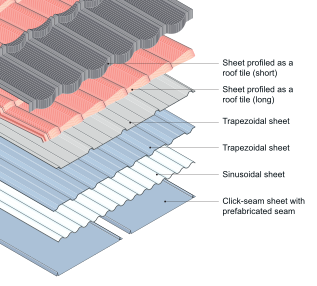
Figure 93. Examples of prefabricated metal sheets designed for roof covering.
Surface Treatment
The surface treatment of metal sheets for roof covering is assessed in relation to corrosion protection, scratch resistance, UV-resistance, and easy cleaning.
Steel sheets for roof covering are always zinc-coated (galvanised), and any surface coating is thus applied to the zinc (see Figure 94). Galvanised sheets are available where aluminium has been added to the zinc layer to improve the corrosion protection (aluzinc). Stainless steel sheets are also available which can be used untreated.
The quality of the surface treatment is a major determinant of the longevity of the sheets.
Materials used for surface treatment are typically polyester or other weathertight materials (e.g., PVF2, PVC, or PUR).
Aluminium sheets can be surface-treated like steel sheets, but can also be used without surface treatment as a thin layer of aluminium oxide (Al2O3) forms naturally over Aluminium when it is exposed to air, and this layer will durably protect the surface. The use of untreated aluminium sheets requires that they be a quality suitable for free exposure and that no galvanic corrosion will occur (e.g., due to fixings made of unsuitable materials).
Aluminium sheets can also be surface treated through anodising.
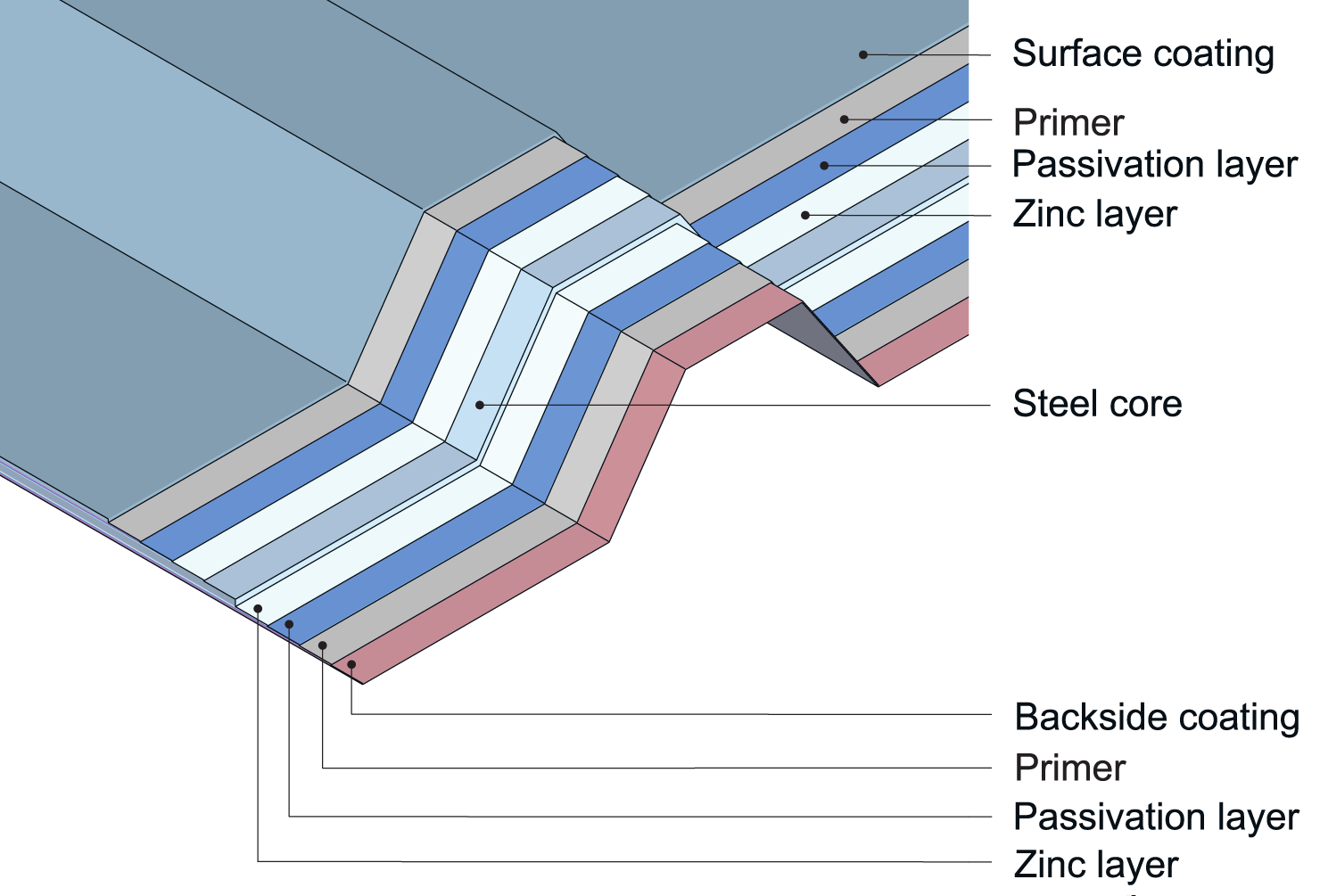
Figure 94. Typical coating structure in metal roofing sheets
5.5.2 Constructing a Metal Sheet Roof
Roofing executed using prefabricated metal sheets is suitable for relatively shallow pitches. However, mechanical joints in metal sheet roofing (e.g., executed as lap joints) are not resistant to water pressure and the minimum roof pitch for these is therefore somewhat higher than for roofing membranes. The roof pitch for profiled (corrugated) metal sheets is often 10–15 °. For shallower pitches (down to approx. 5 °) it will be necessary to use sealants in the joints or roofing underlayment.
Some manufacturers (e.g., of aluminium sheets which are seamed on site, and click-seam sheets with prefabricated seams) permit the use of their products on shallow roof pitches down to 3 °. Pitches as shallow as this require a special assembly protocol and it is essential to follow the manufacturer’s instructions carefully.
For shallow roof pitches, a structured mat is fitted under the aluminium sheets if they are installed on sheet material or rigid-foam thermal insulation.
Interstitial condensate will often form on the underside of metal sheet roofing due to the rapid cooling caused by radiation emission to the atmosphere at night. For this reason, metal sheet roofing should normally be executed using roofing underlayment capable of intercepting dripping condensate. Furthermore, the underlayment provides added security against the ingress of water, via sheet joints for example. Roof underlayment should not be omitted when renovating old houses where there is uncertainty about the degree of airtightness or vapour barrier airtightness.
If the roofing underlayment is omitted, sheets with a condensate-absorbing underside (condensate absorber) must be installed. However, their absorbency is limited and cannot sustain heavy moisture loads. Condensate absorbers on the underside are available in the form of felt or absorbent paint. Felt will absorb up to approx. 1 kg of condensate per m2 while absorbent paint will absorb up to approx. 0.5 kg/m2, which makes it feasible to use sheets without roofing underlayment in moisture load classes 1 and 2 (i.e., above relatively dry rooms) (see Section 1.2, Vented and Unvented Assemblies).
Metal sheet roofing may cause noise problems from rain and hailstones, which must be subject to evaluation in specific contexts. Some profiled sheets are available with sound reduction on the underside and will thus reduce noise nuisance.
Due to the relatively large changes in temperature in metals, steps must be taken to allow for thermal deformation (expansion, and contraction) in the installation phase.
A roof covering of prefabricated profiled metal sheets is installed on a supporting structure of timber rafters or purlins.
In addition to the actual metal sheets, the following elements are used in a metal sheet roof covering:
- Underlayment (if required)
- Spacer bars (if roofing underlayment is used)
- Battens or purlins
- Screws for fixing the sheets, and possibly a sealant
- Walk-proof underlay (if required)
Metal sheet roofing must be vented in accordance with applicable guidelines (cf. Section 2.3, Roof ventilation). Normally, venting is achieved at the eaves with openings fitted with insect mesh or bird grating, and at the ridge using either vent cowls or ridge solutions with integral ventilation.
Guidelines on the use of roofing underlayment are outlined in Section 3, Roofing Underlayment.
A wood board underlay could consist of 23 × 100 mm rough (equalised) timbers installed with 5–10 mm spacing.
If seamed aluminium sheets are installed on plywood sheet decking, roofing underlayment must be installed if the shallow roof pitch is below 10 °. For aluminium sheets, structured matting is usually unnecessary, although some manufacturers recommend it for shallow roof pitches.
Figures 95–97 show examples of roof assemblies with roof coverings of long, profiled sheets.

Figure 95. An example roof assembly with profiled metal sheets and vapour-permeable roofing underlayment. The sheets are installed on battens.
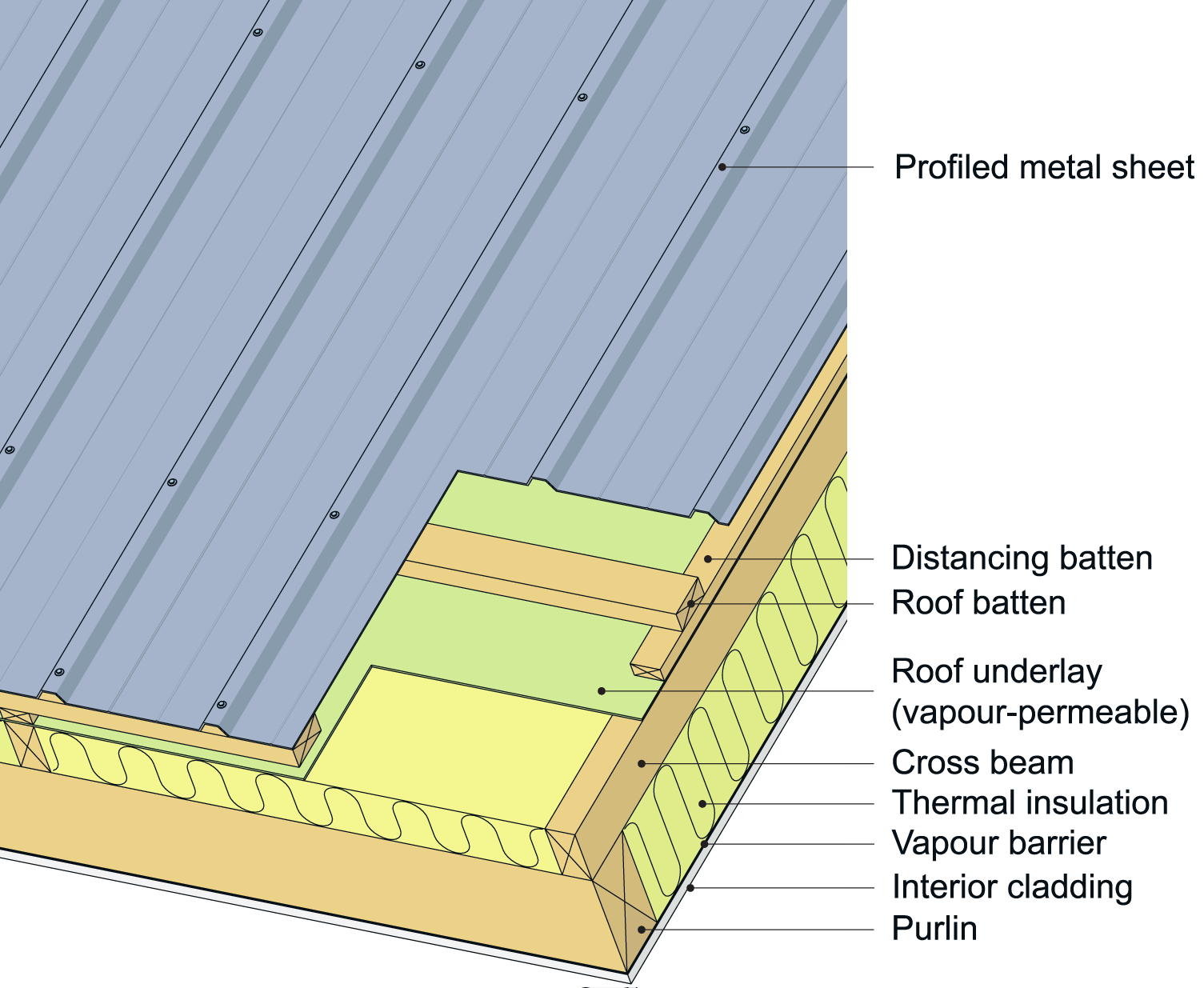
Figure 96. An example roof assembly with metal sheets on battens with vapour-permeable roofing underlayment on a supporting structure of purlins (e.g., resting on an underlying steel frame construction (not shown)).

Figure 97. An example of a roof assembly with profiled metal sheets on lattice trusses with battens and roofing underlayment.
Roof-Tile Profiled Sheets
Two types of roof-tile profiled sheets are available: one with a length corresponding to the batten spacing (see Figure 98), and one with continuous roof-tile profiles spanning several battens.

Figure 98. An example roof assembly with vapour-permeable roofing underlayment and roof-tile profiled metal sheets spanning two roof battens.
Seamed Sheets on a Firm Underlay
Click-seam sheets and sheets seamed on site must be laid on a firm wood-board or plywood decking. With roofing underlayment, these two types can be used for shallow roof pitches down to 3 °.

Figure 99. An example roof assembly with click-seam metal sheets on plywood roofing underlayment. For shallow pitches, structured matting between metal sheets and plywood is used (see Figure 100).
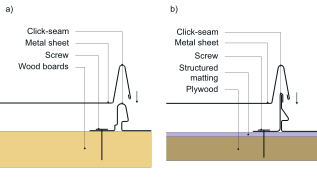
Figure 100. Examples of joining roofing sheets with a click-seam (see Figure 99).
- Click-seam joint on wood board decking.
- Click-seam joint on plywood decking with structured matting.

Figure 101. An example roof assembly with seamed metal sheets on wood board decking. If Plywood is used as decking it may be necessary (dependent on the roofing materials used and the roof pitch) to use structured matting underneath the metal sheet, particularly for shallow pitches.
5.5.3 Installing Metal Sheet Roofing
Since metal sheet roofing is available in many different materials and designs, no general installation or laying guidelines will be given here.
We recommend that metal sheet roofing is always installed on a roofing underlayment both to ensure tightness in overlap joints and to intercept any dripping condensate. Alternatively, dripping condensate can be avoided by using roof covering sheets with a moisture-absorbent underside (see Section 5.5.2, Constructing a Metal Sheet Roof).
Dimensioning and design must be performed in accordance with manufacturer instructions, including maximum span of the sheets, sheet overlap in both horizontal and vertical joints, and fixings. The sheets should be sufficiently robust to tolerate minor mechanical impact without becoming deformed and without damaging the coating.
The sheets must be fixed in such a way as to absorb wind loads on the roof. This requires sufficient anchorage length in the underlying structure (e.g., with battens or purlins).
5.5.4 Details – Metal Sheets
This section shows examples of typical detail design used in prefabricated profiled metal sheet roofing. See manufacturer installation instructions for more detail.
In the design of roof details, it is necessary to adhere to general guidelines for several issues. These include guidelines concerning ventilation and Building Regulations for fire safety and thermal insulation. General issues concerning the choice of roof are outlined in Section 1.1, Roof Design.
For further examples of roof detail design, please see Section 6, Dormers, Roof Lights, and Skylights, Section 7, Flashings – Penetrations and Intersections, and Section 9, List of Examples.
Ridges
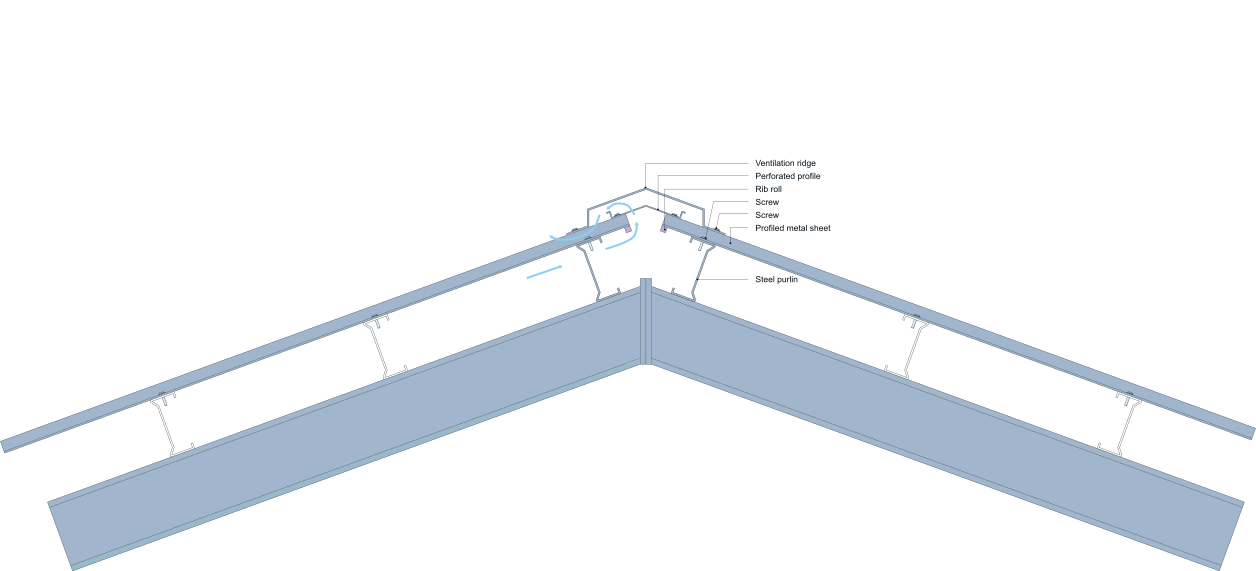
Figure 102. An example of a fascia verge design in a profiled metal sheet roof covering.
Fascia
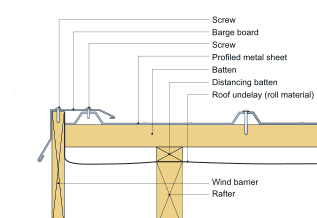
Figure 103. An example fascia verge design using a profiled metal sheet roof covering.
Wall Flashing
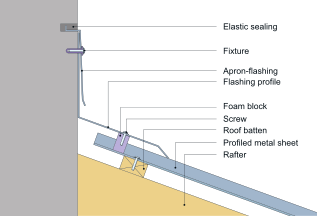
Figure 104. An example of wall flashing. Shown here with flashing fixed to the metal roof covering and wall. The flashing is further protected by a counter-flashing mounted in a 30 mm deep groove milled into the wall. The groove is sealed with caulking compound.
Joining Metal Sheets
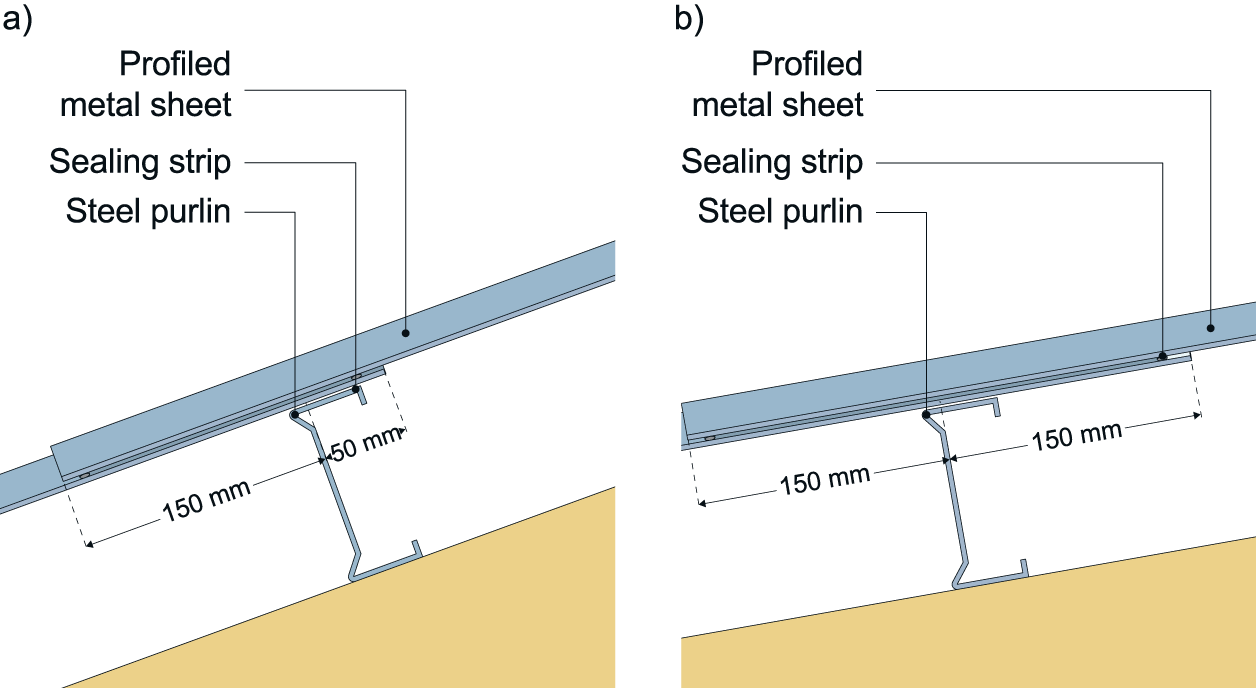
Figure 105. Examples of end lap joints for profiled metal roof sheets.
- End lap for roof pitch steeper than 15 °.
- Minimum end lap for roof pitch shallower than 15 °.

Figure 106. An example of side lap joints for profiled metal roof sheets. In certain cases, screws are placed in the profile valleys, which lead to a heavier water load in screw sheet penetrations.
5.6 Zink, Copper and Aluminium
Zinc and copper roof coverings are traditionally executed in sheeting supplied as roll-formed sheets or so-called coils (rolls) which are subsequently shaped for use as roof covering material. Similar applications are possible for aluminium sheets. Within this chapter, these types of roof coverings are referred to as zinc or copper, which are the most commonly used products of this type.
Weathertightness in zinc, copper, and aluminium roof coverings is achieved with seamed joints between the individual lengths or sheets of metal.
Zinc, copper, or aluminium roof coverings belong to the category of light-weight roofs (see Section 5.1.3, Roof Pitch and Areal Weight).
Fire-Rating Zinc, Copper, and Aluminium Roofs
Zinc, copper, and aluminium are usually laid on wood boards or non-flammable thermal insulation. However, this construction is not covered by the BROOF(t2) pre-approval of the EU Commission (The EU Commission, 2000) (see 2.5.1, Fire from the Outside). The roof covering manufacturer is obliged to advise on the types of underlayment suitable for their specific roof covering.
5.6.1 Zink
Zinc has been used as a roof covering for more than 150 years. Zinc is manufactured as an alloy of almost pure zinc to which small quantities of copper and titanium are added. In the production process, the zinc is melted and roll-formed into sheets or coils (see Figure 107).
Zinc lengths for roof covering are normally between 470 and 670 mm wide. This gives an effective width of 400–600 mm between the seams. Widths with a spacing of more than 600 mm between seams should be avoided.
The material thickness is normally between 0.65 mm (zinc 12) and 0.8 mm (zinc 14).
The material is not usually given any anti-corrosion treatment. After the production process, zinc sheets are glossy (natural zinc or cold-rolled zinc). Natural weathering will add a matt grey coating of zinc carbonate to the zinc surface, forming a natural protection.
Zinc is available in several pre-patinated versions ranging from light grey to a dark anthracite grey colour. The pre-patination is achieved with a chemical surface treatment applied during the production process, which alters the colour of the surface.
Zinc is also available in several lacquer-coated versions.
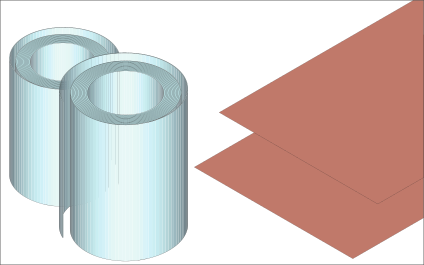
Figure 107. Zinc and copper roof coverings are supplied in sheets or coils.
Applicable Standards for Zinc
Zinc for roof covering purposes is subject to the following European standards:
- DS/EN 988, Zinc and zinc alloys. Specification for rolled flat products for building (Danish Standards, 1996).
- DS/EN 506, Roofing products of metal sheet – Specification for self-supporting products of copper or zinc sheet (Danish Standards, 2008).
Specific qualities of zinc:
- Density: 7200 kg/m3
- Melting point: 418 °C
- Expansion coefficient: 0.022 mm/(m °C)
- Can be soft-soldered
5.6.2 Copper
Copper for roof covering purposes is made from almost (99.9%) pure copper. During manufacture, the copper is cast and roll-formed into sheets or coils (rolls). These are normally 1 metre wide and 0.6 or 0.7 mm thick.
The copper is oxidised, giving it a green surface of alkaline copper carbonate. In areas with a high concentrations of sulphur in the air, copper tends to turn black.
Applicable Standards for Copper
Copper for roof covering purposes is subject to the standard DS/EN 1172, Copper and copper alloys – Sheet and strip for building purposes (Danish Standards, 2012f).
Specific qualities of copper:
- Density: 8900 kg/ m3
- Melting point: 1083 °C
- Expansion coefficient: 0,017 mm/(m °C).
- Can be soft-soldered, hard-soldered, and welded
5.6.3 Constructing Zinc and Copper Roofs
The roof pitch for seamed zinc or copper roofs is min. 5 °. However, roof pitches below 15 ° or roofs in exposed locations require certain precautionary measures to prevent water ingress (e.g., sealant applied in seamed joints and carefully executed and positioned flashings). Some zinc manufacturers allow the use of zinc down to a 3 ° pitch. This requires careful observation of manufacturer instructions. For shallow pitches special attention must be given to waterproofing details, particularly valleys.
A zinc or copper roof covering is normally installed on a supporting structure of wooden rafters such as attic trusses or lattice trusses.
Apart from the actual zinc and copper covering, the following elements are used in the roof assembly:
- Underlayment (if required)
- Spacer bars (if roofing underlayment is used)
- Underlay of wood boards, sheeting, or thermal insulation
- Structured matting (if wood board or thermal insulation underlayment is used)
- Seam clips and nails for fixing and a seam sealant (if required)
Furthermore, exposed locations will require the application of seam sealant to avoid water ingress.
Zinc and copper must be installed on a plane and vented decking. A pH-neutral underlayment should be used.
Zinc or copper roofs are normally installed in vented roof assemblies with wood board or sheeting underlayments. The installation can be made with or without structured matting, depending on the underlayment and roof pitch. Roof assemblies with a covering of zinc or copper should be vented as specified in Section 2.3, Roof Ventilation. For pitched roofs (i.e., pitches steeper than 10 °) vent openings are made along the eaves as well as the ridge.
Battens or Rough Wood Board Underlayments
Zinc and copper can be installed directly on a rough board underlayment of fir or Norway spruce. Boards of wood species with a pH value less than 5 or above 8 (e.g., oak, cedar, or damp pressure-impregnated wood) are unsuitable as zinc underlay. Wood species should also be considered for details (e.g., drip edges, where the zinc might come into contact with these wood species). By contrast, copper is used extensively as flashing material for cedar wood claddings.
Rough boards are spaced at 5–10 mm and must be robust enough be walk-proof. According to TRÆ-rapport 09 (WOOD report 09) (Træinformation, 2015b), rough wood boards can be installed with a maximum c.t.c. span of max.:
- 0.6 metre for boards measuring 23 × 115 mm
- 0.8 metre for boards measuring 25 × 125 mm
- 1 metre for boards measuring 28 × 125 mm
If the span between rafters is too big, an intermediate support in the form of a strut or a purlin plate can be inserted. The boards must be full-edged without loose knots. The rough battens are installed horizontally on the roof. The wood moisture content of the boards must be maximum 18% and they must be protected against moisture by covering them up until the zinc or copper covering can be installed.
If, for practical reasons, it is expedient to use a roofing underlayment in connection with a rough wood board underlayment (e.g., to protect the assembly during construction) the underlayment must be installed underneath the boards, so that moisture from the back of the zinc can still escape through the boards.
Figures 108–112 are examples of zinc or copper roof covering structures.
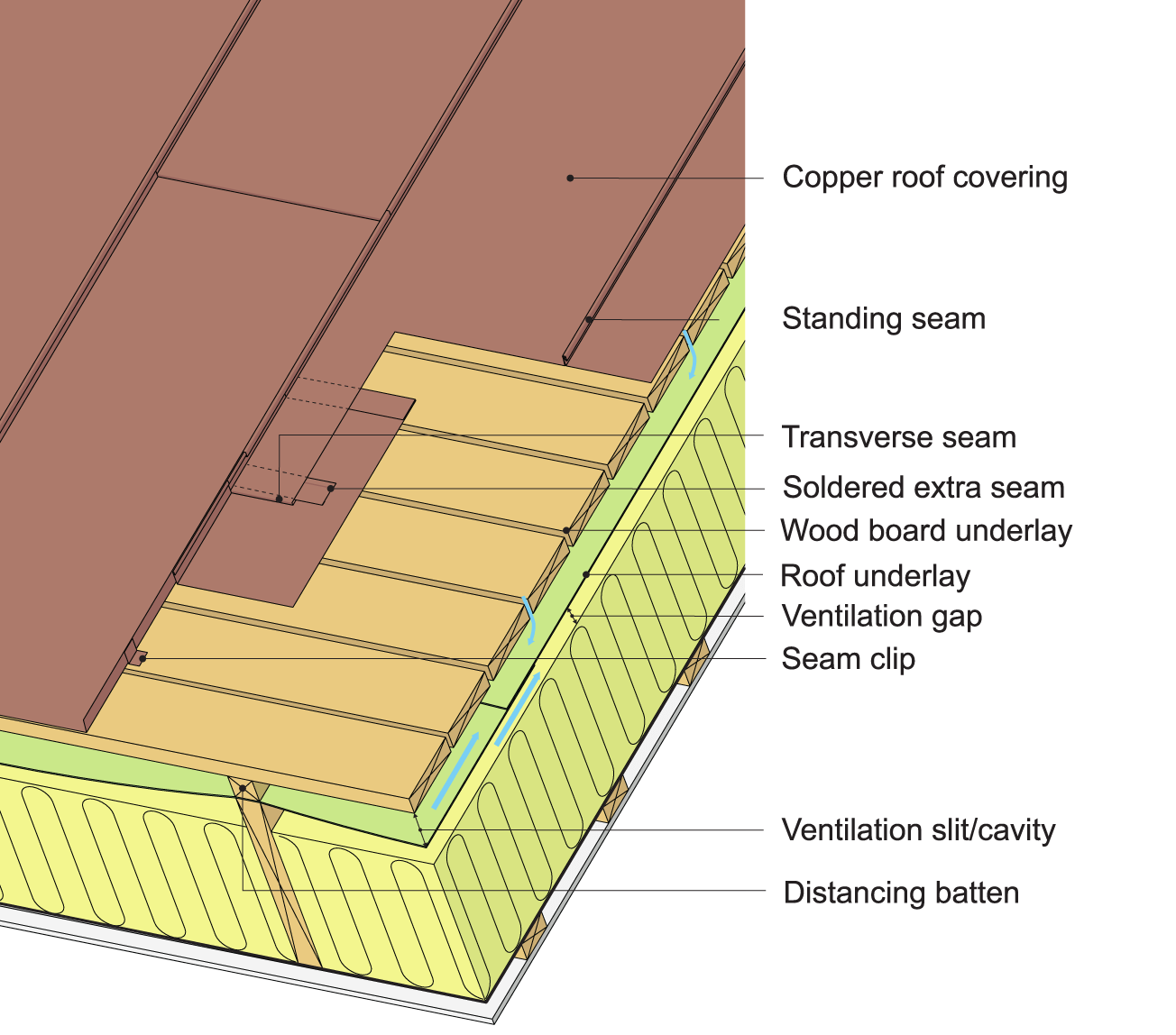
Figure 108. An example of copper (or zinc) roof covering installed directly on a wood board underlayment in a vented assembly with a vapour-impermeable roll-material roofing underlayment. Roofing underlayment can also be executed as a firm or a vapour-permeable underlayment. In this example, there is a vent space between the wood board underlayment and the roofing underlayment, ensuring that any condensate can dissipate. Furthermore, this example shows a cross welt which will absorb expansion in the metal lengths (see Figure 116).
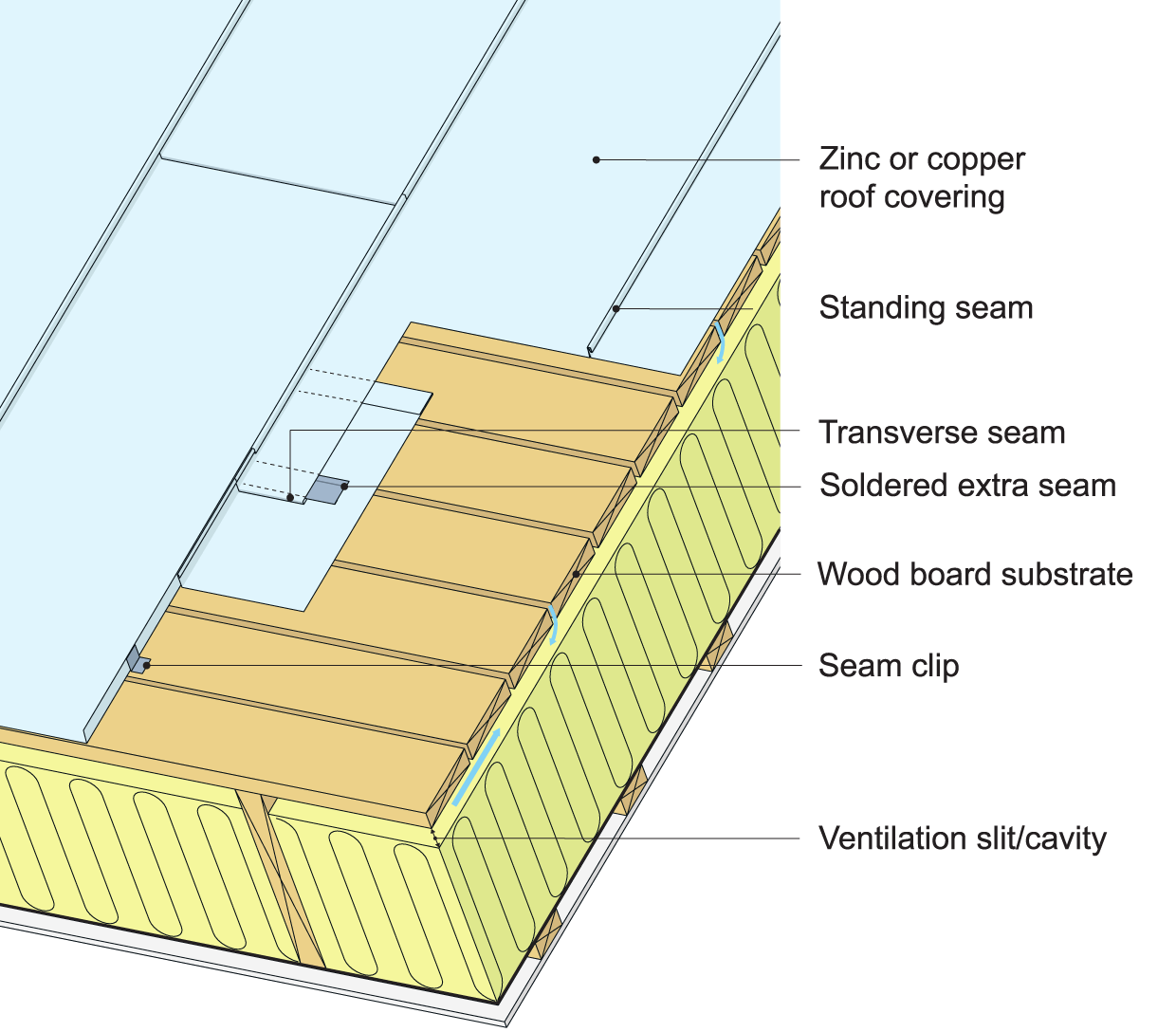
Figure 109. Example of zinc (or copper) roof covering installed directly on wood board underlay in vented roof construction without underlayment. In this example, there is a vent space between the board underlay and the thermal insulation ensuring that any condensate can dissipate. The example shows a cross welt, which will absorb the expansion in the metal lengths (see Figure 116).
Sheeting Underlay
For zinc and copper roofs on a fully covering underlay (e.g., plywood, thermal insulation materials, or tongue-and-groove boards) structured matting must be laid between the underlay and the zinc or copper roof covering (see Figure 110).
Zinc is available with a coated or lacquered backside. If this is used, structured matting can sometimes be left out (cf. manufacturer instructions).
For a seamed roof with a low pitch or for exposed locations, we recommend that the structured matting is laid on a watertight underlay (e.g., a roofing membrane).
Examples of zinc or copper roof covering structures with structured matting are shown in Figures 111 and 112.

Figure 110. Examples of different structured matting designs. The purpose of structured matting is to allow oxygen access to the underside of the metal roof covering and thus to allow condensate to escape.
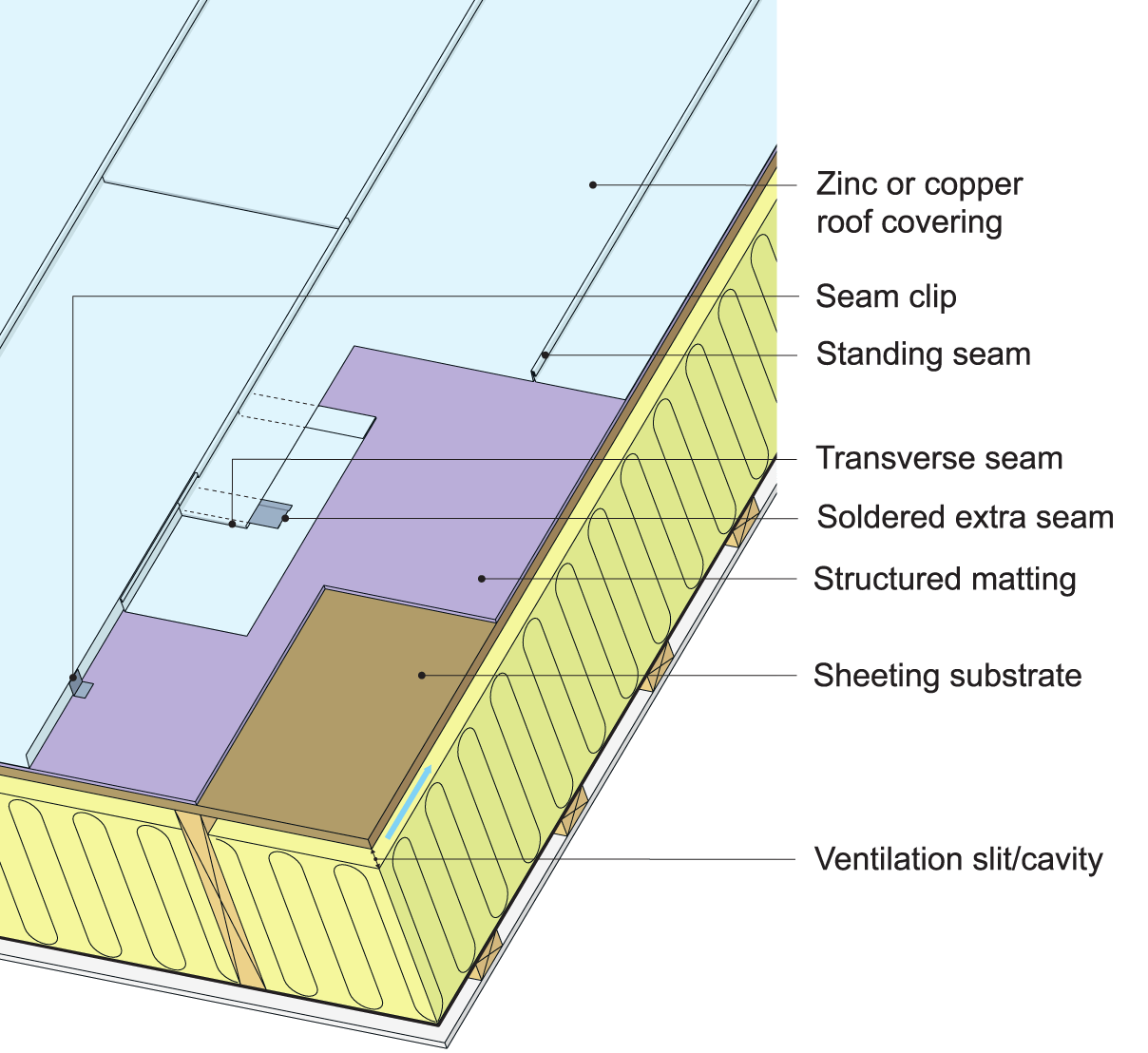
Figure 111. An example of zinc or copper roof covering on a vented roof assembly with plywood decking. Roofing underlayment with structured matting has been laid between the plywood and zinc, partly to allow oxygen access to the underside of the metal roof covering and partly to allow condensate to escape. The example shows a cross welt, which will absorb the expansion in the metal lengths (see Figure 116).
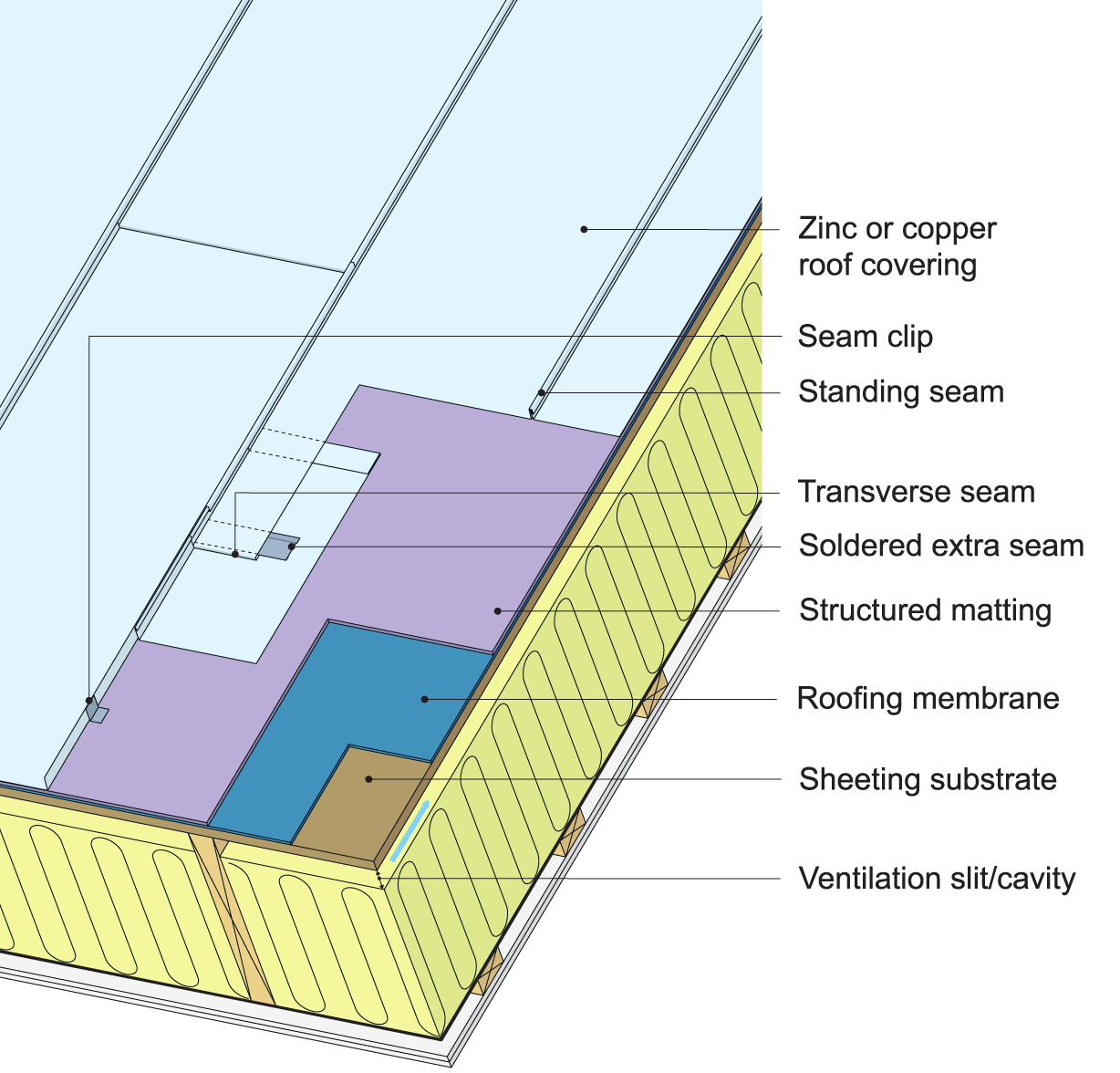
Figure 112. An example of zinc or copper roof covering on a vented roof assembly. Plywood roofing underlay with roofing membrane normally used for shallow-pitch roofs. Between the roofing membrane and the zinc, structured matting is laid, partly to allow oxygen access to the underside of the metal roof covering and partly to allow condensate to escape. The example shows a cross welt, which will absorb the expansion in the metal lengths (see Figure 116).
5.6.4 Installing Zinc and Copper Roofs
The zinc or copper lengths are fixed to the underlay using seam clips (see Figure 113). The seam clips are fixed to the underlay using annular ring nails or screws according to applicable standards or static calculations. Longitudinal joints are usually double-lock standing seams. Thus, metal lengths are fixed to the seam clip.
The expansion coefficient for copper and zinc is significant, which must be factored into the design to avoid damaging the metal or to avoid buckling of the zinc due to expansion. For this reason, two types of clips are used: fixed clips and sliding clips. Fixed clips are used for fixed roofs while sliding clips are designed to absorb thermal movement (i.e., they allow movement in the metal lengths across the roof plane).
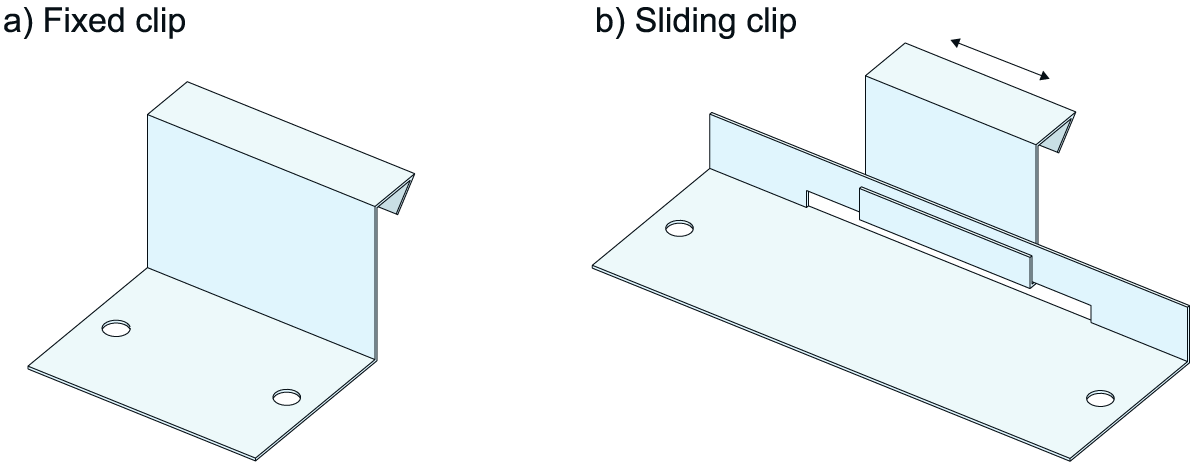
Figure 113. Examples of clips for fixing metal roof coverings. The height of the clips is relative to whether a board underlay or an underlay including structured matting is used.
- Fixed clip fixing the metal lengths.
- Sliding clip, allowing movement of the metal lengths due to dimensional changes resulting from thermal fluctuations.
The coefficient for the lengthwise expansion of zinc is 0.022 mm/(m °C). This means that for every degree the temperature changes, the zinc lengths will extend by 0.022 mm per metre. Thus, a 10 m metal roofing length will extend by 0.22 mm for every degree it is heated. With an applicable temperature span of approx. 100 °C (from approx. – 20 °C to + 80 °C), a metal length of 10 m will incur a total thermal movement of
0.22 mm/°C × 100 °C = 22 mm.
Accordingly, a combination of fixed and sliding clips are used for roofs with standing double-lock seams, which are fitted to allow the absorption of long metal runs. Fixed clips secure the metal lengths at a pre-calculated spot – called the fixing zone, where it is expedient to lock the metal length depending on the size and pitch of the roof. The fixing zone should be between 1 and 2 metres long. Sliding clips are used for free longitudinal expansion.
A sliding clip with a 50 mm slot can absorb an expansion corresponding to a roofing length of max. 8 metres. A sliding clip with a 70 mm slot can absorb an expansion corresponding to a roofing length of max. 16 metres. Special sliding clips allowing greater movement are available for longer roofing lengths.
Longitudinal joints between lengths are made with standing double-lock seams where the metal is folded over the clips. This assembly may include sealant (see Figure 114).
Transverse joints between lengths are made with cross welts (as shown in Figure 115). Where the joint is required to absorb thermal movement, a single lock cross welt with a soldered continuous cleat is used (see Figure 116).
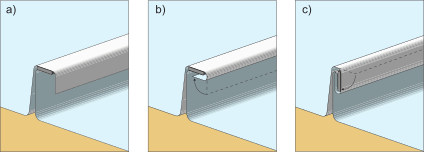
Figure 114. Schematic showing a longitudinal joint between zinc lengths executed as double-lock standing seam (c).
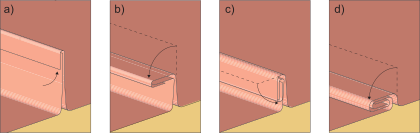
Figure 115. Schematic showing a transverse joint between copper lengths executed as a double-lock cross welt (interlocking seam) (d).
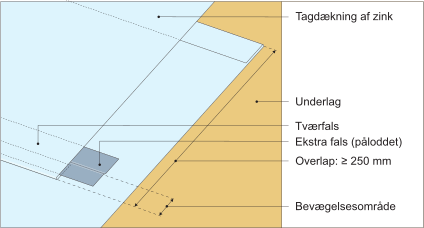
Figure 116. A transverse joint between zinc lengths executed as a single-lock cross welt with a soldered continuous cleat to accommodate dimensional changes. Cross welts require a certain roof pitch in order to be weathertight. The cross welt shown requires a roof pitch above 10 °.
5.6.4 Details – Zinc and Copper
This section describes examples of typical detailing used in roof coverings of seamed lengths of copper or zinc. The examples apply to both materials. Manufacturer installation manuals should be consulted for further information about specific products.
In the design of roof details, it is necessary to take general guidelines for several issues into account (e.g., guidelines concerning ventilation and Building Regulations for fire safety and thermal insulation). General issues concerning the choice of roof are outlined in Section 1.1, Roof Design.
For further examples of roof detail design, see Section 6, Dormers, roof lights, and skylights, Section 7, Flashings – Penetrations and Intersections, and Section 9, List of Examples.
Eaves
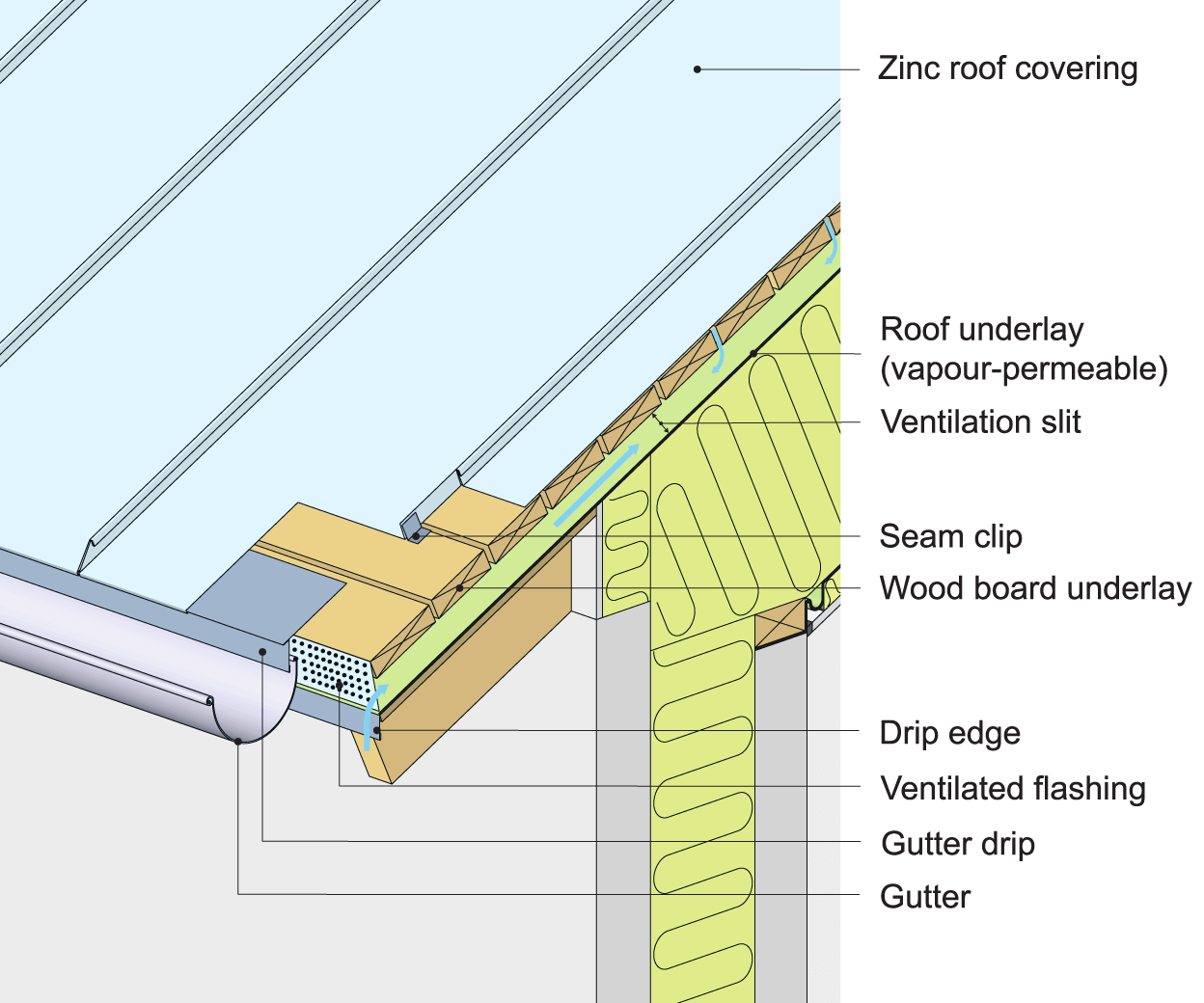
Figure 117. An example eave design for a zinc roof covering on wood board underlay with back-of-gutter ventilation via vented flashing (see Figure 118).
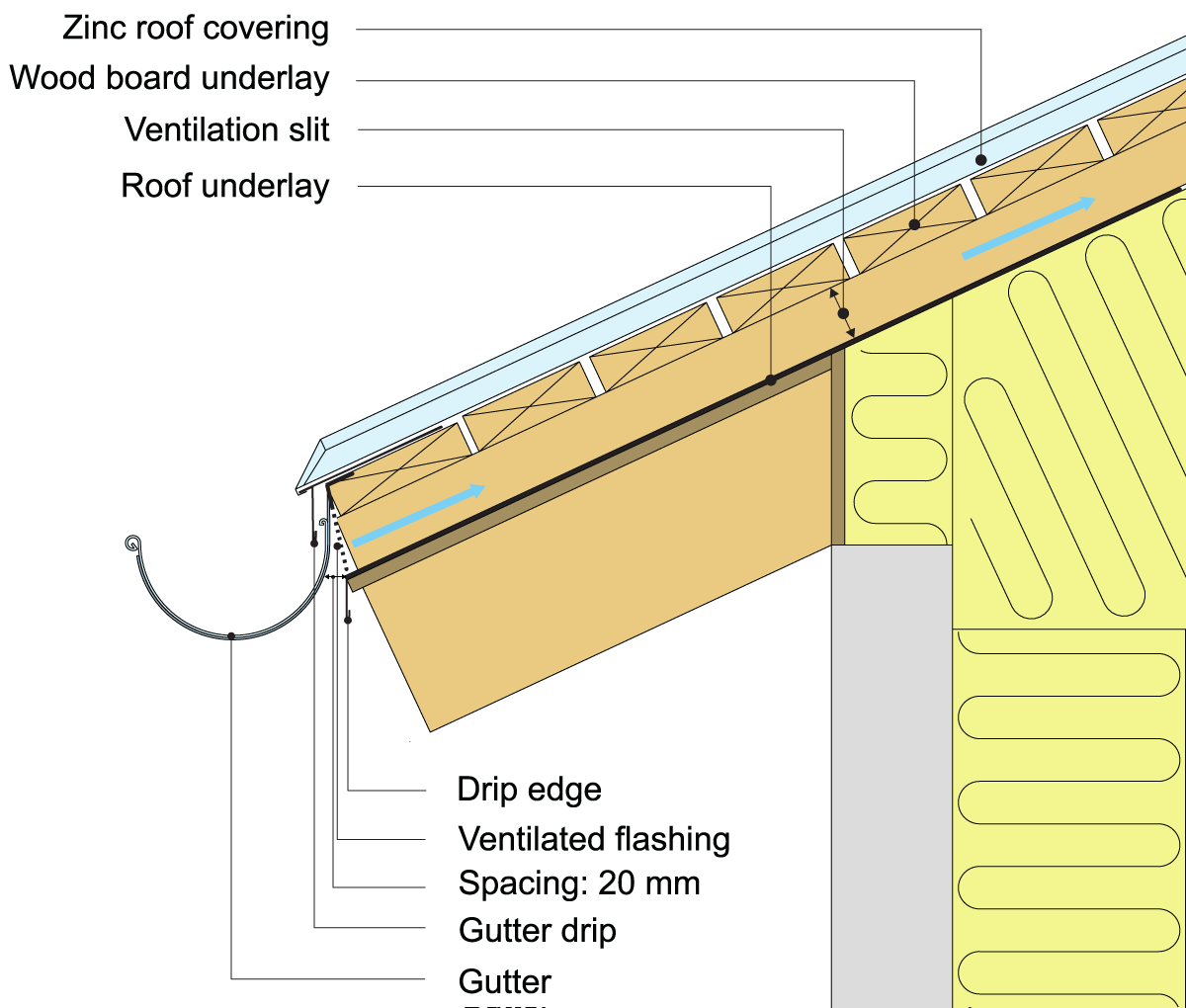
Figure 118. A cross section of the eaves on a roof assembly with zinc roof covering direct on wood board underlay. There is under-board ventilation. This example includes a vapour-permeable underlayment below the vent space. The vent opening is located behind the gutter as a vented flashing in the form of a perforated sheet. There must be at least 20 mm free space behind the gutter to ensure ventilation air intake (see Figure 119).
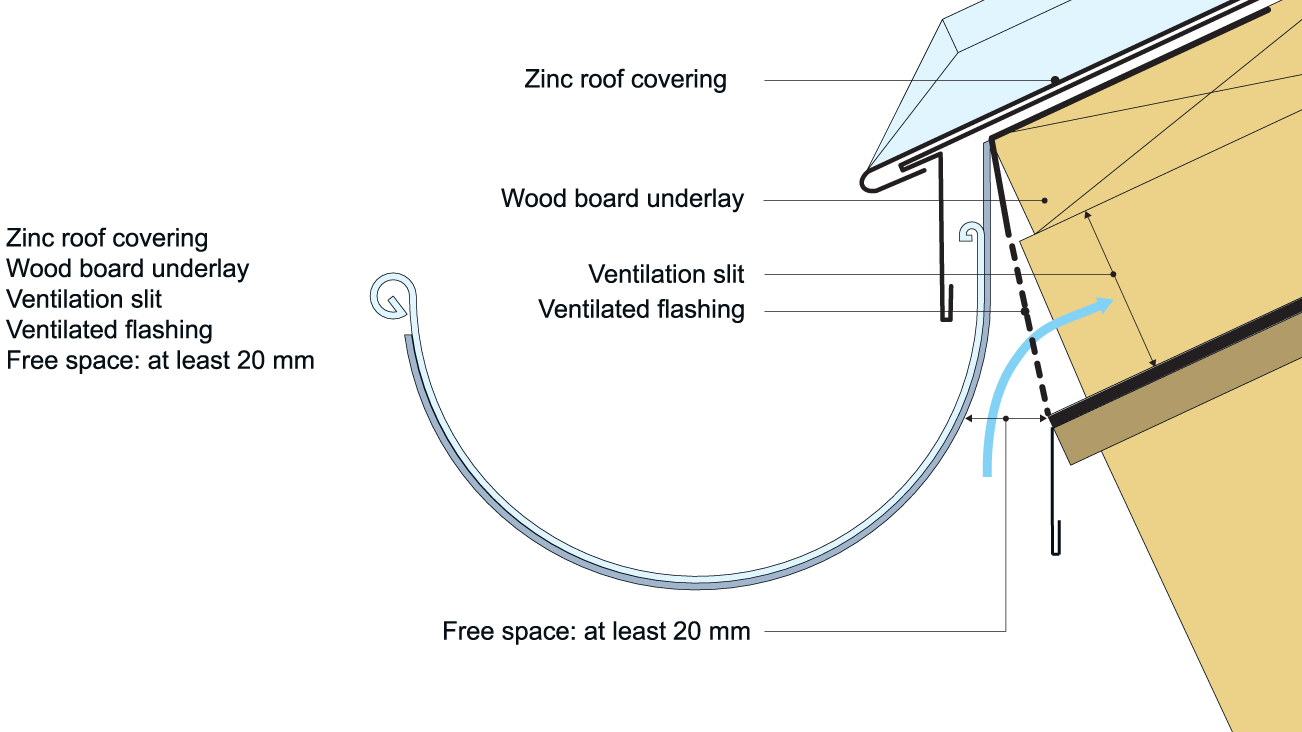
Figure 119. Example eave details with a vent opening behind the gutter. Vented flashing is included in the form of perforated sheeting. There must be at least 20 mm of free space behind the gutter to ensure ventilation air intake.
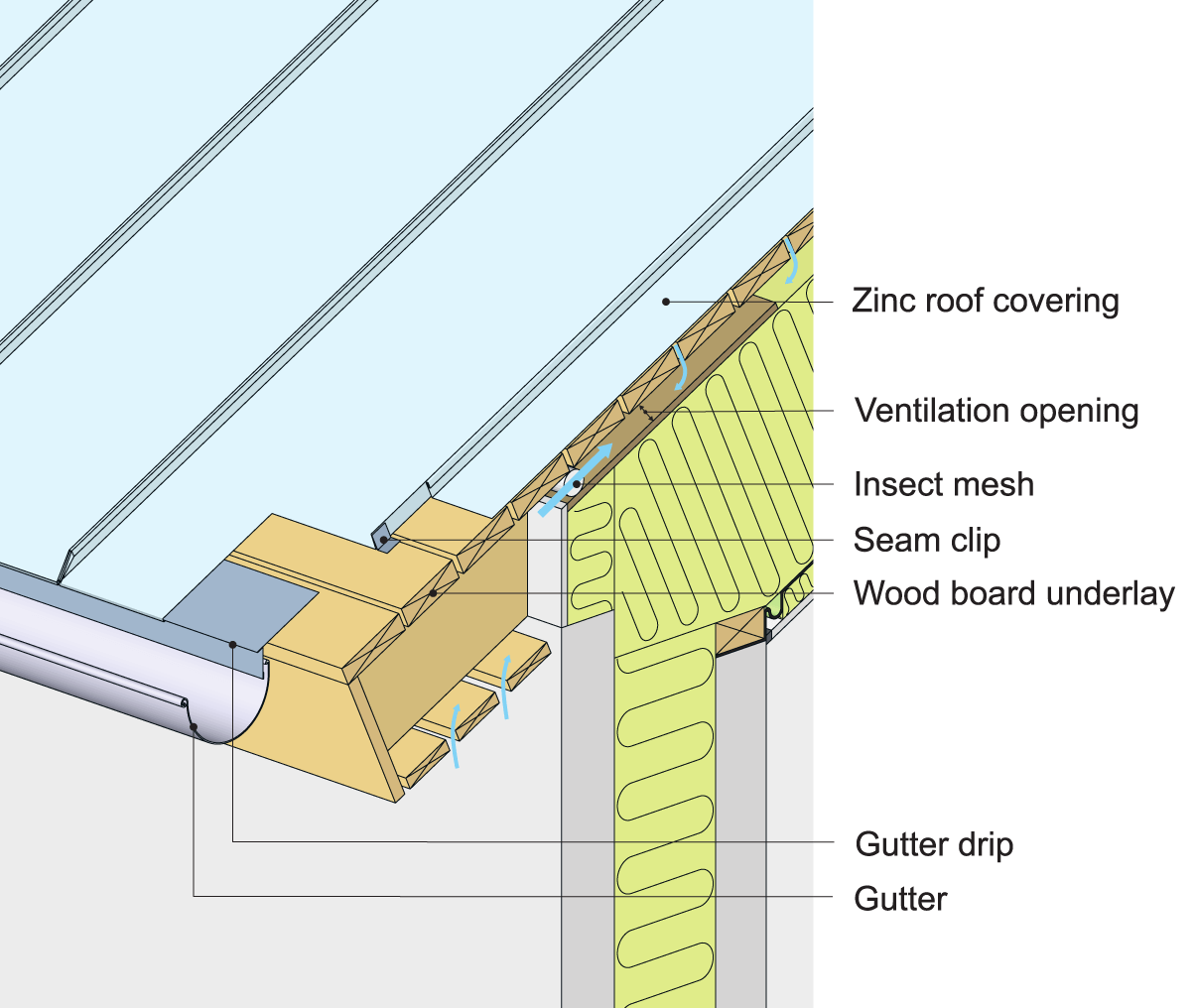
Figure 120. Example of eave design for zinc roof covering directly on wood board underlay with soffit ventilation (see Figure 121).

Figure 121. An example eave design for zinc roof covering on wood board underlay. The example shows eaves with soffit ventilation. An insect mesh has been fitted across the vent opening. Alternatively, the insect mesh can be fitted across the soffit boards.
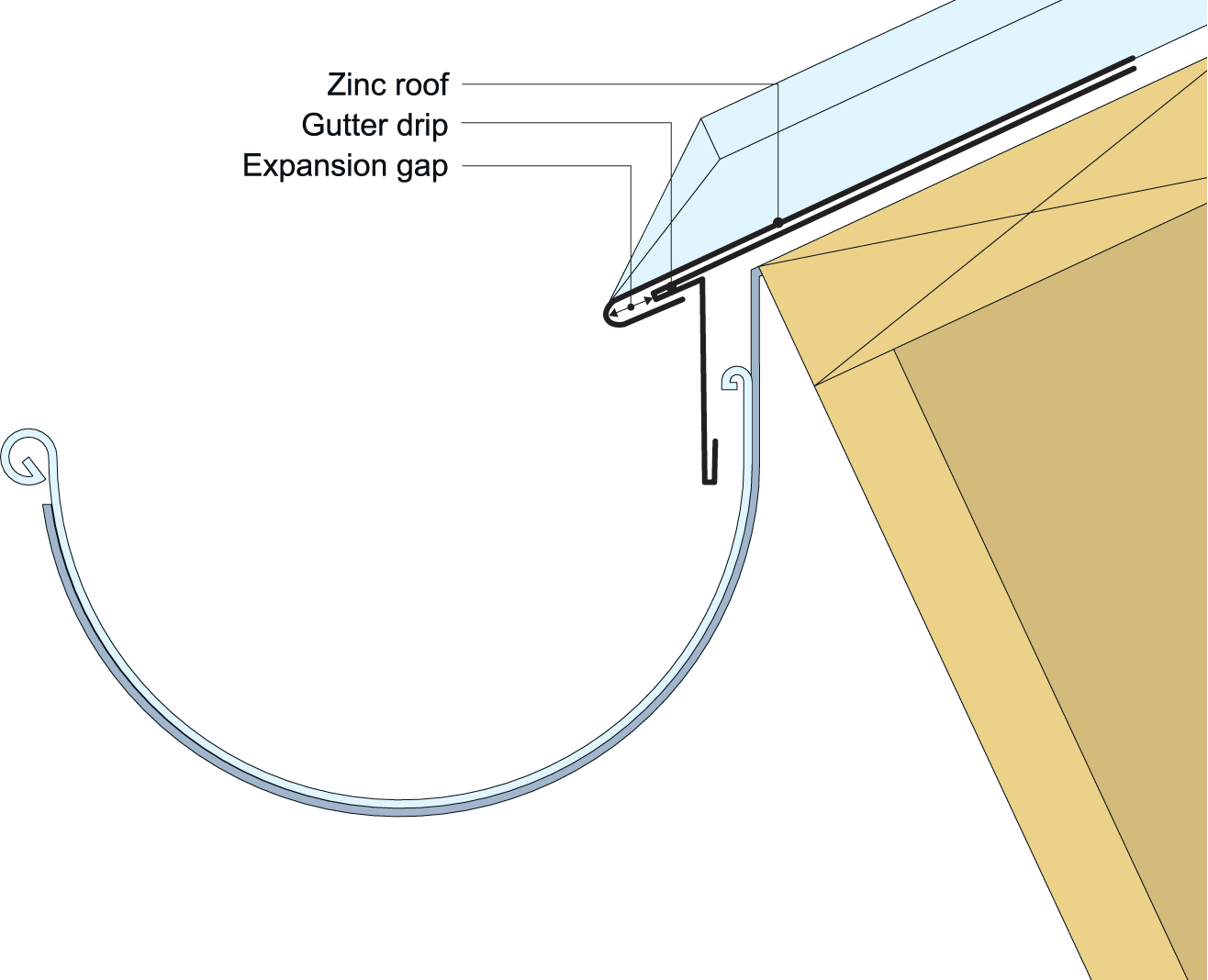
Figure 122. An example of eave details. When terminating the lengths at the eaves, a thermal expansion gap must be inserted. Soffit ventilation is not shown.
Ridge
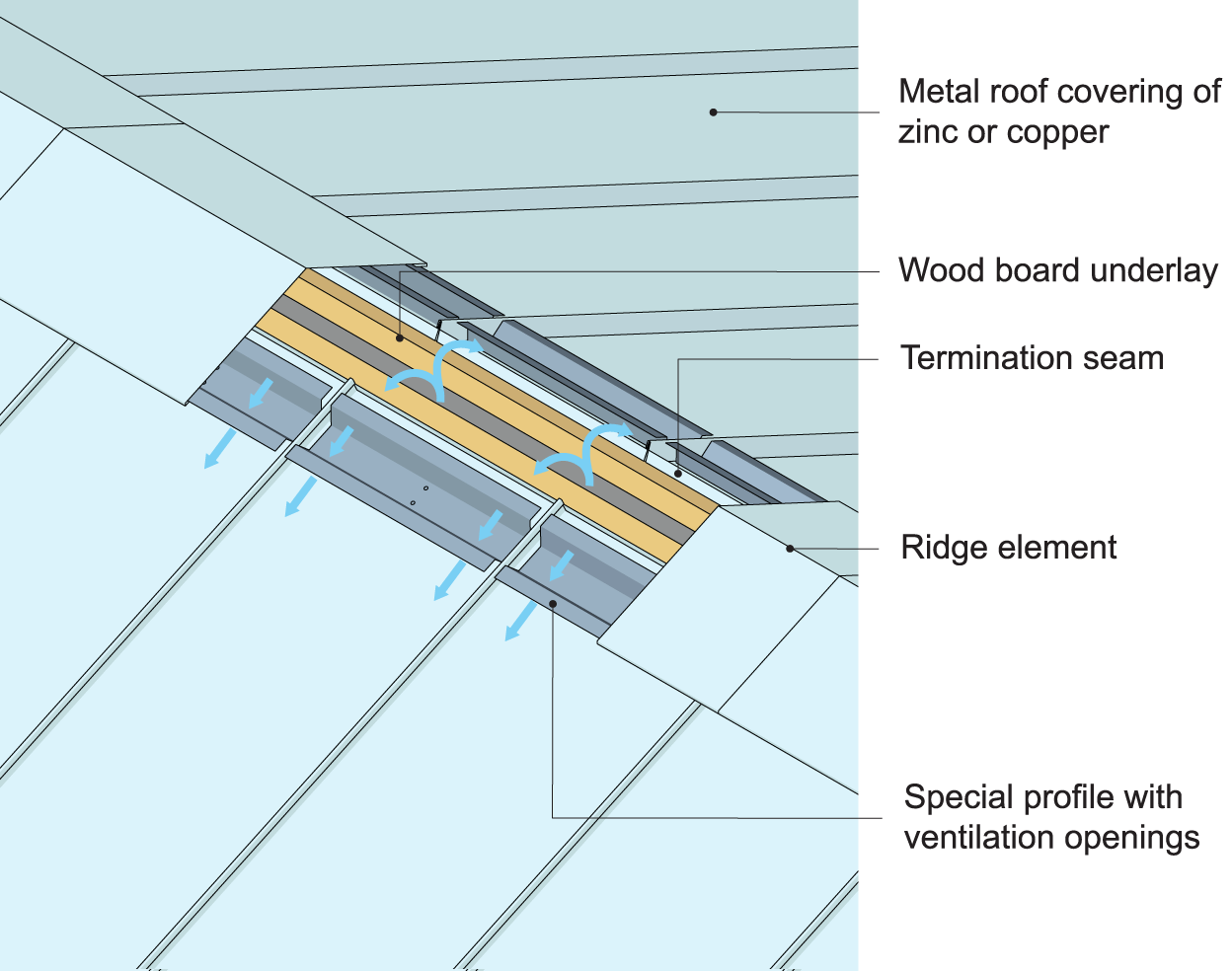
Figure 123. An example of a ridge in a vented roof assembly with a zinc or copper roof covering. Ventilation below the ridge element is facilitated through a special perforated profile, which also fixes the ridge element. When fixing the special profile, expansion gaps must be fitted to allow for longitudinal and transverse thermal movement of zinc lengths (see Figure 124).
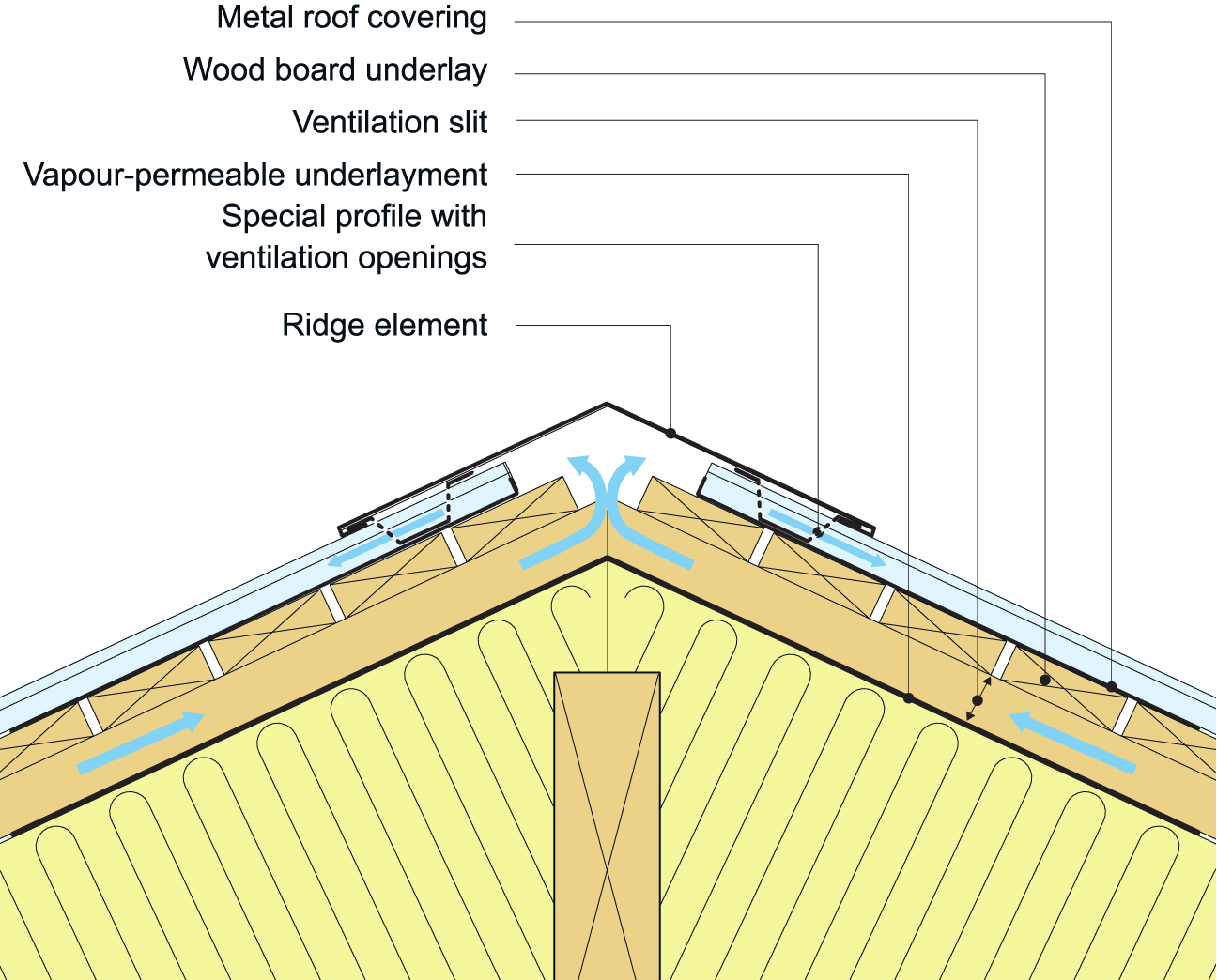
Figure 124. A cross section of a ridge in a zinc or copper roof with a vent opening below the roof covering via special profiles. These also fix the ridge element. When fixing the special profile, it may be necessary to allow for longitudinal and transverse thermal expansion of zinc lengths. This figure shows a solution including vapour-permeable underlayment (see Figure 123).
Large Penetration
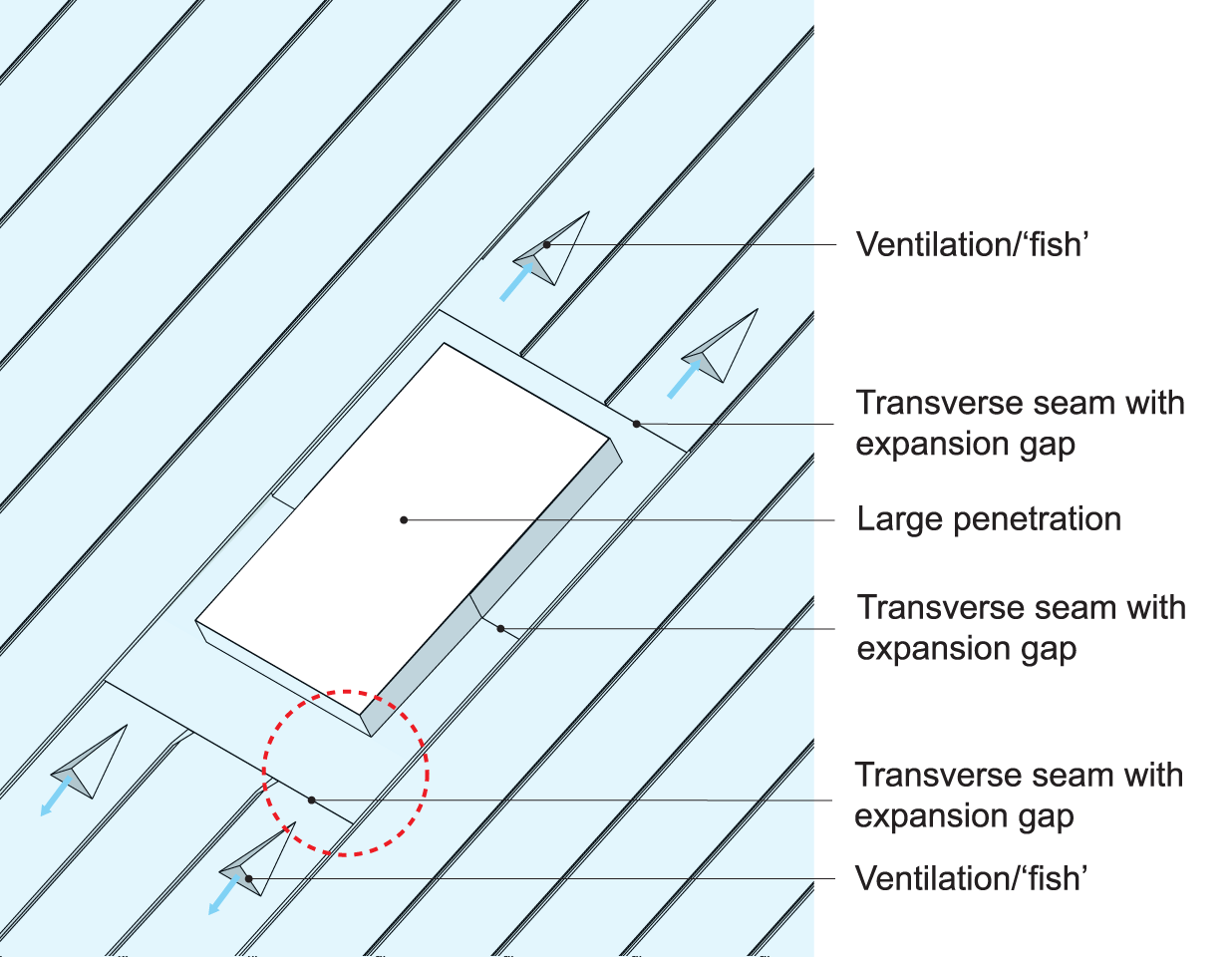
Figure 125. An example of the positioning of vent tiles in zinc roof below and above large penetration (e.g., a roof light). The expansion is secured by placing cross welts with expansion gaps above, below, and along the centre of the penetration (see Figures 126–128).
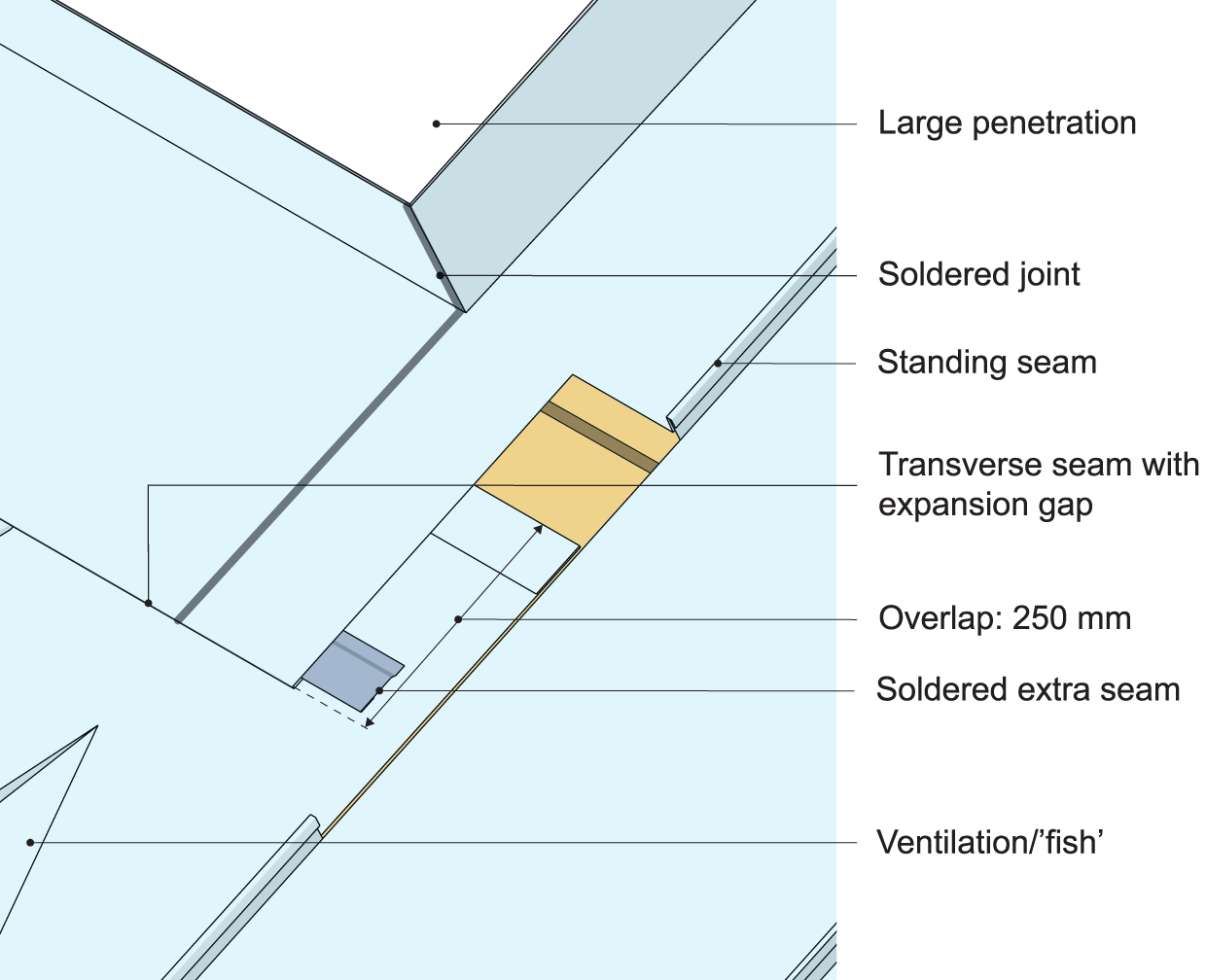
Figure 126. An example of a cross welt design with an expansion gap below a large penetration (detail marked with a red circle in Figure 125). The zinc flashing is placed directly onto the wood board underlay.
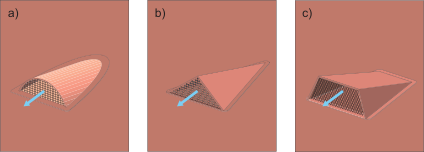
Figure 127. Examples of vent cowl designs for copper and zinc roofs (see Figures 125 and 128).

Figure 128. An example of a vent cowl in copper or zinc roof with approx. 15 mm kerb to safeguard against the ingress of drifting snow and driving rain (see Figures 125 and 127).
5.7 Roofing Membranes
Roofing membranes are marketed as bituminous felt or roofing foils. Both types come in a variety of forms. Roofing membranes are normally supplied in roll form and available in several widths. Some roofing foils can, be customised to some extent (for small roofs).
In the case of both roofing felt and foil, there is a comprehensive array of ancillary products in the form of roof outlets, flashing termination bars, and vent openings (e.g., vent cowls or double ridge elements, and caps). Weathertightness in membrane roofs is achieved using materials which, besides being watertight themselves, can be joined with watertight joints. Hence, roofing membranes can be used for shallow-pitch roofs without the risk of ingress of driving rain and drifting snow in the finished roof covering. Roofing membranes require continuous, walk-proof substrates, as membranes require full support. This can be in the form of concrete, wood boards, plywood sheets, OSB sheets or (walk-proof) thermal insulation material (see Section 5.7.4, Constructing a Membrane Roof).
Roofing membranes are also used as waterproof membranes in green roofs and duo-roofs, see Section 5.11, Green Roofs.
Roofs with a roofing membrane installed on a wood board or plywood/OSB decking belong to the category of light-weight roofs (see Section 5.1.3, Roof Pitch and Areal Weight).
The lifespan for roofing membranes depends on the roof covering material as well as the roof assembly. The pitch is critical for the length of time the roof covering is likely to be exposed to moisture and whether, for directly exposed roofing membranes, there is a risk of dirt accumulating on the roof surface (e.g., in depressions on flat roofs). When used in warm-roof assemblies, the roofing membrane will generally be exposed to higher temperatures whereas it will be exposed to moisture for longer periods of time when used in green roofs. All the issues mentioned here may contribute to reducing the lifespan if the membrane material is unsuitable for a specific purpose.
Membranes are relatively thin, and documentation should be available which verifies their resistance to knocks and impact (i.e., their risk of puncture). Likewise, documentation should be available on how alterations or repairs should be carried out if membranes are damaged.
Impartial documentation of essential properties should be obtained prior to using new membrane materials.
Fire-Rating Roofing Membranes
Roofing membranes are flammable and therefore require documentation by testing, unless covered with either a 50 mm layer of gravel or a 30 mm screed layer (e.g., in concrete, or with 40-mm-thick slabs). Roofing membranes must only be used if the system (underlay and roofing membrane) is classified as BROOF(t2) (cf. Bygningsreglementets Bygningsreglementets vejledning til kapitel 5 – brand (Guidelines in the Building Regulations for Chapter 5 – Fire)) (The Danish Transport, Construction and Housing Authority, 2018).
Testing of bituminous felt and roofing foil is conducted according to method 2 in DS/CEN/TS 1187, Test methods for external fire exposure to roofs (Danish Standards, 2012e), where the roof covering is tested on three standard substrates (chipboard, mineral wool, or polystyrene) or on the substrate in question.
Following a successful test, a classification according to DS/EN 13501-5 (Danish Standards, 2016d) is issued where the roof covering is classified on a substrate like the one used with a density down to min. 75% of the one used in the test. If the roof covering passes with a substrate of polystyrene, the classification applies to all substrates with a higher density. The fire performance of roofing membranes can be enhanced by adding fire retardant, glass reinforcement, or by altering the material composition.
5.7.1 Bituminous Felt
Bituminous felt is a bitumen-based membrane intended for roof covering in one or two layers.
The term bituminous felt stems from the way the material was originally made. Bitumen consists of viscous crude oils which are gradually plasticised through heating. There are several different subgroups of bituminous felt relative to the intended application (with rooting inhibitors for use in green roofs) (see Section 5.11, Green Roofs).
Today, bituminous felt is manufactured with a polyester base (reinforcement), or a combination of polyester and glass felt, and a modified bitumen coating on both sides of the base. So-called oxidised bitumen used to be used, but it has inferior properties and should no longer be used as top felt.
The bituminous felt is reinforced for strength and dimensional stability. Polyester felt is particularly strong and has good elongation at fracture but limited dimensional stability. Glass felt has good dimensional stability but has limited strength and a modest elongation at fracture of 2–4%. In some cases, a combination of polyester felt and glass felt is used as reinforcement, often in two independent reinforcement layers of polyester felt and fibre glass. This achieves a combination of the best qualities of both materials, including dimensional stability. Glass felt reinforcement is especially useful for assemblies requiring superior fire performance.
Bitumen is gradually broken down by ultraviolet (UV) light from the sun. To reduce deterioration, the surface is protected by a layer of slate shingle, or similar covering, combined with modified bitumen (e.g., APP, which is more resistant to UV light).
Bituminous felt is usually supplied in rolls 1 metre wide and 7–8 metres long. The thickness of bituminous felt varies between 2–3 mm for underfelt and 4–6 mm for top felt and single-layer linings.
Types of Bituminous Felt
At present, there are two main types of bituminous felt, both of which use polymer-modified bitumen. The two main types are:
- SBS-modified bituminous felt. This type of bituminous felt is manufactured with bitumen modified by adding styrene-butadiene-styrene (SBS), which gives the finished product elastomeric properties. SBS-modified bituminous felt, therefore, has a degree of elasticity, enabling it to regain its original shape following minor deformation. Normally, 10–15 percent-by-weight SBS is added to the bitumen mixture. The amount added is a major determinant of the properties of the lining. A layer of slate shingle is usually added to bituminous felt made of SBS-modified bitumen to reduce deterioration by UV light.
- APP-modified bituminous felt. This type of bituminous felt is made with bitumen modified by adding atactic polypropylene (APP), giving the finished product plastomeric properties while retaining a degree of elasticity and enabling it to regain its original shape following minor deformation. APP-modified bituminous felt, therefore, may sustain permanent deformations if there is significant movement of the substrate.
To achieve optimal properties, approx. 30% APP should be added to the bitumen mixture. The amount added has a significant bearing on the properties of the lining. APP-modified high-quality bitumen is fairly resistant to UV light and the shingle layer can therefore be dispensed of if, instead, glass felt is used to protect the membrane surface. In this case, the bituminous felt can be executed with a smooth surface. APP-modified bituminous felt without a shingle layer should not be used in conjunction with cleat edge flashings and gutters made of zinc. This is because acidic breakdown products from the bituminous felt will be separated out due to impact from UV light (solar impact).
Applicable Standards for Bituminous Felt
Bituminous felt is subject to the standard DS/EN 13707, Flexible sheets for waterproofing – Reinforced bitumen sheets for roof waterproofing – Definitions and characteristics (Danish Standards, 2013h).
The most important properties for bituminous felt together with the applicable standards for test methods are listed in Table 20.
For products used in green roofs, see Section 5.11, Green roofs. Root-inhibitors must be added, which are subject to testing according to DS/EN 13948, Flexible sheets for waterproofing – Bitumen, plastic and rubber sheets for roof waterproofing – Determination of resistance to root penetration (Danish Standards, 2007e).
Table 20. Overview of test standards for bituminous felt.
Properties | Test Standard | |
|---|---|---|
No. | Title | |
Watertightness | DS/EN 1928 | Flexible sheets for waterproofing – Bitumen, plastic, and rubber sheets for roof waterproofing. Determination of watertightness (Danish Standards, 2000b) |
Dimensional stability | DS/EN 1107-1 | Flexible sheets for waterproofing. Part 1: Bitumen sheets for roof waterproofing. Determination of dimensional stability (Danish Standards, 1999b) |
Tensile strength and elongation at fracture: | DS/EN 12311-1 | Flexible sheets for waterproofing – Part 1: Bitumen sheets for roof waterproofing. Determination of tensile properties (Danish Standards, 1999c) |
Flexibility in cold temperatures before and after ageing | DS/EN 1109 DS/EN 1296 | Flexible sheets for waterproofing – Bitumen sheets for roof waterproofing – Determination of flexibility at low temperature (Danish Standards, 2013i) Flexible sheets for waterproofing – Bitumen, plastic, and rubber sheets for roofing – Method of artificial ageing by long term exposure to elevated temperature (Danish Standards, 2001) |
Strength of joints | DS/EN 12316-1 | Flexible sheets for waterproofing. Part 1: Bitumen sheets for roof waterproofing. Determination of peel resistance of joints (Danish Standards, 1999d) |
DS/EN 12317-1 | Flexible sheets for waterproofing. Part 1: Bitumen sheets for roof waterproofing. Determination of shear resistance of joints (Danish Standards, 1999e) | |
Thermal stability | DS/EN 1110 | Flexible sheets for waterproofing – Bitumen sheets for roof waterproofing – Determination of flow resistance at elevated temperature (Danish Standards, 2011e) |
5.7.2 Roofing Foil
Roofing foils are plastic or rubber membranes intended as single-layer roof coverings.
The chemical composition of roofing foils differs in the basic material, type, and quantity of additives as well as to their reinforcement, which might be made from polyester or glass felt (the latter is normally only used underneath ballasts). Furthermore, their structures vary considerably. Hence, roofing foil properties differ significantly.
The type of roofing foil should be given special consideration in the selection and design phase.
Roofing foils are normally supplied in rolls 1–2 m wide and 15–20 m long. The thickness of roofing foils usually varies between 1.2 and 2 mm. In certain cases, the roofing foil can be customised for the roof in question.
One can distinguish between the two main types of roofing foils based on the materials used:
- Thermoplastics, which, after production have primarily plastic properties, but still retain a degree of elasticity, enabling it to regain its original shape following minor deformation. The most used types of thermoplastics are:
- PVC (polyvinyl chloride), which is a widely used type of roofing foil. PVC includes 30–35% of plasticiser to obtain the desired properties. Plasticisers contribute to the flexibility of the materials and, as such, they positively impact the lifespan of the roofing foil. Furthermore, fire retardants, UV stabilisers, and colour pigments are added. PVC is produced in various subgroups relative to the intended use and fixing method. If PVC is used with bitumen products such as bituminous felt, a migration barrier must be used to avoid deterioration due to the plasticisers migrating from the material. PVC has proven resistant to chemicals.
- TPO (thermoplastic polyolefin) where the foil is produced by combining the materials ethylene and propylene. The finished foil is more flexible than ordinary polypropylene, but not as flexible as PVC. Fire retardant, UV stabilisers, pigment, etc. are added to the foil, but no plasticiser. TPO has a proven resistance to UV light, ozone, and chemical impact.
- Elastomers which have elastic properties (i.e., they are capable, to some extent, to regain their original shape following deformation). The following main types are:
- EPDM (ethylene propylene diene monomer), a collective designation for ethylene-propylene compounds and various diene monomers. Carbon black or activated carbon is added to EPDM to increase its lifespan, but other than that, it contains no additives or plasticisers. EPDM has a proven resistance to UV light and ozone. EPDM is compatible with bituminous products.
- PIB (polyisobutylene) produced from polyisobutylene with a high molecular weight. This foil material has been on the market as roofing foil longest among elastomers. PIB has self-healing edges.
Applicable Standards for Roofing Foil
Roofing foils are subject to the standard DS/EN 13956, Flexible sheets for waterproofing – Plastic and rubber sheets for roof waterproofing – Definitions and characteristics (Danish Standards, 2013l).
The most important properties for roofing foils together with the applicable standards for test methods are listed in Table 21.
Products used in green roofs may require the chemical composition of the products to be changed (see Section 5.11, Green Roofs).
Table 21. Overview of test standards for roofing foils.
Properties | Test Standard | |
|---|---|---|
No. | Title | |
Watertightness: | DS/EN 1928 | Flexible sheets for waterproofing – Bitumen, plastic, and rubber sheets for roof waterproofing. Determination of watertightness (Danish Standards, 2000b) |
Dimensional stability | DS/EN 1107-2 | Flexible sheets for waterproofing – Determination of dimensional stability – Part 2: Plastic and rubber sheets for roof waterproofing (Danish Standards, 2001) |
Tensile strength and elongation at fracture: | DS/EN 12311-1 | Flexible sheets for waterproofing – Part 1: Bitumen sheets for roof waterproofing. Determination of tensile properties (Danish Standards, 1999f) |
Flexibility in cold temperatures before and after ageing | DS/EN 495-5 | Flexible sheets for waterproofing – Determination of foldability at low temperature – Part 5: Plastic and rubber sheets for roof waterproofing (Danish Standards, 2013j) |
Strength of joints | DS/EN 12316-2 | Flexible sheets for waterproofing – Determination of peel resistance of joints – Part 2: Plastic and rubber sheets for roof waterproofing (Danish Standards, 2013k) |
DS/EN 12317-2 | Flexible sheets for waterproofing – Determination of shear resistance of joints – Part 2: Plastic and rubber sheets for roof waterproofing (Danish Standards, 2010a) | |
5.7.3 Roof Slope for Membrane Roofs
Membrane roofs are suitable for both pitched and flat roofs. The slope is important as it reduces the risk of major damage in case of leakages. A well-defined slope will also reduce the accumulation of dirt and foliage on the roof surface, potentially resulting in blockage of roof outlets and ice formation, which may break down lap joints and shingle layers in the case of bituminous felt.
Flat Roof Falls (Slopes < 10 °)
Flat roofs are often installed with a slope as low as 1:40 corresponding to 25 mm/metre. Roofs with low slopes place special demands on design and execution to achieve a well-defined fall across the roof surface. Allowances must be made for any expected deformations of the roof assembly when planning the construction of falls. Special attention must also be given to falls near supporting structures (where angle changes may occur), to the resulting falls near deflections (resulting from dead loads and snow), or as a consequence of any cambering (e.g., from pre-stressed concrete slabs, and in split levels between elements, if any exist) (see Section 5.7.4, Constructing a Membrane Roof).
It is particularly important that roof outlets are positioned at the base of falls. Minor deviations are tolerated in certain cases (areas of up to 10 m2) with the finished falls being only 1:50 corresponding to 20 mm/metre. Furthermore, lower falls are acceptable in valleys (typically 1:100–1:165).
Falls can be integrated in the actual roof structure. In warm roofs the assembly can be constructed with a horizontal upper side and the falls can be constructed using thermal insulation material laid on top of the structure (see Section 1.1.2, Roof Types According to Structure).
When constructing falls on flat roofs, a distinction is normally made between the following methods, see Figure 129:
- Falls towards valleys, either tapered valley firrings with single falls or crickets
- Falls towards box gutter
- Tapered falls
When designing roofs with tapered falls or tapered valley firrings, valleys will occur between the roof surfaces and ridges have falls towards the roof outlet. If the main roof surface slope is 1:40, it is unavoidable that the falls in the valley will be less than 1:40, but the valleys must have falls towards the outlet to discharge rainwater from the roof. A steeper roof surface slope is advantageous as it also produces steeper falls in the valleys, thereby minimising the risk of ponding.
Requirements for discharging rainwater from roofs and recommended slopes are outlined in Section 2.2, Roof Drainage.
All model solutions must ensure that lap joints between lengths of roofing membranes and flashings do not result in elevated areas preventing the correct discharge of rainwater.
For low slopes, there is an increased risk of depressions forming (local depressions or puddles) on the roof surface. Due to installation tolerances, overlap joints of membrane lengths, and flashings, it is virtually impossible to avoid depressions in very low-slope roofs, and their use should be limited as far as possible. Guidelines for acceptable deviations are listed in Table 22.
Table 22. Tolerances for depressions in flat roofs (falls > 1:40) with membranes.
Roof Surface | Valleys and Intersections | Box Gutters | |
|---|---|---|---|
Maximum water depth | 10 mm | 15 mm | 15 mm |
Greatest occurrence of depressions | 1.5 m2 (enkelt lunke) Højst 10 % af tagfladen | 5 m2 (single depression) | 15 % of gutter length |
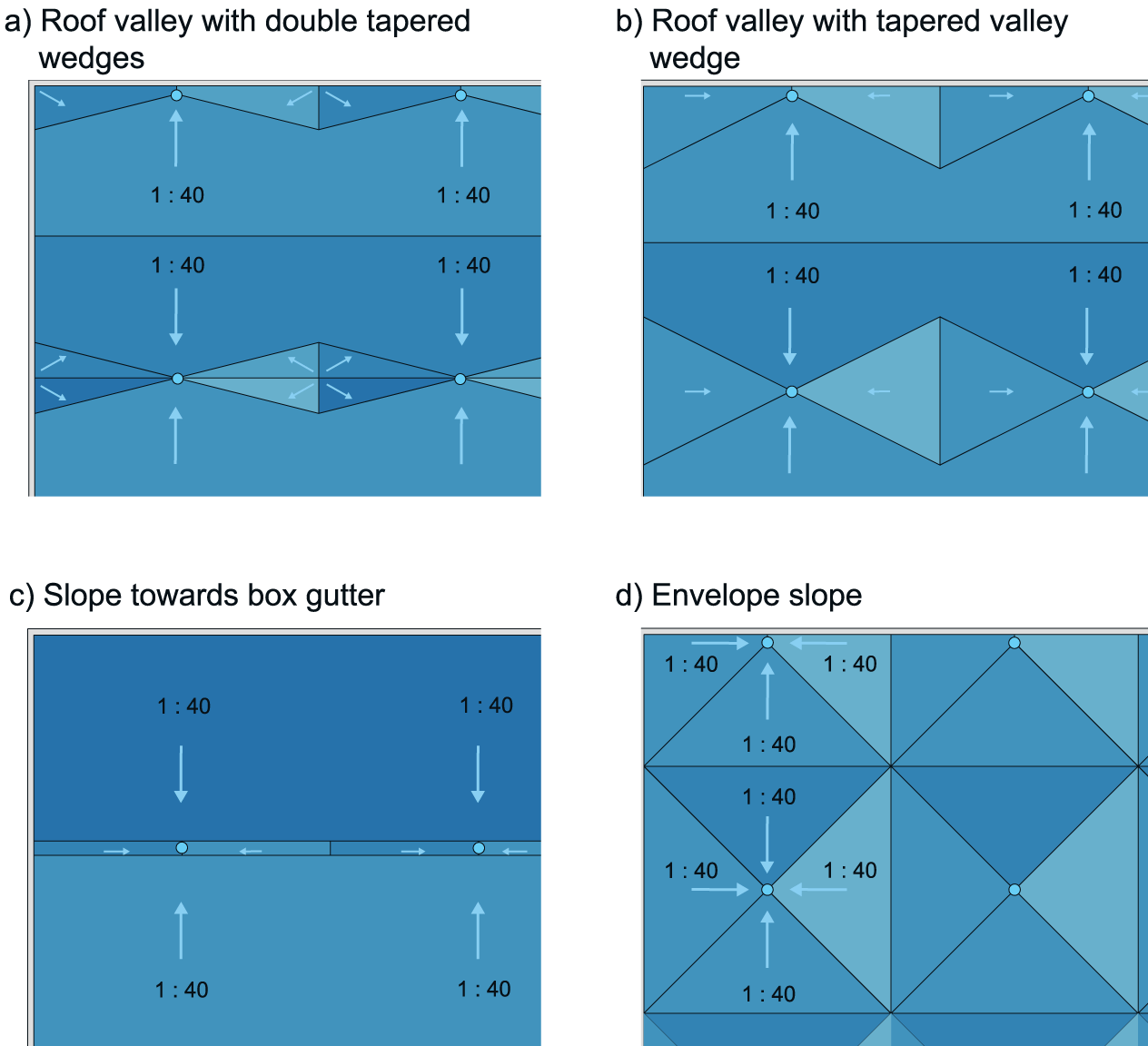
Figure 129. Examples of flat roof fall construction (slope < 10 °) (see Figures 130–133).
- Falls towards roof valley with dual-fall crickets (see Figure 130).
- Falls towards roof valley with single-fall firring (see Figure 131).
- Falls towards box gutter, itself with falls towards a discharge outlet (see Figure 132).
- Tapered falls (see Figure 133).
Falls Towards Valleys
Falls on roof surfaces can be constructed using single-fall firring or dual-fall ridge structures (crickets), which will result in valleys on the roof surface. These valleys must also have falls, to ensure that rainwater can be discharged.
Crickets have falls in two directions (e.g., 1:60 lengthwise and 1:15 crosswise) (see Figure 130). Using these types of ridges in a roof with a surface slope of 1:40 will result in very slight falls in the intersections (typically 1:165).
For single-fall valley firring, the falls provided by the firring are usually half the size of the falls in the slope of the roof surface. For a fall of 1:40, firring with a fall of 1:80 is used (see Figure 131), which results in a reduction of the fall in the intersection. This solution is rarely used but provides greater falls in the intersections and therefore less risk of ponding than the solution using crickets.
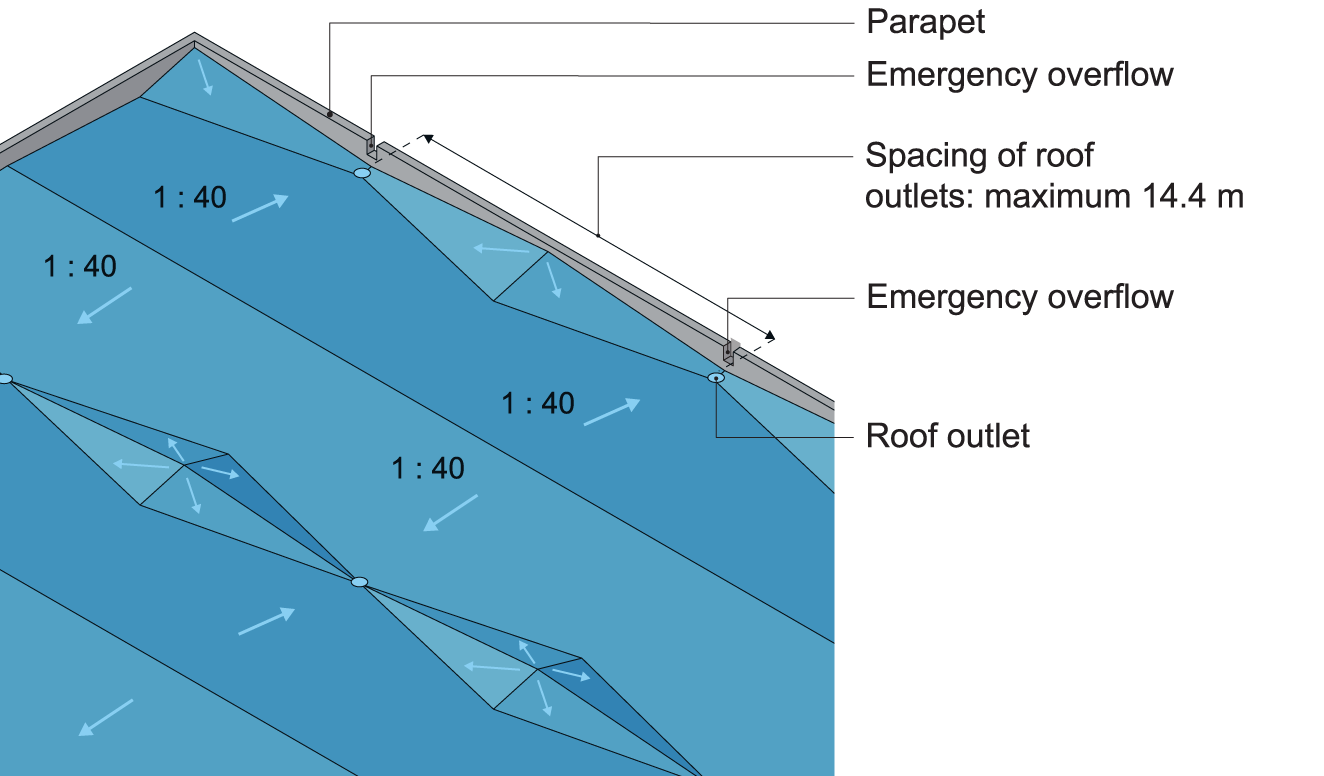
Figure 130. Falls on a flat roof with dual-fall ridges towards valleys (crickets). The main falls of the roof are made using firring with a 1:40 slope towards the valley. Crickets have slight falls, which vary lengthwise and across.
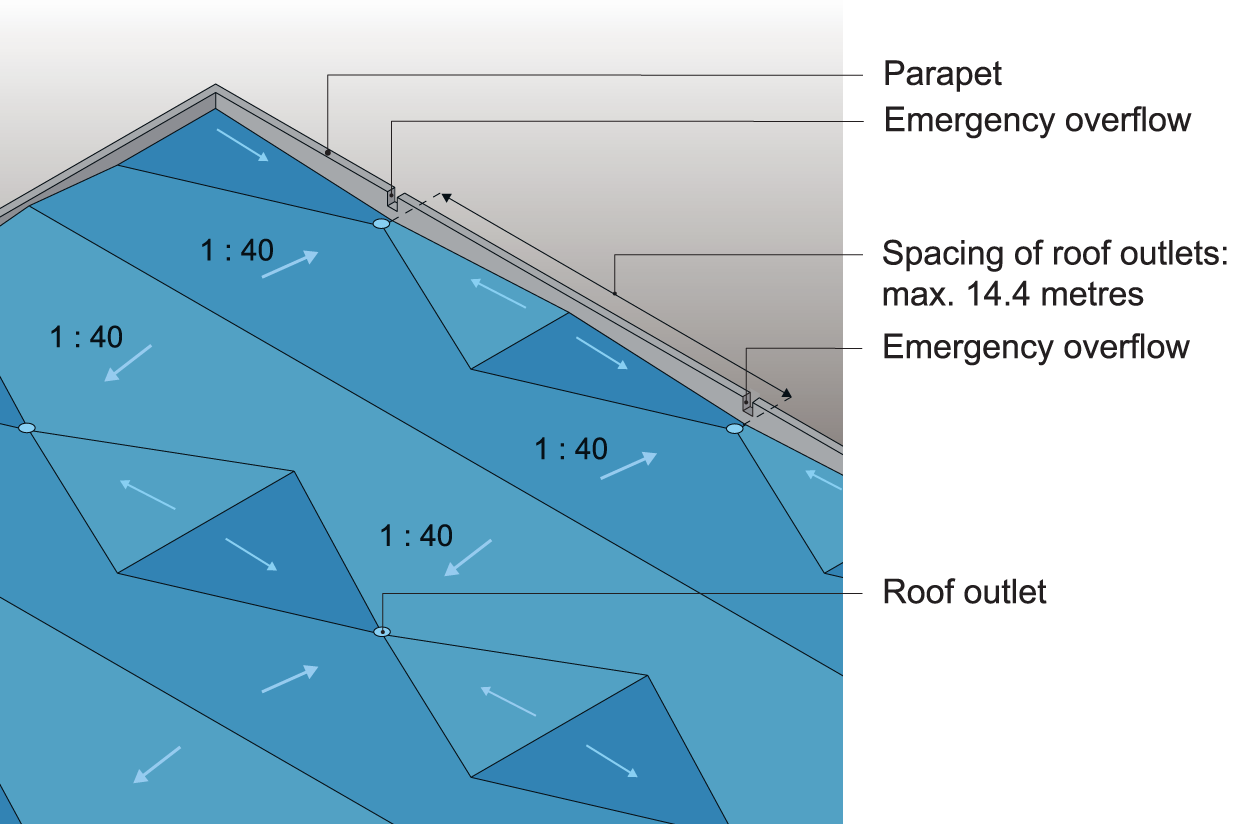
Figure 131. Falls on a flat roof with single-fall firring towards valleys. The roof’s main fall is structured using dual-fall 1:40 crickets.
Falls Towards Box Gutters
Box gutters are rectangular recesses in the roof surface. The bottom of the gutter is executed with falls towards outlets placed inside the gutter (see Figure 132). Gutter falls must be at least 1:100, but should preferably be bigger. Box gutters must be executed with sufficient width to allow the installation and flashing of roof outlets. A width of 600 mm is commonly used.

Figure 132. A fall on a flat roof towards a box gutter. The main fall on the roof is min. 1:40 and the fall in the box gutter is min. 1:100. The width of the box gutter should be min. 600 mm for proper functioning. The spacing between roof outlets should be max. 14.4 metres
Tapered Falls
To achieve tapered falls, the roof surface is constructed in four plane surfaces intersecting one another below a 45-degree angle, all with falls towards a roof outlet (see Figure 133). The intersecting lines between individual roof surfaces must always equal the bisector to avoid level changes in the thermal insulation thickness. Large roof surfaces may comprise several roof surfaces, each with their own tapered falls. For a 1:40 fall in the individual roof surfaces, the fall in the intersecting lines for a square roof will be 1:56. Larger slopes are preferable, and a 1:20 fall will result in a fall in the intersecting lines of 1:28, minimising the risk of ponding. However, this entails increased insulation thickness. Tapered falls lead to considerable waste in thermal insulation material.
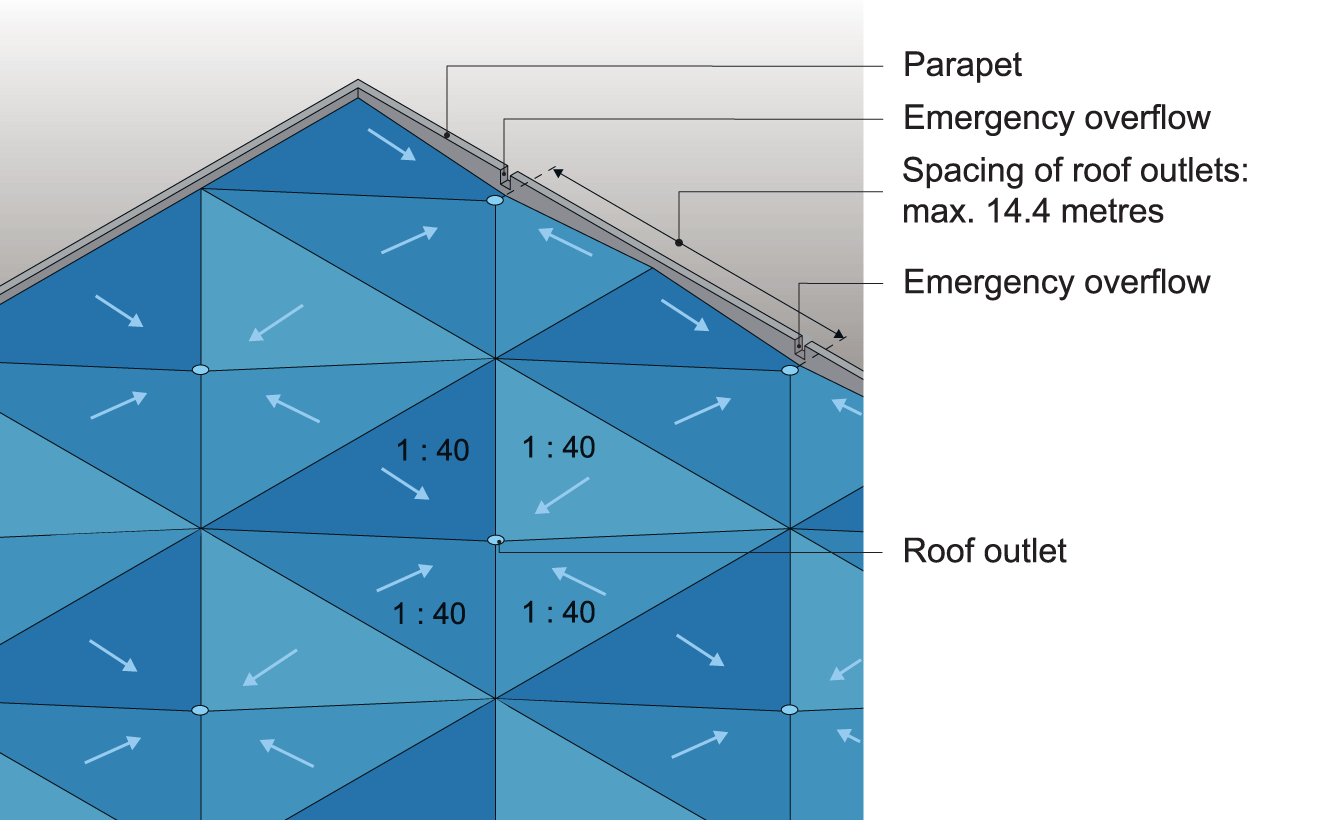
Figure 133. Falls on flat roof constructed using tapered thermal insulation with a 1:40 slope. The spacing between roof outlets should be max. 14.4 metres.
Penetrations
In the case of penetrations wider than 1 metre, such as roof lights or chimneys, rainwater must be led around the penetrations (see Figure 134). This can be achieved with so-called back-pan flashing or a ’saddle’ using tapered insulation material. Roof surface penetrations must be spaced out sufficiently for two neighbouring penetrations to be flashed correctly, allowing min. 0.5 metres between them (see Figure 134).
Penetrations (such as pipes or ducts) should never be placed near to valleys or box gutters where the water load is great or where there is a risk of ponding. There must be a min. clearance to parapets of 0.5 metres (see Figure 135).
Issues concerning the installation of roof lights in flat membrane roofs are outlined in Section 6.1, Roof Lights for Flat Roofs.

Figure 134. Back-pan flashing or ‘saddle’ structure behind a major roof penetration, ensuring that rainwater is led around it with no risk of ponding behind the penetration.
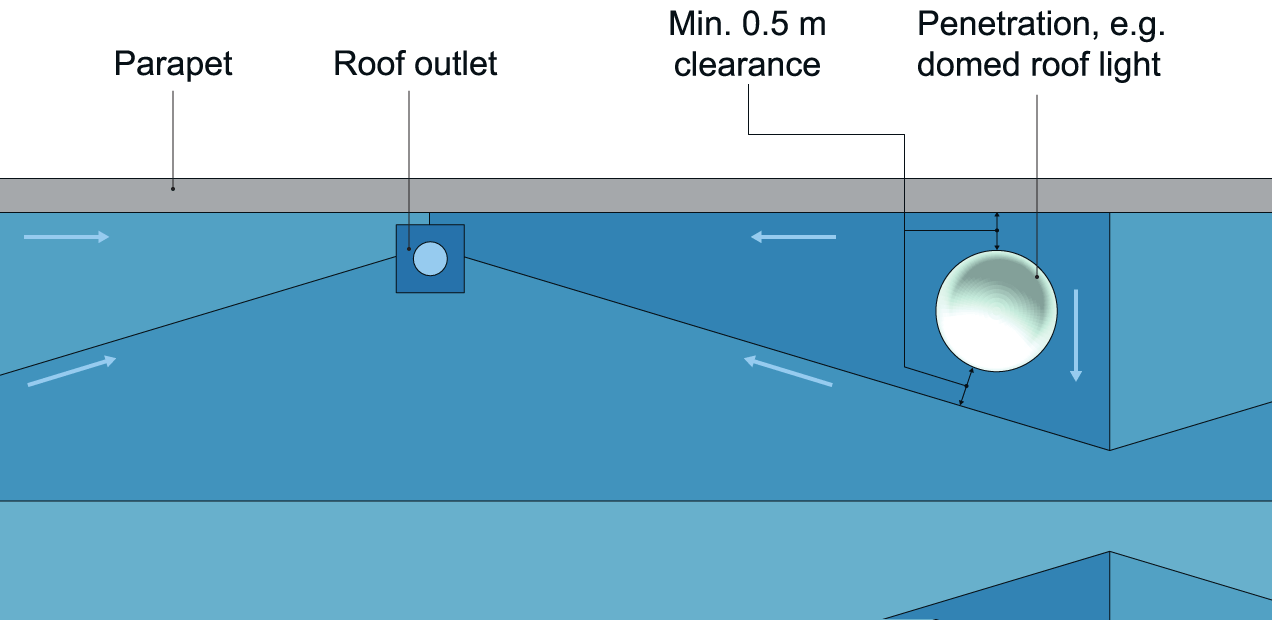
Figure 135. Example positioning of a penetration (in this case, a domed roof light) on a membrane roof that has falls built with crickets. Spacing of min. 0.5 metre between the bottom of the valley and the penetration and min. 0.5 metre between the penetration and the parapet is required.
5.7.4 Constructing a Membrane Roof
Membrane roofs can be constructed on supporting roof structures of both timber, steel, and concrete.
Roofing membranes require a continuous, stable substrate, as the membranes must be fully supported. Substrate requirements are relative to whether the roof is warm or cold. Detailed guidelines for warm and cold roof assemblies are outlined in in Section 1.3, Warm and Cold Roofs.
Generally, the substrate must be sufficiently planar and well-defined to ensure that correct falls can be achieved everywhere on the roof covering.
No correction of the falls is possible in the roof covering or in the thermal insulation material laid on the substrate. Roof insulation can only compensate for inaccuracies in the substrate to a limited extent. If tapered thermal insulation is used, the substrate underneath the insulation may be executed horizontally.
Furthermore, when roofing membranes are directly installed onto decking (e.g., concrete or plywood), the decking must have an even and smooth surface without major level differences, burrs, or holes. If burrs occur, they should not be sharp as this can damage the membrane.
Only the following materials can serve as substrate for roofing membranes:
- Concrete cast on site
- Precast concrete slabs
- Wooden boards
- Plywood
- OSB sheets (Oriented Strand Board)
- Roofing slabs
- Profiled steel sheets with an interlayer of thermal insulation.
Figures 136–140 show examples and descriptions of how to construct a membrane roof onto these substrates.
Concrete Deck as a Substrate for Roofing Membranes
Concrete decks used as substrate for roofing membranes must have dry and firm surfaces and be free of dust. Recesses and penetrations must be cast-in-place. Burrs, level differences, and depressions must be max. 5 mm deep. If any burrs exist, these should not be sharp as this can damage the membrane.
The max. deflection of the concrete deck must not exceed 10 mm lengthwise to the falls and 5 mm across (both measured using a 2.4-metre smoothing board).
In small areas (approx. 10 m2) deviations of max. 5 mm/metres are acceptable on concrete surface falls measured with a 2.4-metre smoothing board (corresponding to a resulting fall on the main roof surface of 1:50 or 20 mm/metre).
Concrete Decking as an Insulation Substrate
Concrete decks used as substrate for roof insulation with roofing membranes must not have burrs or level changes of more than 8 mm. There must be no depressions bigger than 10 mm measured using a 2.4-metre smoothing board.
Concrete decks cast on site should have a min. thickness of 100 mm.
For concrete slabs, all installation clamps must be removed. Recesses must be even and level with the rest of the roof surface.
Concrete slab joints must be executed to avoid any movement between the slabs. Alternatively, they must be sufficiently rigid for the deflections resulting from half of the characteristic snow load to be max. 5 mm.
Falls on the concrete slabs should be designed in a longitudinal direction. Across falls, there are requirements for the span of the slabs (see Table 23), as well as the exact spot measured. If the slabs are supported, height differences between them must not exceed 5 mm. In the case of significant level differences, the surface must be levelled to comply with the tolerance requirements for depressions (see Table 22).
If falls run in a crosswise direction to the slabs, level differences between two neighbouring slabs must not exceed 5 mm.
For spans larger than 6 metres, centre-of-slab height differences of up to 5 mm per 6 metres of span are acceptable, up to a maximum of 30 mm. Height differences above 10 mm are levelled by adding a levelling layer of concrete to achieve a smooth fall on the surface in both directions, ensuring that roof surface falls are correct.
Table 23. Requirements concerning maximum level differences between two neighbouring slabs used as substrate for roofing membrane or for roof insulation with a membrane (relative to span of concrete slabs).
Span [m] | Maximum Level Differences Between Two Neighbouring Slabs [mm] |
|---|---|
< 6 | 10 |
6 – 12 | 15 |
12 – 18 | 20 |
18 – 24 | 25 |
24 – 30 | 30 |
Roof Insulation
Roof insulation can be used as substrate for roofing membranes in warm roofs with supporting structures of timber, steel, and concrete (see Figure 136–140).
Roof insulation used as substrate for roofing membranes must be walk-proof (i.e., they must be resistant to point load from walking), during installation and subsequent use corresponding to a characteristic short-term compressive strength of min. 20 kN/m² (cf. DS/EN 826) (Danish Standards, 2013f).
The slope can be incorporated into the roof insulation with tapered insulation material or into the supporting structure (see Section 5.7.3, Roof Slope for Membrane Roofs).
Roof insulation must be laid so that the surface is even and level with the specified slope.
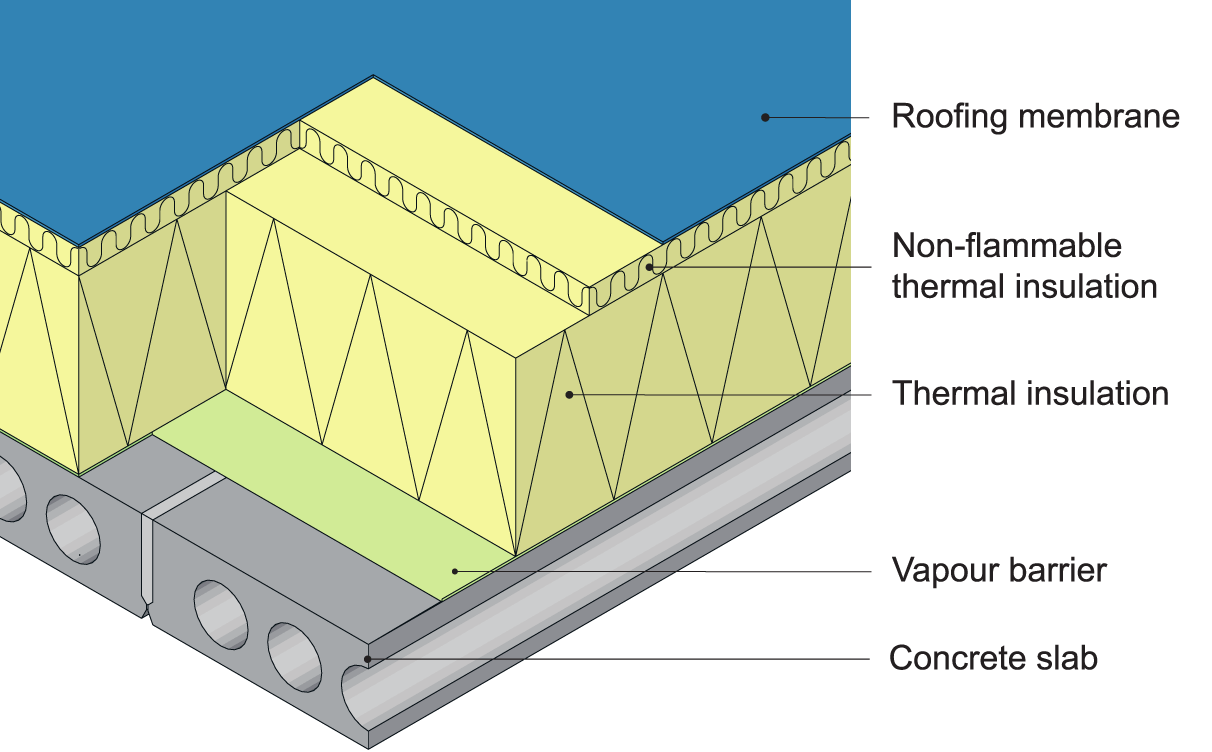
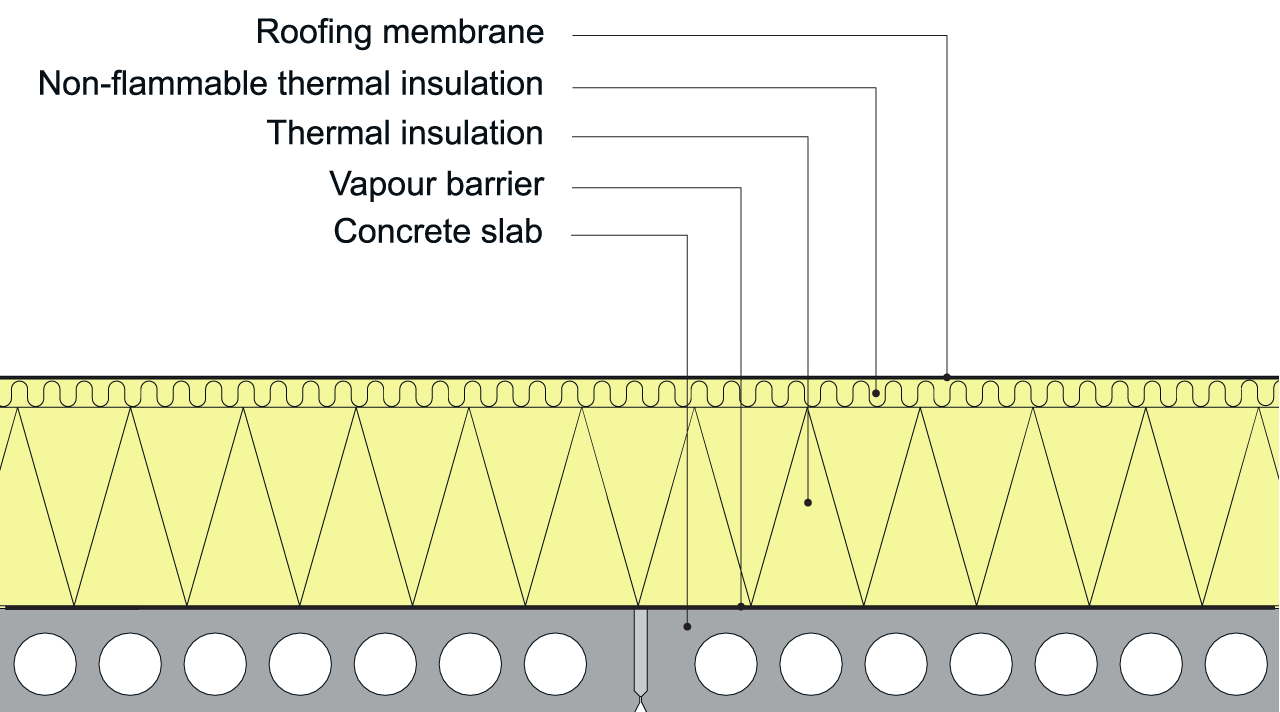
Figure 136. Example showing warm roof assembly constructed from concrete slabs. The vapour barrier is a roofing membrane. The primary thermal insulation shown here is flammable. Therefore, a non-flammable layer of thermal insulation (min. thickness 25 mm) is used under the roofing membrane to comply with fire safety regulations.
Roof insulation mats must be pushed together tightly. Any joints must be packed with insulation material (e.g., mineral wool).
Level differences in joints between two thermal insulation mats in the direction of falls must be max. 10 mm. Level differences in joints across the direction of falls must be max. 5 mm. The roof insulation must be sufficiently dimensionally stable to avoid changes in level differences over time.
The roof insulation must be dry and moisture absorption on the building site must be avoided. The roof insulation is fixed mechanically according to the applicable standard Eurocode 1 – Part 1–4 (Danish Standards, 2007c).
If roof insulation is used in conjunction with bonded or welded bituminous felt, the insulation must be suitable for bonding (such as foamed glass) and should have a characteristic peel strength of min. 3 kN/m² after moisture and thermal ageing. Delamination strength is determined according to DS/EN 1607 (Danish Standards, 2013g). For more information, see the next Section 5.7.6, Fixing Systems for Roofing Membranes. Please note that separate types of roof insulation material may have different fire classifications (relative to the height and usage of the building). This is critical to how the assembly should be assessed and protected in terms of fire safety (see Section 2.5.1, Fire from the Outside).
Wood Boards (Fir or Norway Spruce)
For cold timber-framed roof assemblies, wood boards can be used as substrates for membrane roofs (see Figure 137). For warm timber-framed roof assemblies, wood boards can be used as a substrate for a roofing membrane acting as a vapour barrier (see Figure 138 (shown here as a wood-based sheet)).
Wood boards are used as substrate for roofing membranes as well as for firm roofing underlayment (see 3.3.1, Firm Underlayment).
Wood boards as substrate for roofing membranes must be fir or Norway spruce with tongue-and-groove joints. The max. width of the boards must be 115 mm (net coverage). The wood board quality must be sexta or better (where this rating corresponds to class C according to ’Nordic Wood Sorting Rules’, 1994, or classes G4–2 or G2–2 according to DS/EN 1611-1) (Danish Standards, 1999).
The boards must be level and free of loose knots, fissures, and major rough edges on the upper side. Minor rough edges are acceptable across short areas or max. 1.5% of the boards. There should also be no rough edges that might compromise tongue-and-groove joints.
To achieve a sufficiently strong and rigid wood board substrate, dimensions and max. spans must comply with those indicated in Table 24 in TRÆ-rapport no. 09, Faste undertage og tagunderlag – Baggrund for dimensioneringstabeller (Firm Roofing Substrates – Basis for Dimensioning Tables) (Træinformation, 2015b).
Table 24. Thickness and corresponding max. spans for wood board substrates with tongue-and-groove joints relative to span (Træinformation, 2015b).
Thickness [mm] | Span [mm] |
|---|---|
21 | 800 |
23 | 1000 |
25 | 1100 |
34 | 1200 |
Roof boards are joined across the substrate while unsupported joints are allowed for every third board. For boards with tongue-and-groove joints - including end joints - unsupported joints can be used without reducing the span relative to the values indicated in Table 24. For end joints that are not tongue-and-groove, the span for unsupported joints must be reduced by 20%.
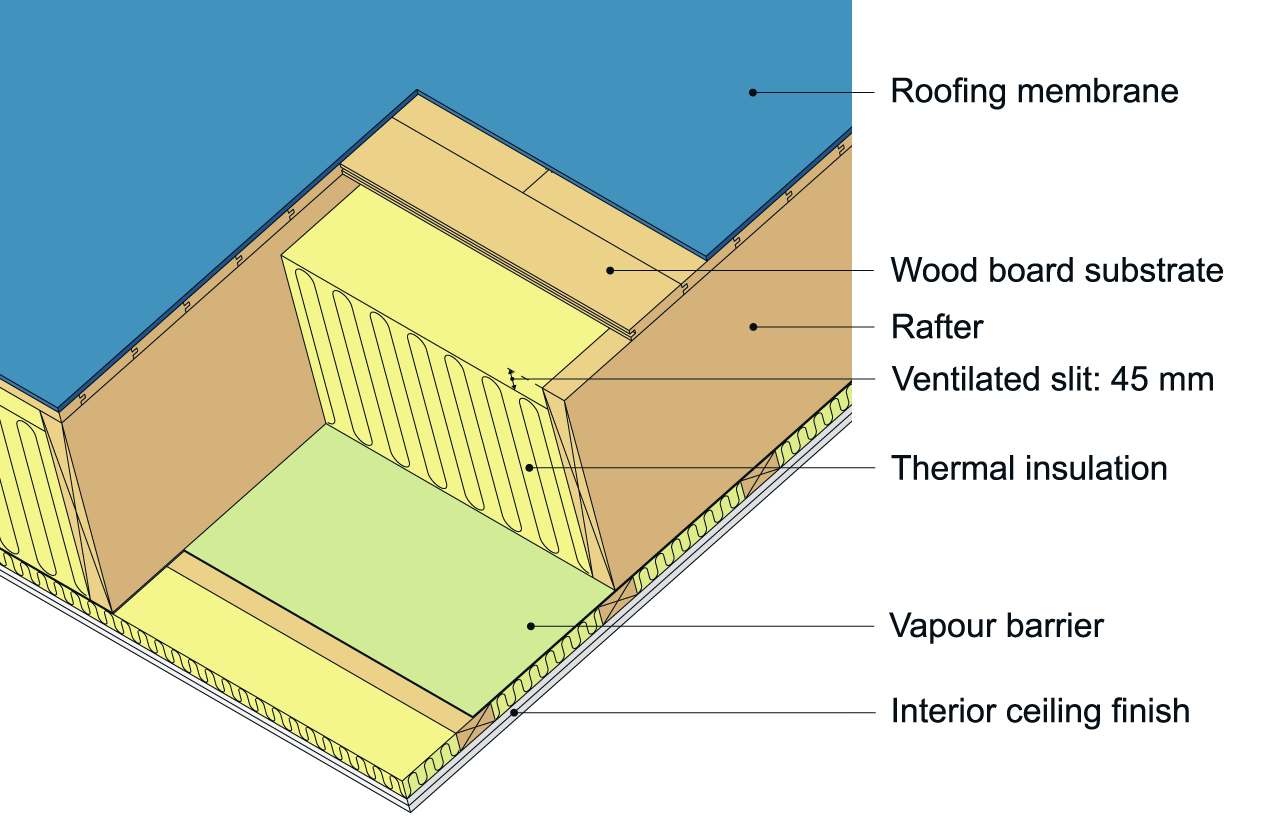
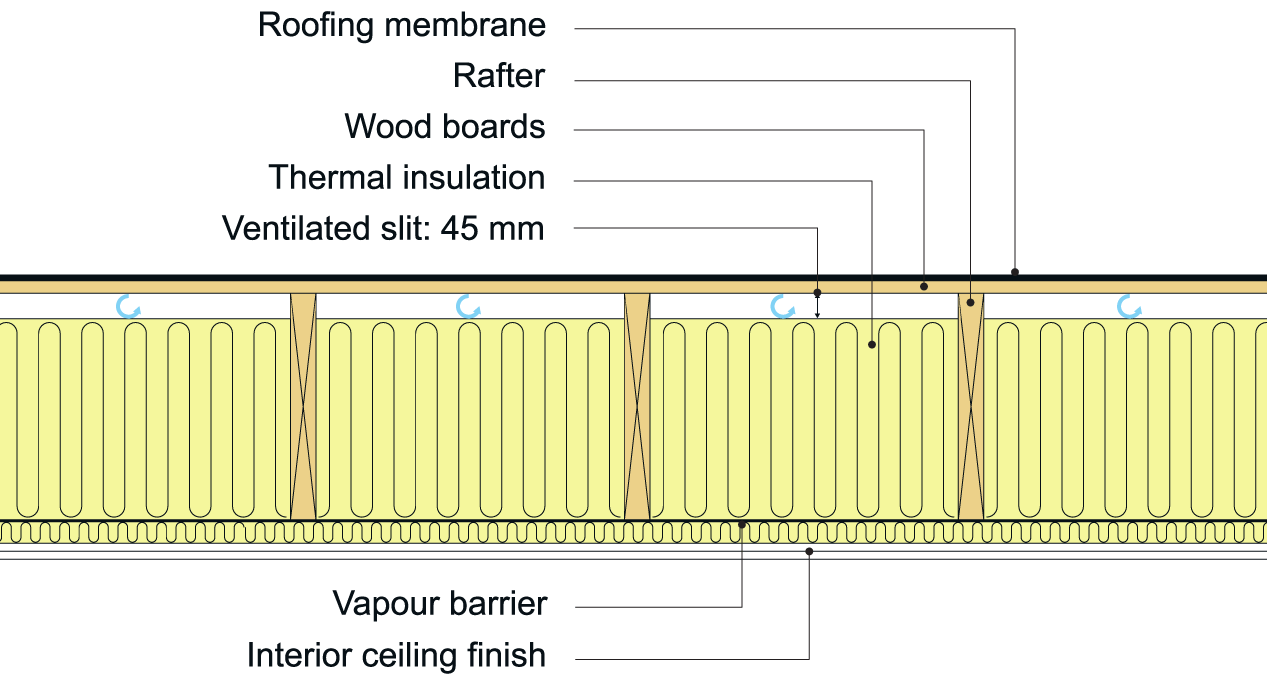
Figure 137. Example showing cold roof assembly with wood board substrate. For tongue-and-groove joints including end joints, unsupported joints are acceptable for every third board without reducing span relative to the values indicated in Table 24.
Moisture content should be 14–16% on installation, and should not exceed 20%. If moisture content is below 14%, the boards must be laid with a joint spacing of 2 mm. If moisture content is 15–17%, the boards must be laid with a joint spacing of 1 mm.
Boards are laid with the tongue facing the roof surface. The boards are nailed to the substrate using hot-galvanised nails. A minimum of one nail should be used per board per support, preferably in the upper third of the board. In perimeter zones, along sides, gable ends, and major penetrations in the roof, the board should be fixed using two nails per board. Boards of maximum 25 mm thick should be nailed using 2.8 × 50 mm ring nails or 2.8 × 65 mm square-shank nails. For buildings higher than 5 metres and buildings in particularly exposed locations, the fixing must be documented.
Plywood Sheets
For timber-framed cold roof assemblies, plywood sheets can be used as substrate for membrane roofs (see Section 1.3, Warm and Cold Roofs). For timber-framed warm roof assemblies, plywood sheets can be used as substrate for a roofing membrane functioning as a vapour barrier (see Figure 138).
Plywood sheets are used as substrate for roofing membranes as well as for firm underlayment (see Section 3.3.1, Firm Underlayment).
Plywood sheets as substrates for roofing membranes must be CE-labelled according to DS/EN 13986 (Danish Standards, 2004b), should be marked ’Roofing’, and should comply with the rules governing roofing sheets in the national index of Eurocode 5 (Danish Standards, 2015c). Further information about timber sheets is available in TRÆ 60, Træplader (Timber Sheets) (Træinformation, 2012).
Plywood as substrate must meet the requirements of the application class indicated in Table 25. The definition of application classes is given in the Danish national annex to Eurocode 5 (Danish Standards, 2015c)
Table 25. Application classes for plywood roof decking listing application examples (Danish Standard, 2015c).
Application Class | Examples |
|---|---|
1 | Warm roofs |
2 | Vented roofs |
3 | Unvented roofs |
Sheets are laid in accordance with manufacturer's installation manual. ‘Half’ sheets with a max. weight of 18 kg must be used (cf. Brancheaftale om træbaserede tagplader (Trade Agreement on Wood-based Roofing Sheets)) (Træinformation, 2010). Full sheets may be used where mechanical aids are available to handle them (e.g., at a factory).
Moisture content in plywood sheets should be 12–14% on installation, and should not exceed 20%. The sheets must be laid using the joint-gap width specified in the manufacturer installation manual, which is typically 1–2 mm.
On unsupported long edges, the plywood sheets must be tongue-and-groove. Short edges can only be abutted across supporting structures and must not be tongue-and-groove. The sheets must be installed in bond. Level differences must be max. 2 mm between any two sheets. At valleys, joints in tapered falls, and similar details, all sheet edges must be supported. If relevant, ventilation must be installed.
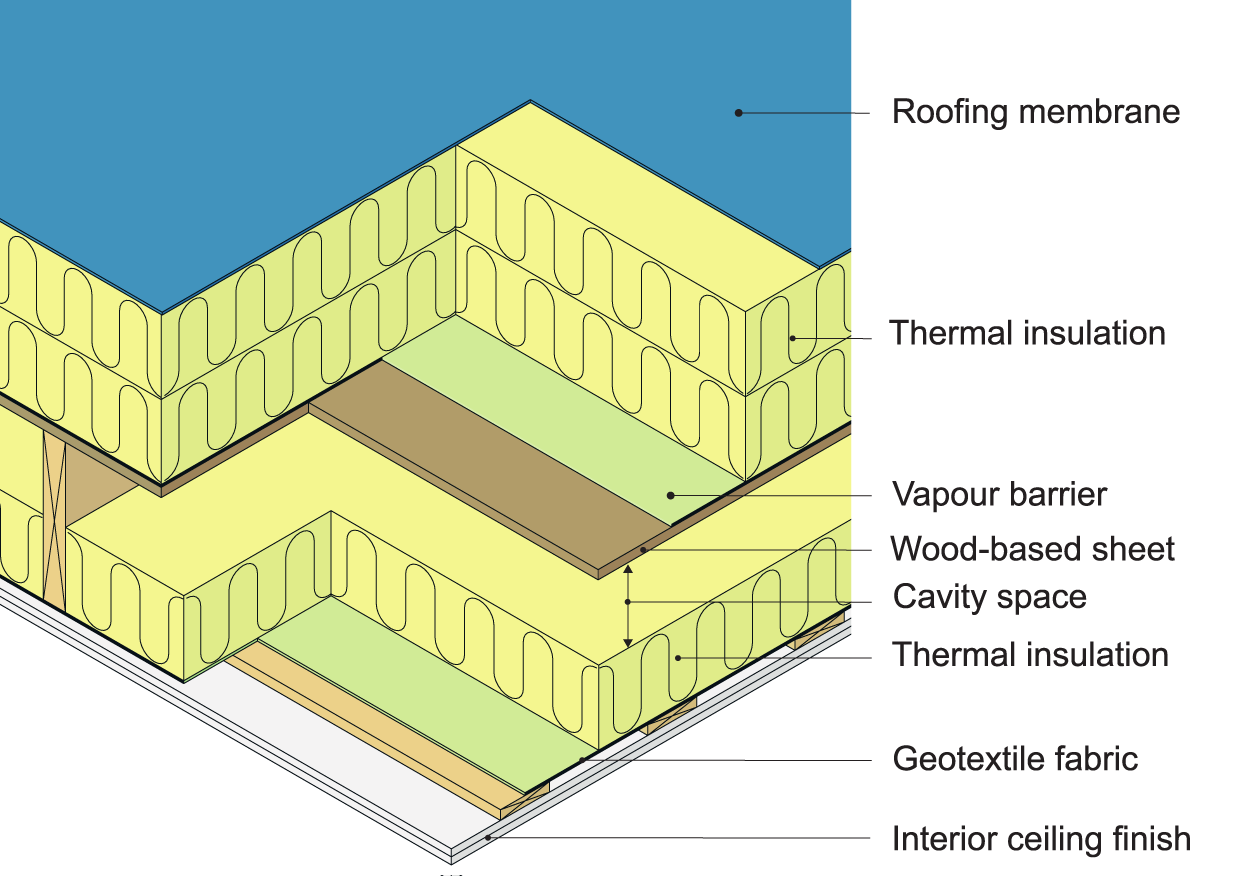

Figure 138. Example of timber-framed warm roof assembly. The assembly is executed using plywood or OSB sheets as substrate for roofing membrane functioning as a vapour barrier. The insulance factor/thickness of the thermal insulation under the vapour barrier is relative to the moisture load class (see Table 5).
To limit deflection, c.t.c. maximum sheet spans of 0.6 metres, for 12 mm sheets, 0.8 metres for 15 mm sheets, and 1.2 metres for 18 mm sheets should be used. For visible roof surfaces, sheets one class thicker should be used.
The above stipulations apply in general terms. There may be deviations which will become apparent based on the CE-labelling.
The sheets are nailed to the substrate using corrosion-proof ring nails (e.g., hot-galvanised nails), every 150 mm along edges and every 300 mm at underlying supports. Sheets of thicknesses up to and including 15 mm are nailed using 2.8 × 50 mm nails. Sheets of thicknesses up to and including 18 mm are nailed using 2.8 × 65 mm nails. Ring nails with similar measurements can be used.
OSB Sheets (Oriented Strand Board)
For OSB sheets used as substrate for roofing membranes, the same principles apply as for plywood. OSB sheets must be CE-labelled according to DS/EN 13986 (Danish Standards, 2004b) and must be marked ‘Roofing’. It is not possible to use OSB sheets in application class 3 (cf. Table 25). The definition of application classes is given in the Danish national annex to Eurocode 5 (Danish Standards, 2015c).
OSB sheets must be at minimum OSB/3 and the sheets must be labelled as such. Further information about timber sheets is available in TRÆ 60, Træplader (Timber Sheets) (Træinformation, 2012).
‘Half’ sheets must be used with a max. weight of 18 kg (cf. Brancheaftale om træbaserede tagplader) (Trade Agreement on Wood-based Roofing Sheets))(Træinformation, 2010). Sheets are laid in accordance with manufacturer's installation instructions. Full sheets may be used where mechanical aids are available to handle them (e.g., at a factory).
Moisture content of the sheets should be 10–12% when installed, and should not exceed 20%.
Unless stricter requirements appear from manufacturer’s installation manual, OSB sheets may be used for warm roofs (application class 1) and for cold, vented roofs (application class 2), if the requirements specified are complied with (as documented). This will typically include roofs in dwelling houses, or similar constructions. Classification of buildings according to moisture load class is outlined in Section 1.2, Vented and Unvented Assemblies.
OSB sheets must be laid with the joint spacing specified in the manufacturer installation manual. Joint-gap widths are typically 2–4 mm (i.e., twice as big as for plywood). Level differences must be max. 2 mm between any two sheets.
To limit deflection, the maximum c.t.c. sheet span is 0.6 metres for 12.5 mm sheets, 0.8 metres for 15 mm sheets, and 1,2 metres for 18 mm sheets. For visible roof surfaces, sheets one class thicker should be used.
OSB sheets are nail-fixed with spacings as indicated for plywood sheets in the section Plywood Sheets.
Composite Roofing Slabs
Prefabricated composite roofing slabs with timber-based sheets can be produced as substrate for membrane roofs. The roofing slabs should be supplied with roofing membrane readily installed and joints should be taped over immediately after installation to avoid moisture absorption from precipitation.
Composite roofing slabs must comply with the same requirements applicable to top sheets in terms of bearing length as sheeting (plywood or OSB sheets) in the slab.
Substrates for slabs must normally comply with elevation tolerance requirements of + 5/- 15 mm with slabs not installed on wall plates. Roofing slab joints must be executed to avoid any movement or deflection between the slabs. Alternatively, they must be sufficiently rigid for the deflections resulting from half of the characteristic snow load to be max. 5 mm.
For roofing slab joints in the direction of falls, height differences between slabs at right angles, in the direction of falls, must not exceed 5 mm for spans up to 6 metres and 10 mm for spans up to 12 metres.
Deflection for characteristic snow load must not exceed 1/350 of the span.
Detailed descriptions of issues concerning composite roofing slab assemblies are provided in Section 4, Composite Roofing Slabs.
Profiled Steel Sheets
Profiled steel sheets can be used to provide a supporting structure in a warm membrane roof on a thermal insulation substrate. The vapour barrier can also be executed using a roofing membrane on thermal insulation (see Figure 139). To ensure that the substrate is level with well-defined falls, the steel sheets must comply with several requirements.
The thickness of the steel sheets must be min. 0.7 mm. The stability and rigidity of individual profiles must be sufficient for them not to overturn or subside, nor to dent due of light traffic during installation and roofing work.
Deflection for characteristic snow load must not exceed 1/200 of the span.
The metal sheet profile must be shaped in such a way as to support the thermal insulation across min. 30% of the roof surface. The thermal insulation must be executed in such a way as to prevent treading through profile valleys and deforming the crests. The maximum span of the insulation layer is relative to the specific material and thickness used.
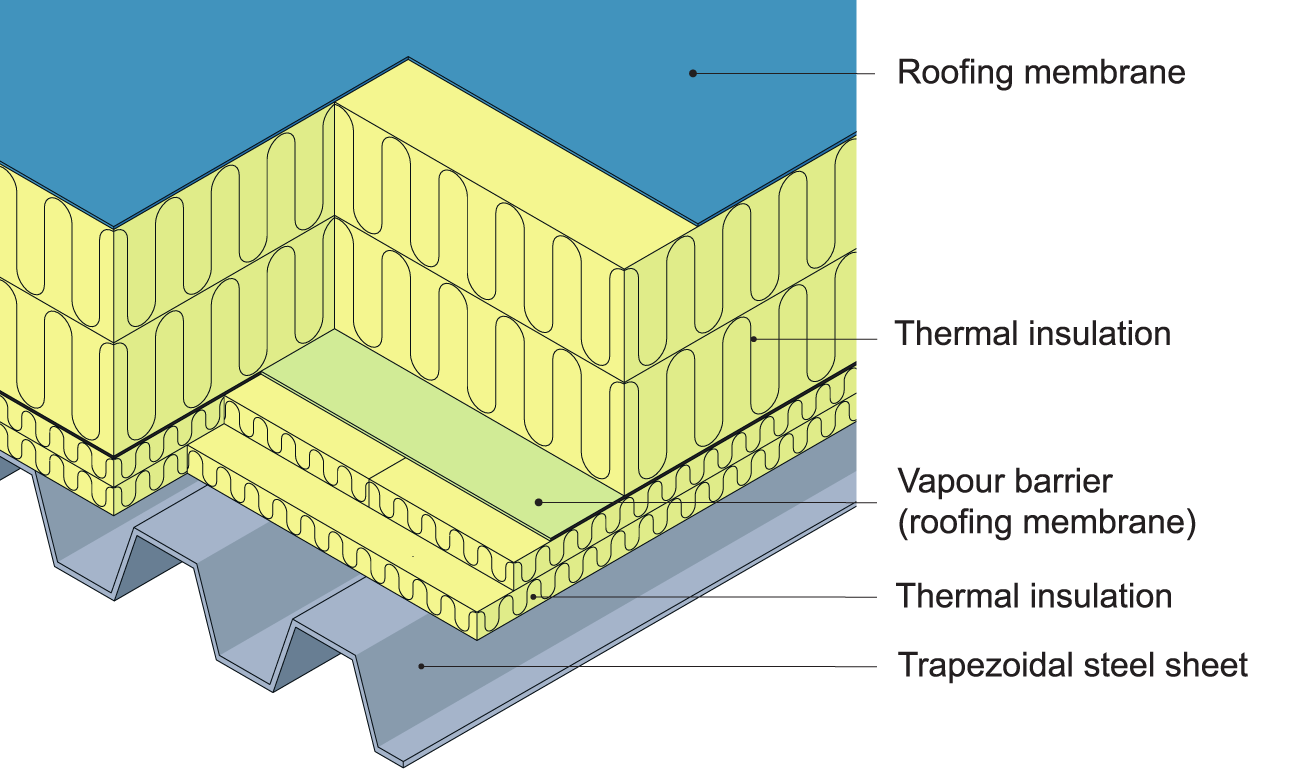
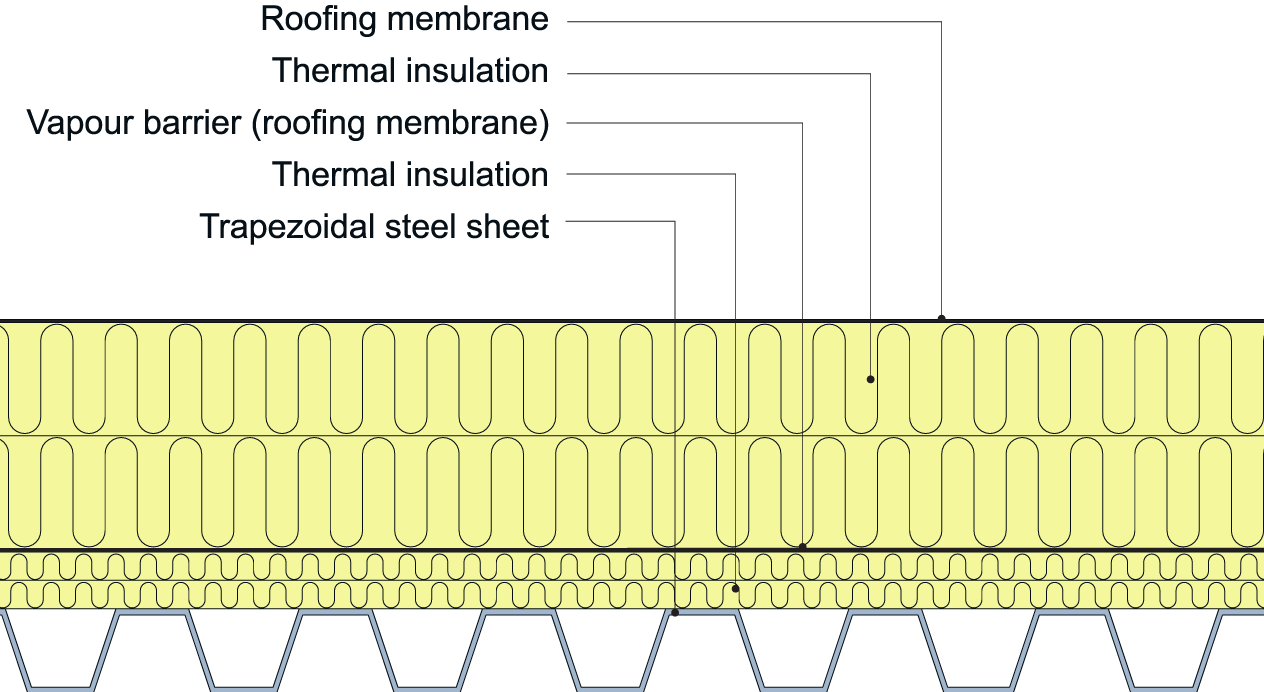
Figure 139. Example of warm roof assembly with a membrane roof covering on a substrate of profiled steel sheets. The vapour barrier must be protected from fire from the inside and is therefore placed 50 mm into the insulation layer. If cellular glass insulation is used above the vapour barrier, the lower insulation layer must be 2 × 25 mm mineral wool insulation layers with staggered joints. One should ensure that the vapour barrier is tight, and that the insulation is secured to the assembly with fixtures. This is best done using a robust vapour barrier (e.g., a roofing membrane).
Openings (e.g., for roof lights) must be reinforced or trimmed to make the metal sheets sufficiently stable and rigid.
To ensure a robust substrate exists for the vapour barrier and to protect it from fire from the inside, sheeting can be laid (e.g., two layers of cement particle board with staggered joints). This is also suitable for securing the fixtures of the roofing membrane onto (see Figure 140).
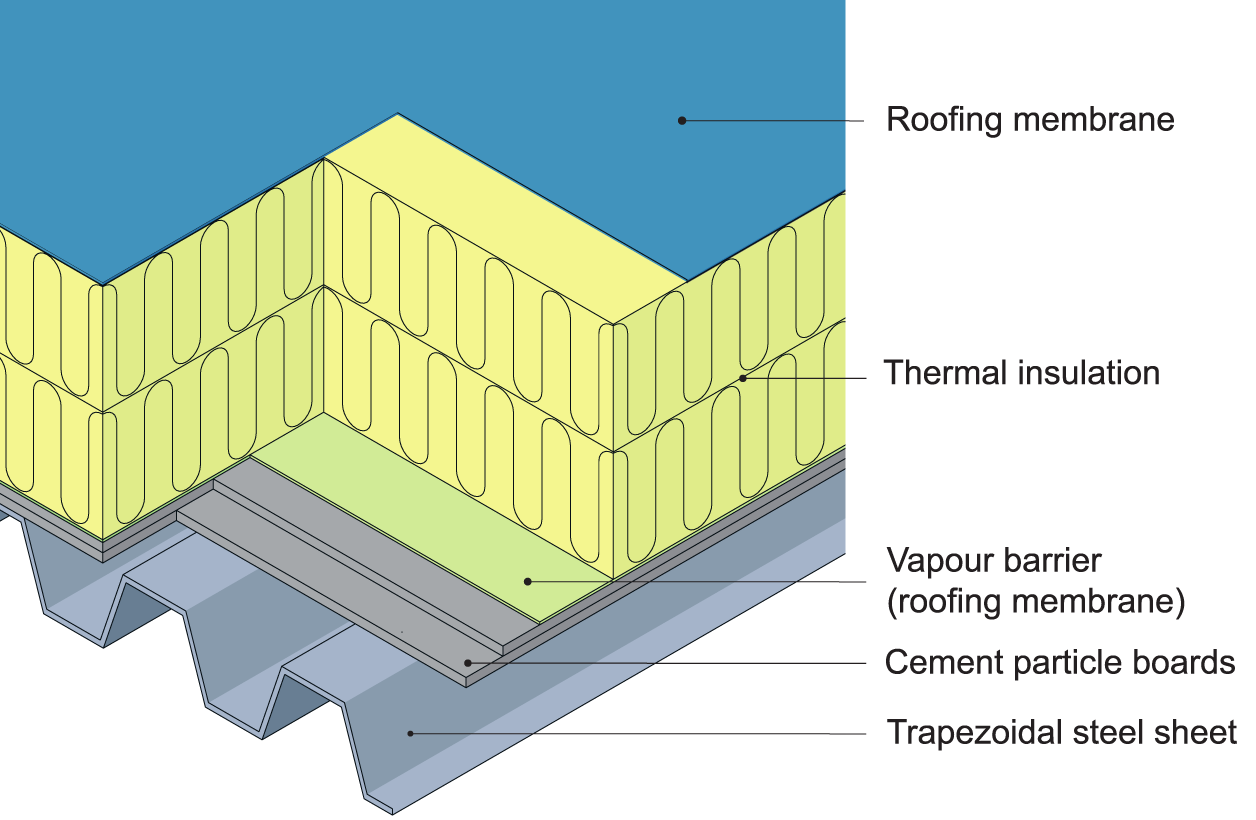
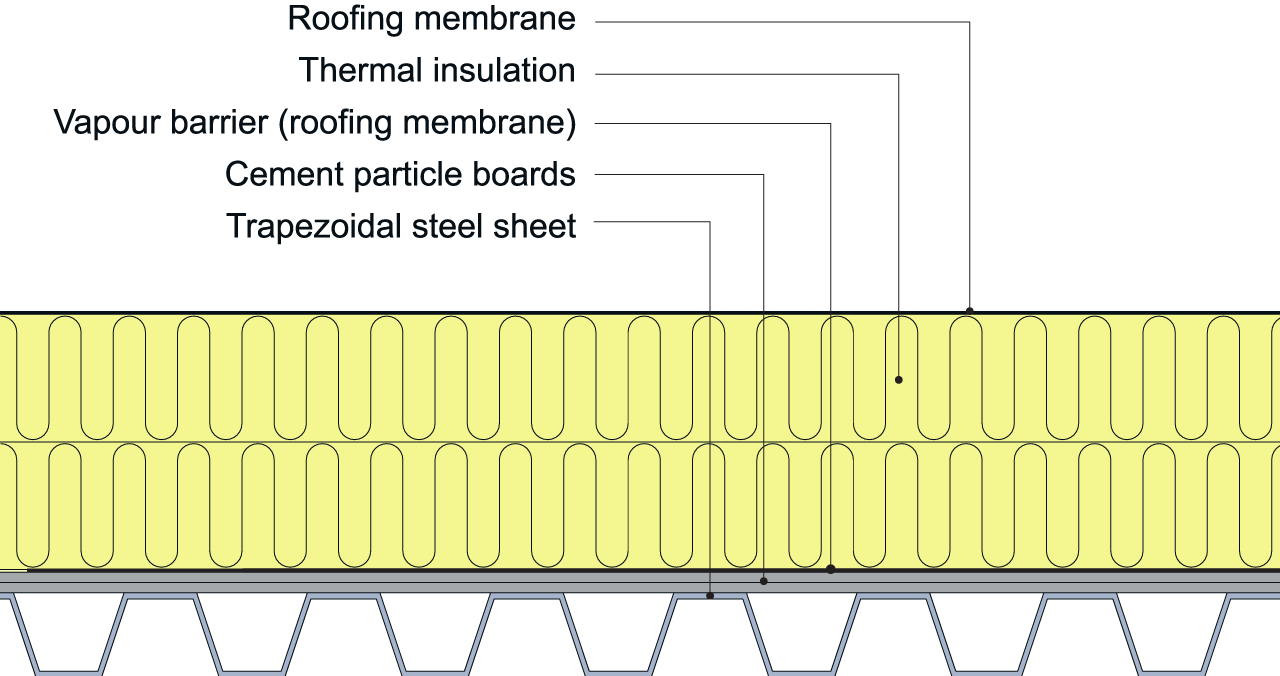
Figure 140. An example of a warm roof assembly with a membrane roof covering on a profiled steel sheet substrate. The vapour barrier must be protected from fire from the inside and is therefore placed above two layers of cement particle board with staggered joints. The vapour barrier must be tightly installed and should remain so after having secured the insulation to the assembly with fixtures. This is best achieved with a robust vapour barrier (e.g., a roofing membrane).
The vapour barrier should be made from a robust material (such as roofing membrane) to assure airtightness when mechanically fixing the overlaying roof insulation and roofing membrane. Sheeting underneath the vapour barrier also enhances airtightness.
To protect the vapour barrier against fire from the inside, 50 mm of thermal insulation could be inserted between the vapour barrier and steel sheet. When using cellular plastic insulation above the vapour barrier, the lower insulation layer must be 2 × 25 mm mineral wool insulation with staggered joints.
5.7.5 Sizing and Fixing
Roofing membranes and exterior roof insulation must be fixed to resist expected local wind action. Wind action depends on conditions in the local terrain and the height of the building.
Sizing is based on:
- The rated wind load sustained by the roof, based on the geometry and surrounding terrain/built-up area
- The rated strength of the fixing system.
During the sizing process, fixing methods must also be determined in areas subject to the most stress such as verges and corners.
Wind Load on the Roof
The wind load on flat roofs normally leads to a partial vacuum across the entire roof and the roof covering must be securely fixed to avoid damage.
The rated wind load on the roof is calculated according to Eurocode 1 – Parts 1–4, General actions – Wind actions, with the corresponding national Danish annex (Danish Standards, 2007c). Eurocode 1 – Parts 1–4 focus on supporting structures, but these sections are also applicable to secondary structures (such as claddings and roof coverings) due to their inability to distribute forces and heavier loads sustained locally. The form factors applied for external pressure correspond to 1 m2.
The excess pressure on the on the underside of the roof covering must also be considered (e.g., interior excess pressure from wind action via open gates) on the underside of large open overhangs and elsewhere where the roof structure is not itself airtight.
The rated wind suction per m2 of roof surface is calculated as:
where:
Excess pressure should be added to the interior to compensate for the upward wind suction. This corresponds to a form factor of 0.2–0.9 depending on the size of gate openings.
Determining the Maximum Wind Velocity Ratio and Terrain Category
The sized wind load which equals the max. wind velocity ratio can be determined after determining the following (cf. Eurocode 1 – Parts 1–4):
- The basic wind velocity
- The asperity factor (which depends on the terrain category)
- The 10–minute mean velocity pressure
If the terrain category is unclear, the most even category should be used (i.e., the one giving max. exposure to wind).
A building’s wind conditions can change relative to changes in its immediate surroundings (e.g., due to the demolition of houses, new construction, or planting).
The max. wind velocity ratio is visualised in Figure 141 as a function of the building height, terrain category, and basic wind velocity.
The basic wind velocity is determined at 24 m/s, applied everywhere in Denmark, except for a 25-km perimeter zone along the west coast of Jutland and at Ringkøbing Fjord where 27 m/s is applicable (Danish Energy agency, 2015).
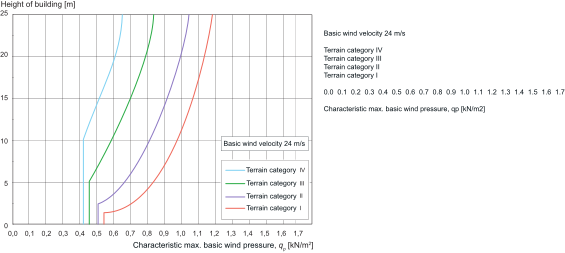
Figure 141. Characteristic max. wind velocity ratio at a basic wind velocity of 24 m/s. Specific min. building heights apply for the various terrain categories (corresponding to the vertical parts of the graphs).
Dividing up the Roof Surface – Form Factors
Most storm damage occurs at roof perimeters where wind suction is greatest and it is important, therefore, to anchor the roof insulation efficiently in these zones.
The roof is typically divided into three main zones: corner, perimeter, and middle zone. Figure 142 shows these zones for a flat roof without a parapet.
The form factors indicated in Figure 142 apply to exterior wind suction.
Furthermore, interior excess pressure may occur, which may affect the roof covering and fixings if the roof assembly is not airtight (such as a concrete deck with open joints or a profiled steel sheet deck). Due to interior excess pressure, a rated form factor of cpi,1 between 0.2 (for openings evenly distributed in the facades, e.g., windows and doors) and 0.9 (for buildings with large gates or similar openings).
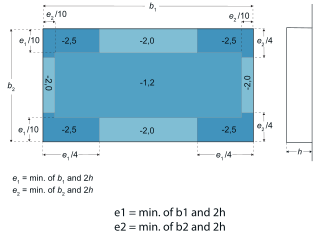
Figure 142. An example of form factors in a flat roof without a parapet (with a slope less than 5 ˚). The extent of the zones is relative to building height (h) and width (b), and the parameter e is determined as follows:
- e1 equals the lowest of b1 and 2h, and
- e2 equals the lowest of b2 and 2h.
Reduced form factors can be applied to flat roofs with parapets on all four sides, taking into the account the height of the parapet relative to the height of the building. Tables with further detail are available in Eurocode 1 – Parts 1–4 (Danish Standards, 2007c.
Overhangs
In buildings with overhangs, wind pressure on the underside of these structures will sometimes affect the roof covering. The roof covering anchorage above open overhangs must therefore be specified as the sum of the wind suction on the roof plus the excess pressure on the underside of the overhang.
Roof Lights
Roof lights often sustain extra loads from the interior excess pressure in the building. Allowances must be made for this when fixing systems are specified, and roof lights and upstands should therefore be securely fixed to the supporting roof structure (e.g., using angle braces).
5.7.6 Fixing Systems for Roofing Membranes
Roofing membranes and exterior roof insulation is traditionally fixed with one of three methods:
- Mechanical fixing
- Ballast of stones, paving slabs, or other heavy material
- Bonding (warm or cold)
Whereas bonding was more common in the past, mechanical fixing is now the most common technique.
Beyond these methods, another technique is occasionally used where the roof covering is fixed by establishing a partial vacuum on the underside of the roof covering. This method requires a completely airtight roof assembly.
Mechanical Fixing of Roof Covering and Insulation
The most widely used roofing membranes fixing method is currently mechanical fixing, which usually includes fixing the roof insulation as well. The fixing method depends on whether a single-ply or two-ply roofing membrane is used.
Characteristic of this kind of fixing is that delamination of the roof insulation is not considered a rupture, as the insulation is protected against wind suction by the roof covering. On the other hand, there are special requirements for roofing membranes (including joints between lengths) which must have sufficient tensile strength, tear strength, and resistance to dynamic impact (cf. DS/EN 16002, Determination of the resistance to wind load of mechanically fastened flexible sheets for roof waterproofing) (Danish Standards, 2010c), or must have the properties documented in accordance with ETAG 006, Systems of Mechanically Fastened Flexible Roof Waterproofing Membranes (EOTA , 2013).
Mechanical fixing is normally performed using washered fixtures. On a firm decking (e.g., of concrete, timber, or foamed glass insulation), simple fixtures are used while, on flexible substrates (e.g. of cellular plastic insulation or mineral wool), expansion fixtures are used (see Figure 143). Expansion fixtures allow deformation of the substrate (thermal insulation) (e.g., from walking on it), without screws or nails being pressed up through the roofing membrane. The expansive length is typically 2/3 of the insulation thickness, or a minimum of 15 mm. For thin supporting substrates with vapour barriers, there must be min. 30 mm spacing between the expansive part and the vapour barrier to avoid penetrating the vapour barrier.
Bituminous felt can also be nail-fixed on a board substrate.
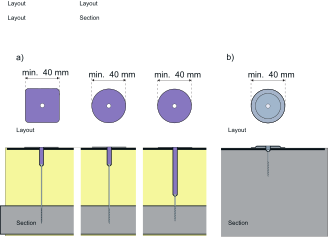
Figure 143. Examples of fixture designs for mechanical fixing of roofing membranes.
- Expansion fixtures for soft substrates (e.g., cellular plastic or mineral wool thermal insulation).
- Metal fixtures for firm substrates such as concrete, timber, or foamed glass insulation.
For new roof assemblies consisting of concrete slabs, profiled steel sheets, or plywood sheets, the quality of substrate materials is specified by standards, so the pull-out strength of these substrates is known. The rated strength of the actual fixing system (i.e., the roofing membrane and ancillary fixtures) is normally stated by the manufacturer.
For other materials for which the quality and strength of substrate materials are not known, the pull-out strength must be assessed through testing to determine how the roof insulation should be fixed.
The min. thickness for mechanical fixing to concrete is 40 mm. Mechanical fixing cannot, therefore, be used for renovation projects involving TT waffle slabs produced pre-1989, as the concrete thickness of these is below 40 mm.
For roof renovations, it will often be necessary to supplement the existing roof insulation, normally improving the fixing as a result (see Section 8.3, Re-insulating Roofs).
Bonding might be an option for the addition of insulation on an existing roof assembly, but only if the existing roof assembly is sufficiently strong. Therefore, mechanical fixing will often be necessary where fixtures are fixed through the existing roof assembly to the supporting structure.
Mechanical fixtures are normally placed in rows with a spacing corresponding to the width of the roofing membrane (the effective width) (see Figure 144).

Figure 144. Fixtures are normally placed in rows corresponding to the effective width of the roofing membrane. Overlaps must be 100–150 mm, adapted to the type of membrane.
For mechanical fixing of one-ply roofing membranes, the membrane and insulation are fixed in one operation using fixtures in the overlap of the roof covering (see Figure 144) or using special seam fasteners (see Figure 145).

Figure 145. For some types of roofing membrane the membrane can be fixed using special seam fasteners, thereby avoiding using fixtures in the membrane.
When mechanically fixing a two-ply bituminous felt roof, the first layer (lower felt) and the roof insulation are fixed mechanically in one operation in the felt lap joint. The second layer of bituminous felt (top felt) is then fastened (e.g., by welding it to the first layer). The joints in the top felt are staggered relative to the lower felt joints (see Figure 146).

Figure 146. An example of a warm roof assembly with a layer of two-ply bituminous felt on a substrate of roof insulation. The lower felt is fixed mechanically in overlaps with expansion joints, so that deformations in the insulation can be absorbed without damaging the membrane. The top felt is welded to the lower felt with staggered joints.
Wind suction may cause the roof covering to bend upwards (see Figure 147), which limits the width of lengths, especially for light-weight or thin roofing membranes. If the remaining roof assembly is not airtight, the wind suction may bend the roof covering up. This may lead to moist indoor air being ’sucked’ up into the assembly, as the upward bend will cause a partial vacuum in the assembly under the roofing membrane.

Figure 147. Especially for thin membranes, there is a risk that wind suction may cause the lengths to bend up between the fixtures due to the pressure difference between the membrane’s two sides. This will lead to a partial vacuum in the roof assembly.
Fixing Using Ballast
In assemblies where roofing membranes are secured with ballast, the watertight membrane is laid loosely on the substrate (see Figure 148). The membrane may be protected by geotextile fabric before laying the ballast. Special attention must be given to membranes of material prone to shrinkage (e.g., by fixing all edges).
Ballast could be a layer of min. 50 mm shingle with a gravel size of at least 16/32 mm. The gravel must have no sharp edges and should not contain flint.
At perimeter and corner zones, heavy wind suction loads and turbulence may occur at high wind velocity, in which case the shingle layer should be replaced by a material that will not shift due to turbulence (depending on building height and terrain category)(e.g., 500 × 500 × 50 mm concrete paving slabs (w × l × t)).
In extensive green roofs where the growth layer is only 40–60 mm, the roof covering must be fixed mechanically.
In intensive green roofs (roof gardens) fixing can normally be omitted, as the growth layer will usually constitute an adequate ballast. However, fixing may be necessary in the construction phase.

Figure 148. Example of warm roof assembly with a loosely laid roofing membrane held in place by shingle ballast.
Bonding or Welding
Roofing membranes can be fixed to the substrate, including insulation with a sufficient peel strength, such as PIR, laid on the actual supporting structure by bonding or welding (see Figure 149). Welding must be carried out in accordance with the DBI Vejledning 10, Del 1 – Varmt arbejde – Brandsikringsforanstaltninger (DBI Guidelines 10, Part 1 – Hot work – Fire protection measures) (DBI Fire and Safety, 2008).
The roof insulation is normally mechanically fixed to the supporting structure but can also be bonded.
The strength of bonded fixing depends on the bonding agent and the substrate, including the insulation and membrane type. Minimum strength requirements apply to the weakest joint. When bonding the membrane to the substrate, the peel strength of the substrate, including the insulation material, if any, must always be higher than the rated wind load. The peel strength is normally the weakest link in a bonded fixing system. No test methods exist for bonded systems and determining the peel strength is therefore exclusively based on manufacturer guidelines.
When welding bituminous felt to a substrate, the welding of the bituminous felt is the element that should be compared to the rated wind load.
For bituminous felt directly all-welded to concrete, foamed glass, wood boards, plywood, or OSB sheets, the rated strength can be estimated at 40 kN/m2.
For stripe or point welding, an effective welding area of only 15% of the welded area can be expected, corresponding to a characteristic strength of 6 kN/m2.
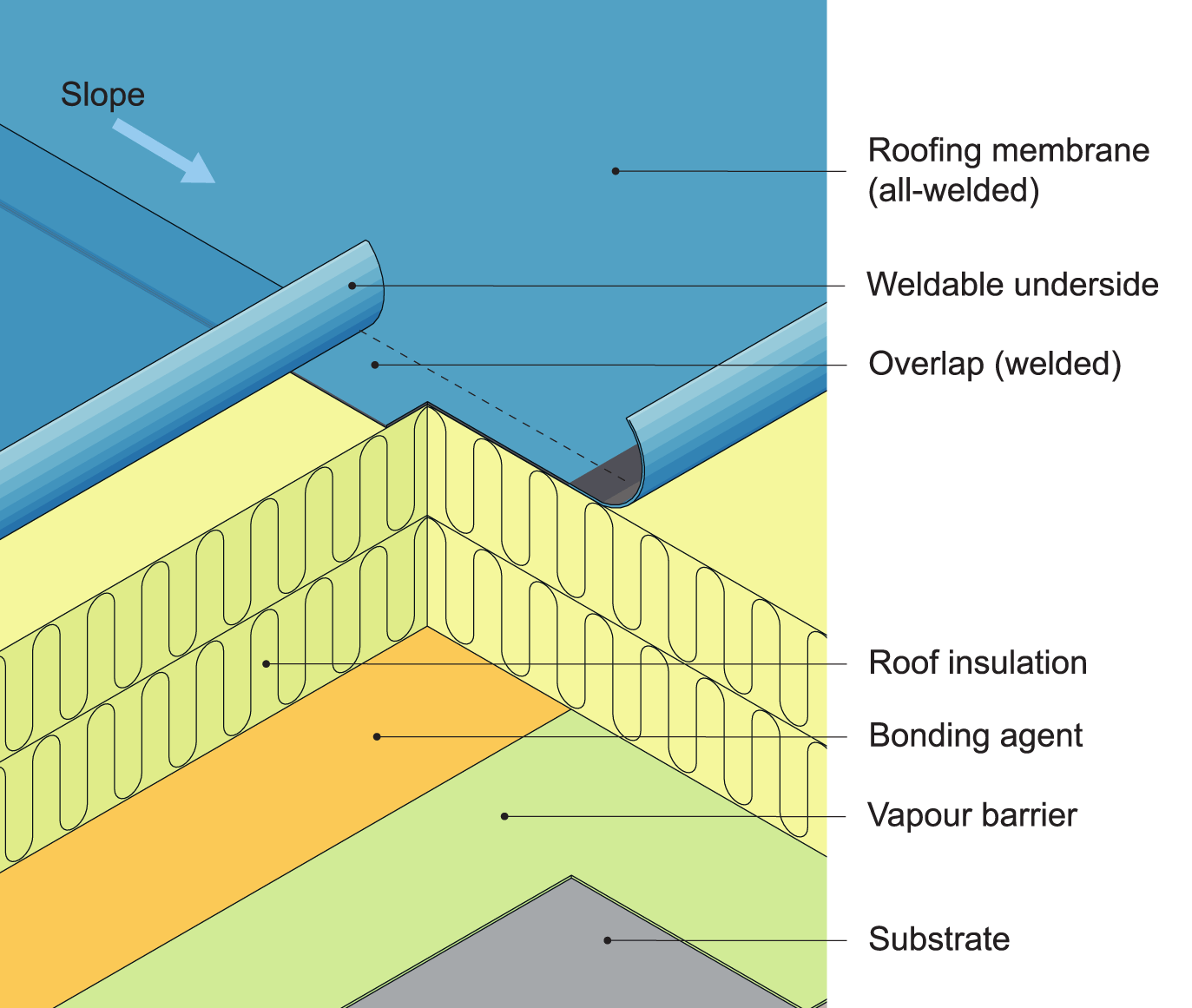
Figure 149. An example of a warm roof assembly with weldable roofing membrane. The membrane is fixed to the substrate (vapour barrier) by bonding and the membrane is fixed to the roof insulation purely by welding.
5.7.7 Details – Roofing Membranes
This section shows examples of typical detail design applied to membrane roofs. The examples are an assortment of one-ply membrane roofs with roofing foil and bituminous felt and two-ply bituminous felt roofs.
Please see installation instructions and further information from manufacturers.
When executing roof details, general guidelines for several issues must be taken into account (e.g., guidelines for ventilation and provisions by the Building Regulations concerning fire safety and thermal insulation). General issues concerning the choice of roof are outlined in Section 1.1, Roof Design.
Further examples of roof detail design are shown in Section 6, Dormers, Roof Lights, and Skylights, Section 7, Flashings – Penetrations, and Intersections, and Section 9, List of Examples.
Flashings
Normally, a flashing height of 150 mm is estimated for roofing membrane flashings against adjoining building parts. Special guidelines apply to roofing membrane flashings in green roofs (see Section 5.11, Green Roofs).
General principles for roofing membrane flashings against adjoining building parts are shown in Figure 150.
Further examples of roofing membrane flashings are shown in Section 7.3, Roofs with Continuous Roof Covering.
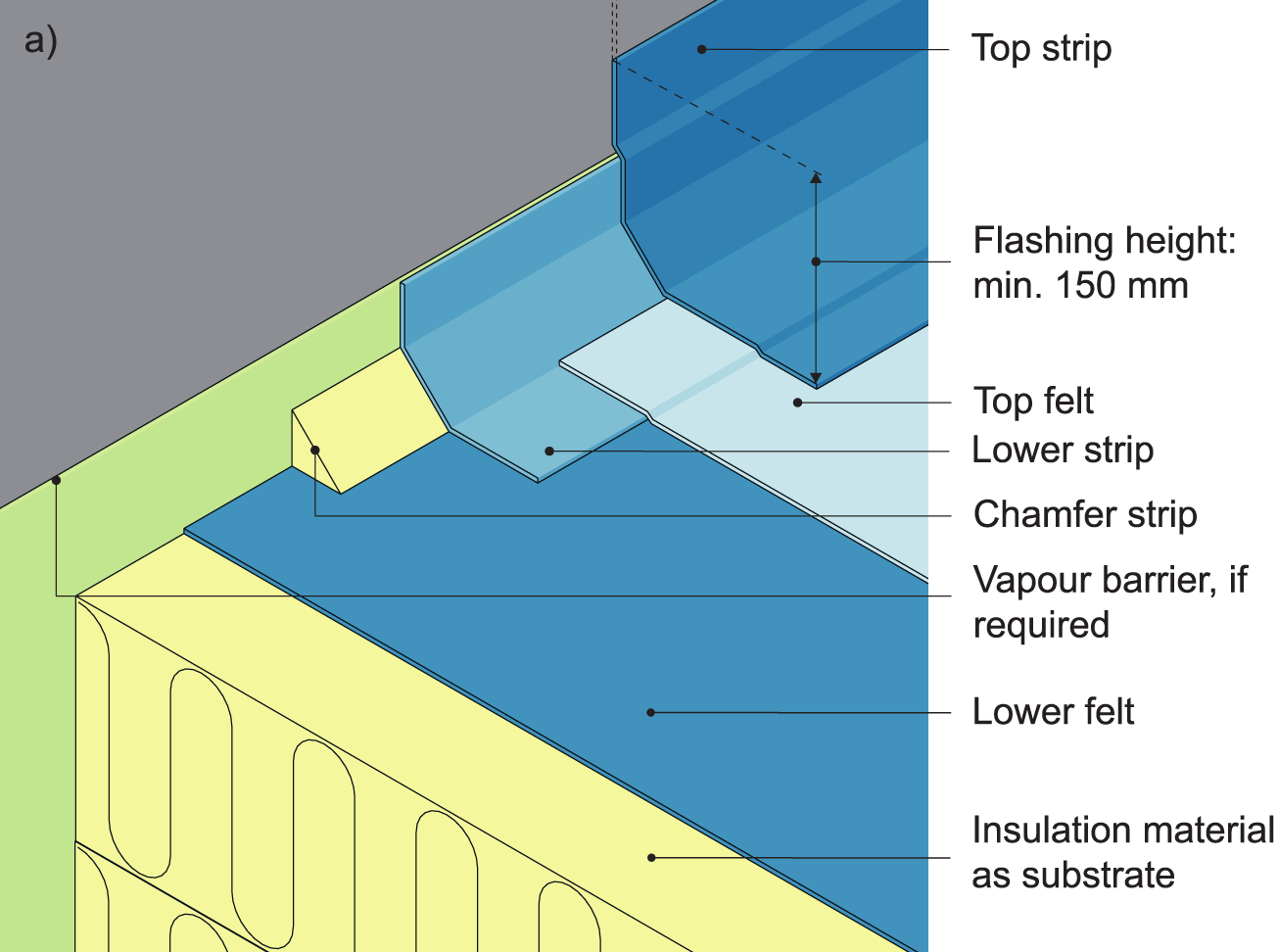
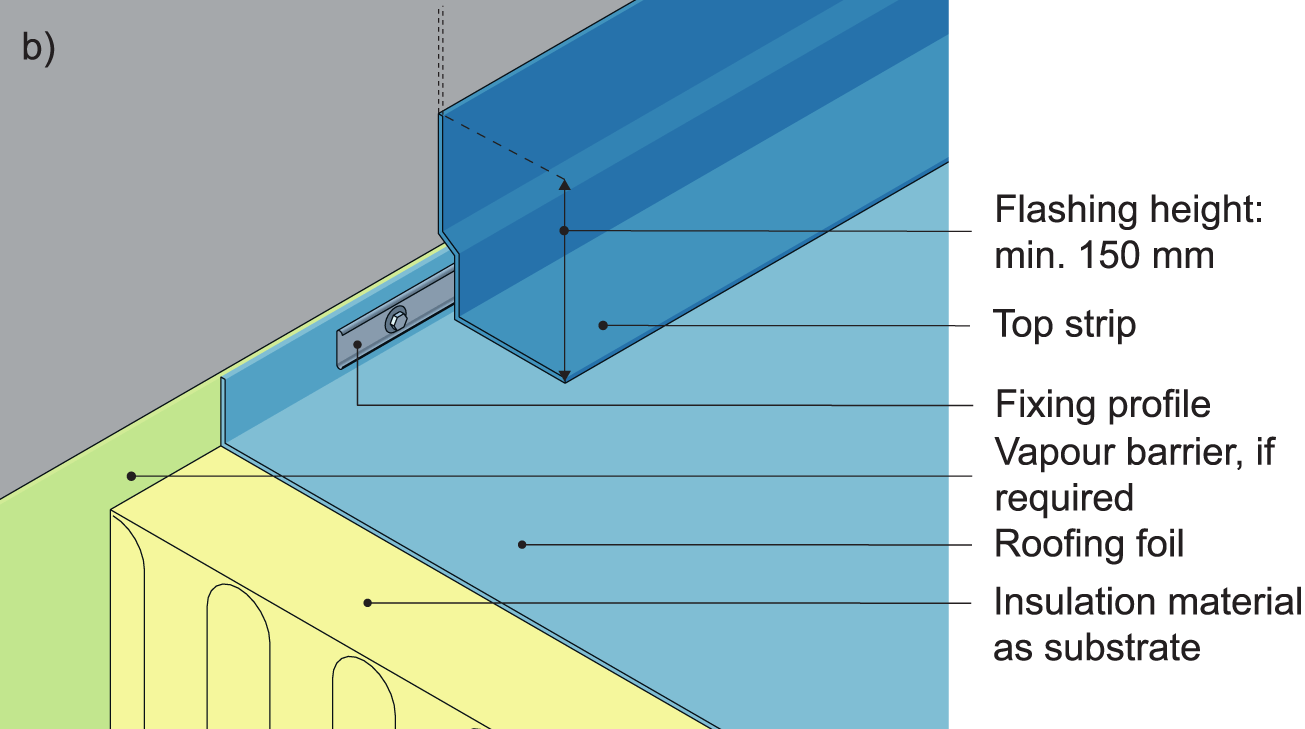
Figure 150. Principles for executing roofing membrane flashings against adjoining building parts. Generally, a flashing height of 150 mm is estimated for roofing membrane flashings against adjoining building parts.
- Schematic of two-ply bituminous felt flashing. Usually, the vapour barrier is also made of bituminous felt, so that the vapour barrier and roofing membrane can be welded together.
- Schematic of one-ply roofing foil flashing. The vapour barrier should be clamped in place (as shown) or be hot-gas welded to the roofing membrane.
Fascia
The fascia ensures that water cannot penetrate the assembly. Often, the roof covering is carried up and over the fascia and covered with a metal cap of aluminium.
On flat mono-pitched roofs, the roof edge on the highest side of the roof can be executed using a metal fascia cap or barge board to fix the roofing membrane (see Figure 151). The fascia cap should have a min. overlap of 100 mm with the exterior wall or fascia boards (bigger for exposed locations) to ensure that driving rain cannot penetrate below the cap. Furthermore, the fascia cap must end min. 20 mm from the fascia board or exterior wall and finished off with a drip edge 30 mm from the wall to ensure the discharge of rainwater from the building (Byg-Erfa, 2016b) (see Section 7.3.4, Flashing Parapet Walls).
In warm roof assemblies, the vapour barrier must be brought up along the inside of the fascia board and joined to the roofing membrane.
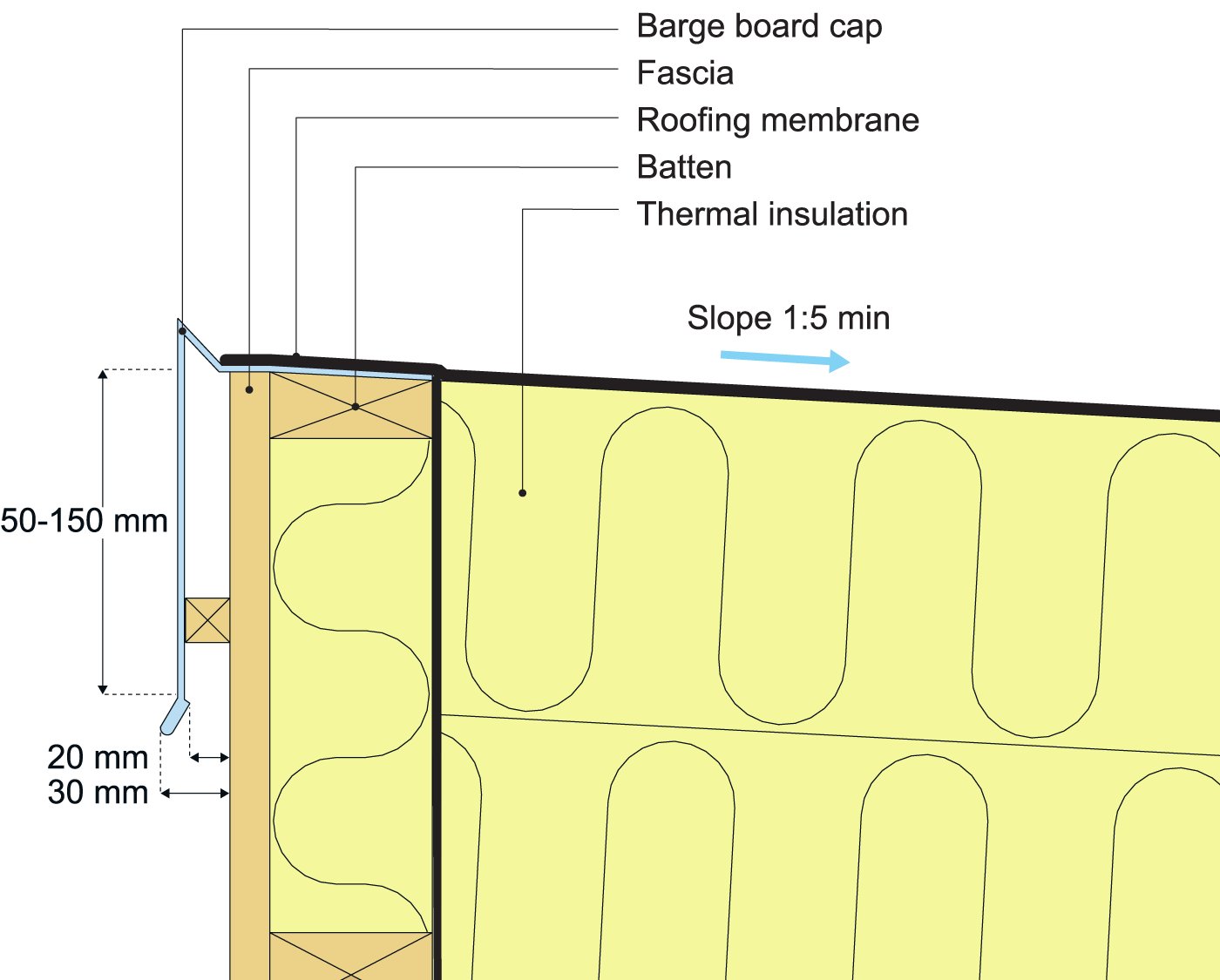
Figure 151. An example of flashing with fascia board and two-ply bituminous felt on a warm-roof timber assembly with a min. slope of 1:5.
5.8 Thatched Roofs
Thatched roofs are constructed on site using reeds laid in position and fixed to roof battens. The reeds usually come from reed forests in wet areas in Denmark or abroad.
Tightness is achieved by the reed overlap and the sheer thickness of the coatwork. The roof pitch should be min. 45 °.
Thatched roof designs vary up and down the country according to time-honoured local traditions. The building and eave designs vary. In modern thatched roofs, copper sheet ridges are sometimes used.
Thatched roofs are vapour-permeable, which can be used advantageously in the construction of roof assemblies, allowing moisture to escape through the roof by diffusion. However, an airtight vapour barrier must always be installed in the underlying structure to prevent moisture from accumulating.
Thatched roofs covered with a coatwork between 250–300 mm thick can provide thermal insulation. Depending on the thickness of the coatwork, the insulance factor corresponds to that of 50–60 mm mineral wool insulation (λ-value 37) if installed on a fire-rated fibre-glass sheet, and to that of 90–110 mm mineral wool if installed on a tight substrate such as plywood. If there is an open vented cavity space underneath the thatched roof, the thatch has no insulating value.
Thatched roofs normally belong to the category of heavy-weight roofs (see Section 5.1.3, Roof Pitch and Areal Weight).
Maintenance or Lifespan
Over time, a thatched roof will be broken down by weathering. The broken-down material will blow away and the thatched roof will become thinner until it will need to be replaced. The lifespan of a thatched roof depends on the roof pitch, orientation of the roof surface, shade from surrounding buildings or trees, and the quality of the material used. The lifespan will be longer if the thatched roof is exposed to plenty of light and air so that it can dry out. Therefore, it might be expedient to remove trees which will shade the thatched roof.
Valleys and dormer roofs have a lower slope than the rest of the roof surface and will therefore break down at a faster rate.
Maintenance consists of repairing minor damage and removing major moss growth.
Fire-Rating Thatched Roofs
Thatched roofs are flammable and traditional thatched roofs do not meet the usual fire safety regulations concerning roof coverings which require a minimum class of BROOF(t2) (cf. Bygningsreglementets vejledning til kapitel 5 – brand (Guidelines in the Building Regulations for Chapter 5 – Fire)) (The Danish Transport, Construction and Housing Authority, 2018e).
Principles and guidelines for constructing thatched roofs which meet applicable provisions for fire safety in accordance with the 2018 Building Regulations are outlined in more detail in Section 5.8.1, Fire Safety Regulations for Thatched Roofs.
Applicable Standards for Thatched Roofs
No product standards exist for thatched roofs, but they are normally executed according to the trade guidelines Veludført stråtag (A thatched roof well executed) (Tækkelauget, 2019) and Tækkebogen – Materialer (Book of Thatching – Materials) (Tarp, 2008).
The design and construction of thatched roofs is based on century-old traditions adapted to modern technology and requirements for roofs issued by the authorities.
5.8.1 Fire Safety Regulations for Thatched Roofs
To safeguard against fire spread to other buildings, there are strict requirements for thatched roofs relating to clearance between boundaries and neighbouring buildings which are less strict for roof coverings which meet class BROOF(t2). Furthermore, the fire resistance of the thatching substrate (and other building parts integrated into thatching) are subject to special requirements.
The requirements are relative to the specific application category, risk class, and fire class the proposed building belongs to (i.e., the usage and height of the building). In addition, insurance companies may require special fire protection measures to be implemented when issuing insurance policies (see Brandsikring af stråtage) (Fire-Proofing Thatched Roofs) (DBI Fire and Security, 1998).
Rules and guidelines about placing a building in an application category, risk class, and fire class are detailed in Chapter 5, Fire, in the 2018 Building Regulations (BR18, § 82–§ 158) and relevant guidelines (The Danish Transport, Construction and Housing Authority, 2018e).
Although thatched roofs do not meet the fire safety regulations for roof coverings as min. class BROOF(t2), they can be used for application class 4 and risk class 1 buildings. However, there are strict requirements for clearance between boundaries and neighbouring buildings.
Rules for protection against fire spread from thatched roofs are relative to the type of building. A distinction is made between the following:
- Detached single-family dwellings (including holiday cottages)
- Integrated single-family dwellings
- Other buildings in application class 4 (multi-storey residential buildings, student accommodation, etc.)
- Other application categories
In all cases, the thatched roof must be secured against collapse above exterior doors and other rescue openings in the event of fire.
Detached Single-Family Dwellings
For detached single-family dwellings, a distinction is made between fireproof and non-fireproof thatched roofs (cf. Bilag 1 – Præ-accepterede løsninger – Enfamiliehuse) (Annex 1 – Pre-accepted Solutions – Single-Family Dwellings in chapter 5 in BR18) (The Danish Transport, Construction and Housing Authority, 2018b). Clearance requirements between neighbouring buildings depend on whether the thatched roof is fireproofed or not.
A fireproofed thatched roof is one which has been thatched directly on to a class EI 30 building part without underlying cavities. Furthermore, said building part must be made of material class D-s2,d0 (class B material). For single-family dwellings with a fireproof thatched roof, applicable clearance requirements are min. 7.5 metres to a building with a BROOF(t2) roof covering and 10 metres to any other thatched building (The Danish Transport, Construction and Housing Authority, 2018b).
A non-fireproofed thatched roof in a single-family dwelling (e.g., a roof with an open unutilised loft space) can be installed if the corresponding clearances are increased to 12.5 and 20 metres, respectively.
In both cases, the loft assembly facing living quarters must be executed as min. class EI 30 and the supporting building parts must be min. class REI 30.
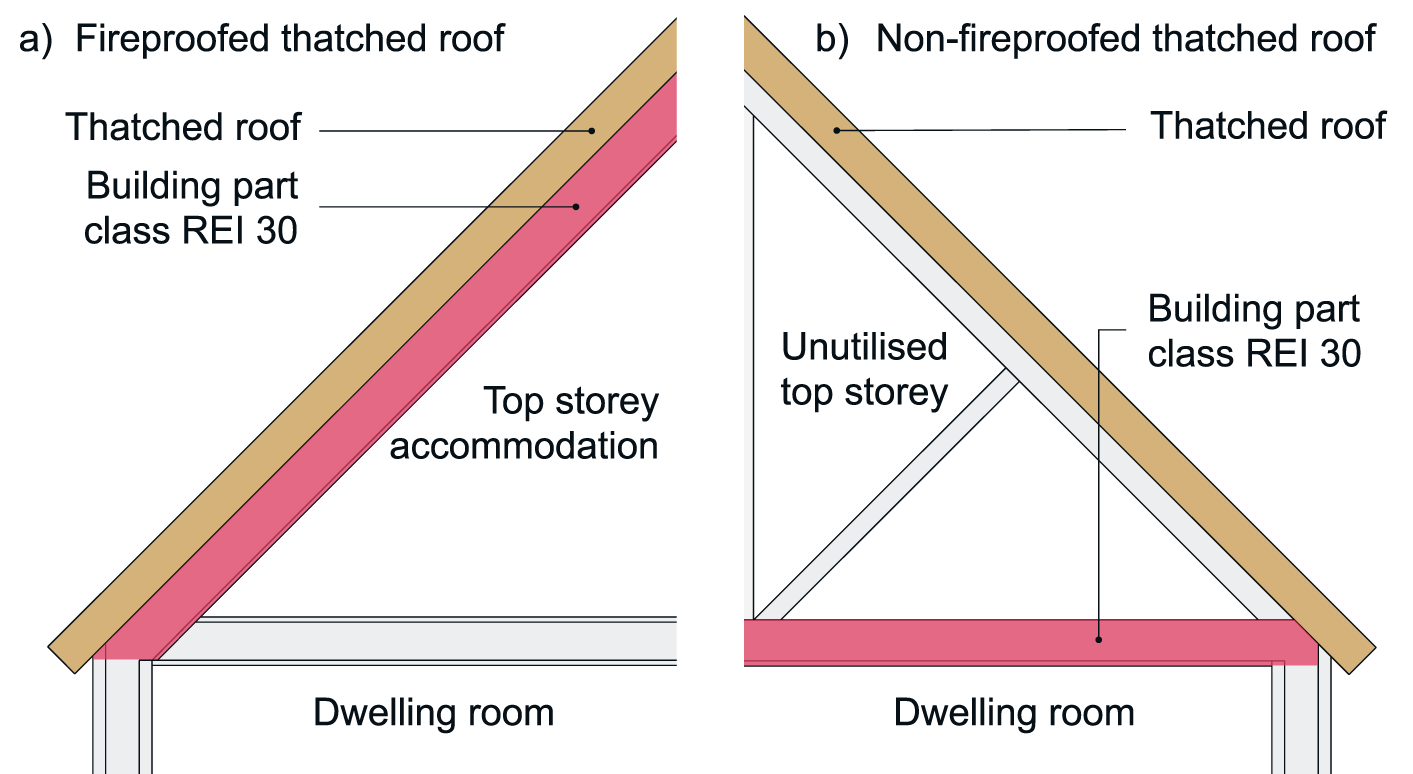
Figure 152. For single-family dwellings, a distinction is made between fireproofed and non-fireproofed thatched roofs.
- An example of a fireproofed thatched roof with an EI30 building part beneath the thatch.
- An example of a non-fireproofed thatched roof with an unutilised top storey and an EI 30 building part facing dwelling room.
Integrated Single-Family Dwellings
For integrated single-family dwellings, there must be a class EI 30 building part immediately under the thatched roof and any cavity between the thatched roof and building part EI 30 must be max. 100 mm. The cavity must be enclosed with min. material class A2-s1,d0 (non-flammable material) (e.g., mineral wool along edges and up to the fire-cell demarcation of neighbouring buildings). At minimum, partitions to dwelling rooms must be class REI 30 building parts and the supporting building parts must be class REI 30.

Figure 153. An example of a thatched roof assembly above integrated single-family dwellings with building parts EI30 underneath the thatched roof. Any cavity space between the thatched roof and building part EI 30 is enclosed along edges with material class A2-s1, d0 (non-flammable material) (e.g., mineral wool) (in yellow) (Danish Energy Agency, 2016) (see also Section 5.8.5, Details – Thatched Roofs).
Other Buildings or Categories
For other buildings in application category 4, thatched roofs may be used where the floor of the top storey is max. 5.1 metres above ground level. Immediately below the thatched roof, there must be a building part of minimum class EI 30 and vertical party walls must at minimum be built as EI 60. Any cavity between the thatched roof and a fireproof building part must not exceed 100 mm. All cavities must be enclosed along the edges of the roof covering with material of min. class A2-s1,d0 (non-flammable material) (e.g., mineral wool) as described for integrated single-family dwellings. All vertical fire-cell partitions must be continued up near to the EI 30 partition under the thatched roof.
Office Buildings
Office buildings can be built as application category 4 buildings while buildings for educational purposes and community centres can only be constructed with a roof covering meeting BROOF(t2) requirements.
5.8.2 Roof Pitch for Thatched Roofs
The roof pitch of thatched roofs should not be less than 45 ° and, for new roofs a 50 ° roof pitch is recommended.
The slope of the reeds is lower than that of the roof because of the installation method (see Figure 154). If the roof pitch is reduced to below 45 °, durability will be reduced proportionately to the shallower pitch.
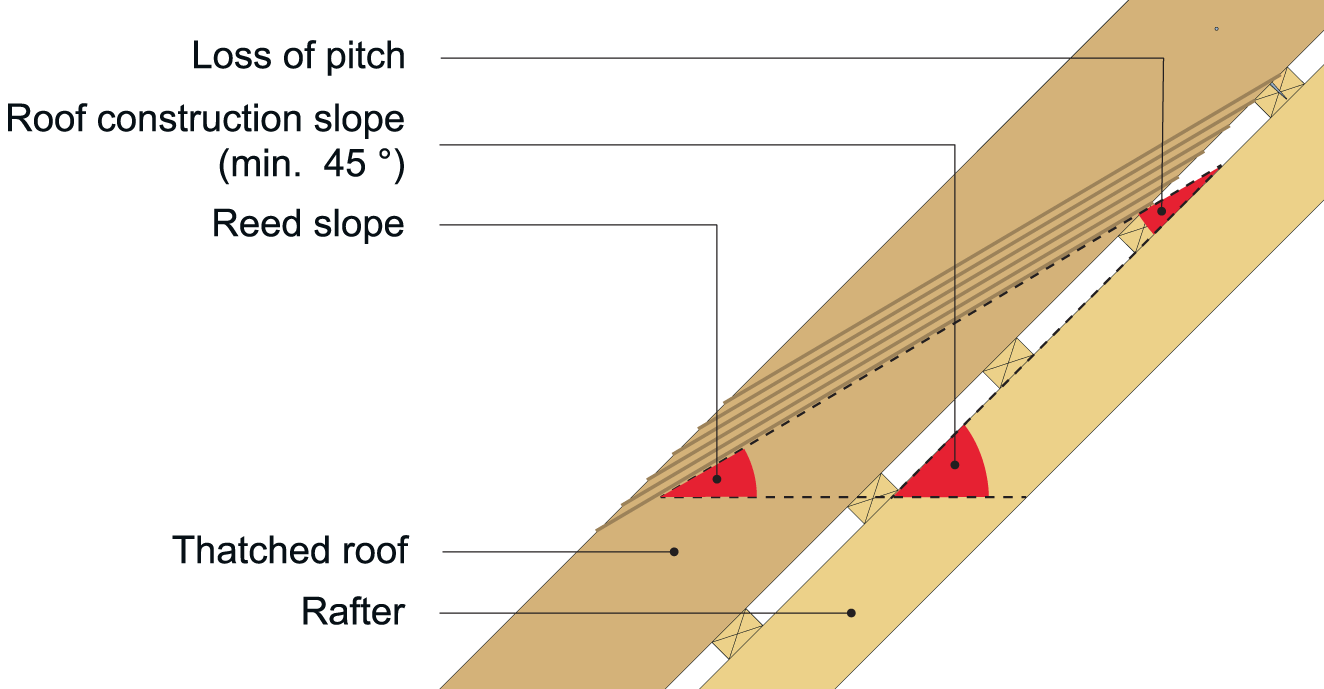
Figure 154. Reed pitch is vital for the lifespan of the thatched roof and a roof slope of min. 45 ° is therefore recommended.
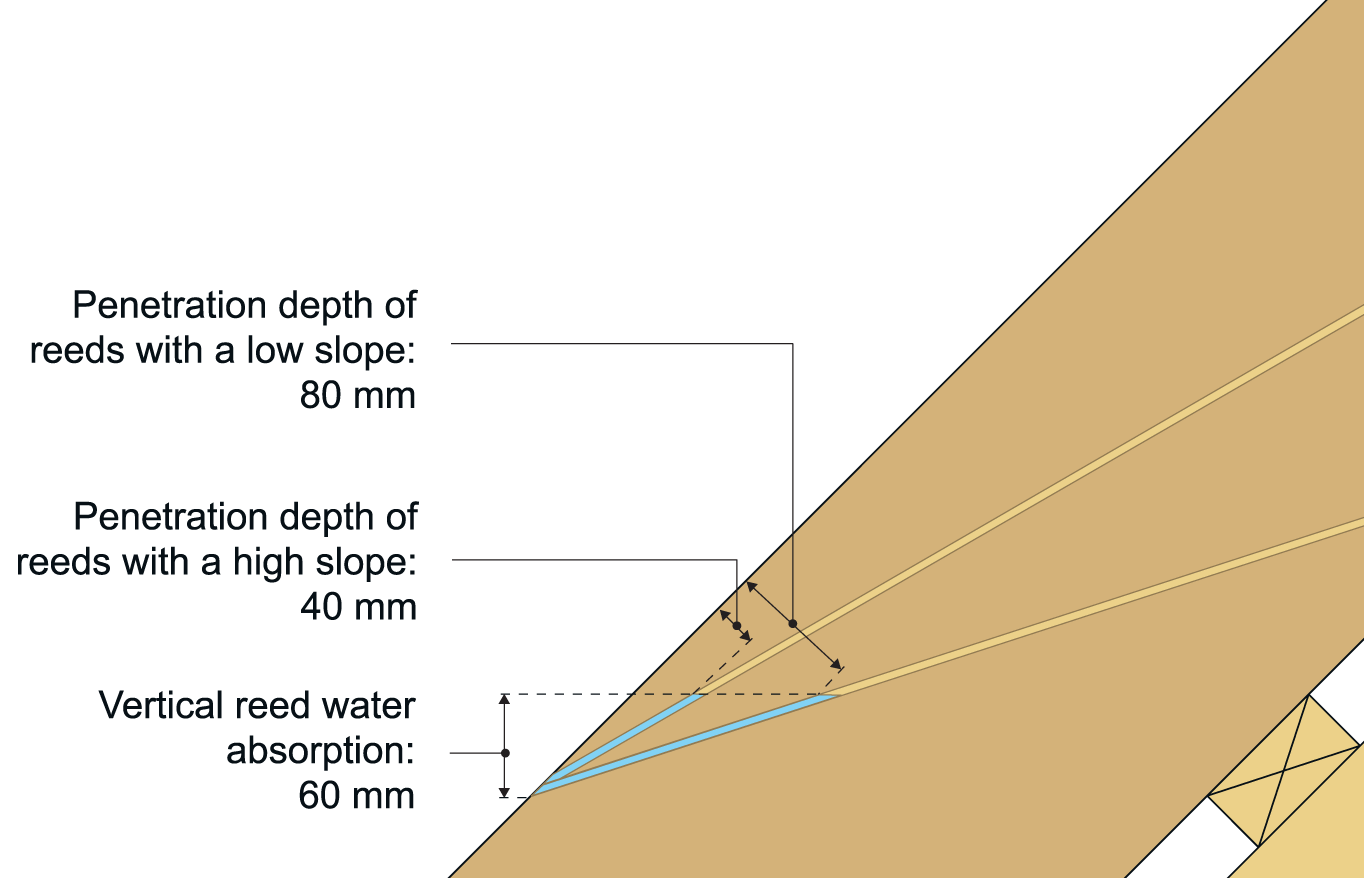
Figure 155. The pitch of the reeds on the roof is lower than that of the roof itself and the lower the reed slope, the longer the period during which the reeds absorb water. Thus, roof penetration depth will increase proportionally to the shallowness of reed pitch.
5.8.3 Constructing a Thatched Roof
Thatched roofs are normally laid on a supporting structure of timber rafters (e.g., attic trusses or lattice trusses).
Besides the reeds themselves, the following elements may be used for a thatched roof:
- Roof battens or sheeting substrate
- Fireproof membrane
- Steel rods (thatching screws with fixing wire for fixing).
Examples of thatched roof detail design are shown in Figures 156–160.
Thatched Roof on a Fireproof Membrane
Thatched roofs can be fireproofed using a fireproof membrane between the reeds and the roof battens (see Figure 156), if a fireproof membrane is installed under the thatch and the distance to adjoining buildings might possibly be reduced (as determined through experiments) (see Section 5.8.1, Fire Safety Regulations for Thatched Roofs).
When using a membrane for fireproofing, this must have a Z-value of less than 3 GPa s m2/kg to protect against moisture accumulation.
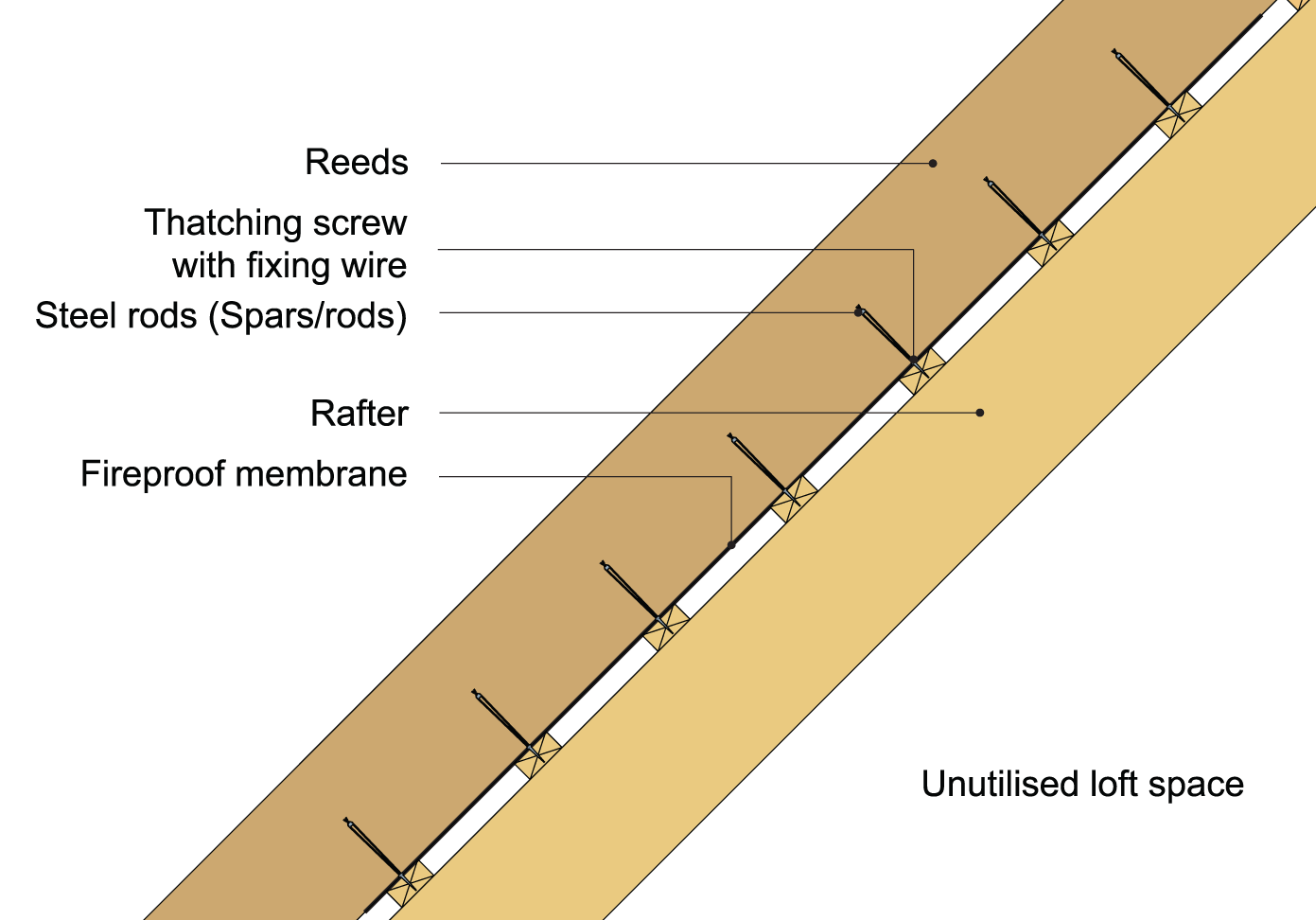
Figure 156. An example of a thatched roof assembly with unutilised loft space. A fireproof membrane is used for fireproofing.
Thatched Roof on Sheet Decking
Thatched roofs can also be fireproofed by installing them on a sheet decking (e.g., plywood) without an underlying cavity space on a class EI 30 building part constructed with materials of minimum class D-s2,d2 (shown in Figure 157).
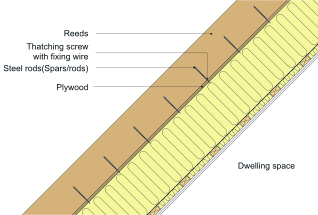
Figure 157. An example of a thatched roof assembly with utilised loft space. Fireproofing is achieved by laying the reeds directly on sheet decking without an underlying cavity space on a class EI 30 building part constructed with material of minimum class D-s2, d2 (e.g., plywood).
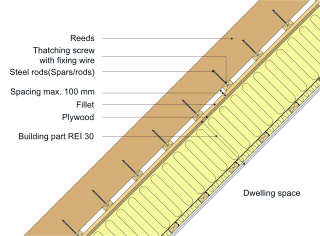
Figure 158. An example of a fireproofed thatched roof on an REI 30 building part for a detached single family dwelling with dwelling space under the roof.
Non-Fireproofed Thatched Roof with Unutilised Loft Space
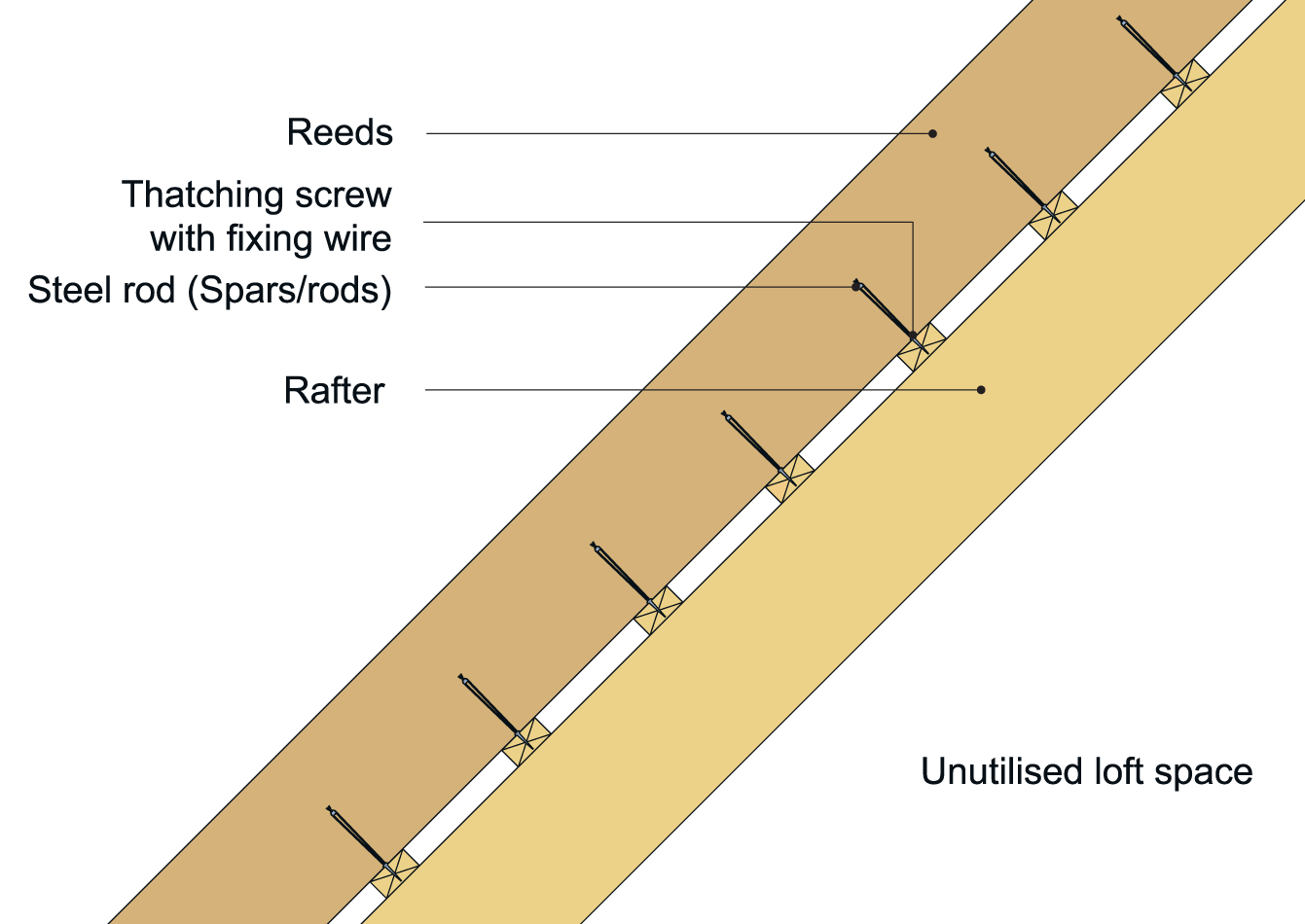
Figure 159. An example of a non-fireproofed thatched roof, applicable where loft spaces are not utilised and where the storey partition facing the dwelling space has been fireproofed (see Figure 152b).
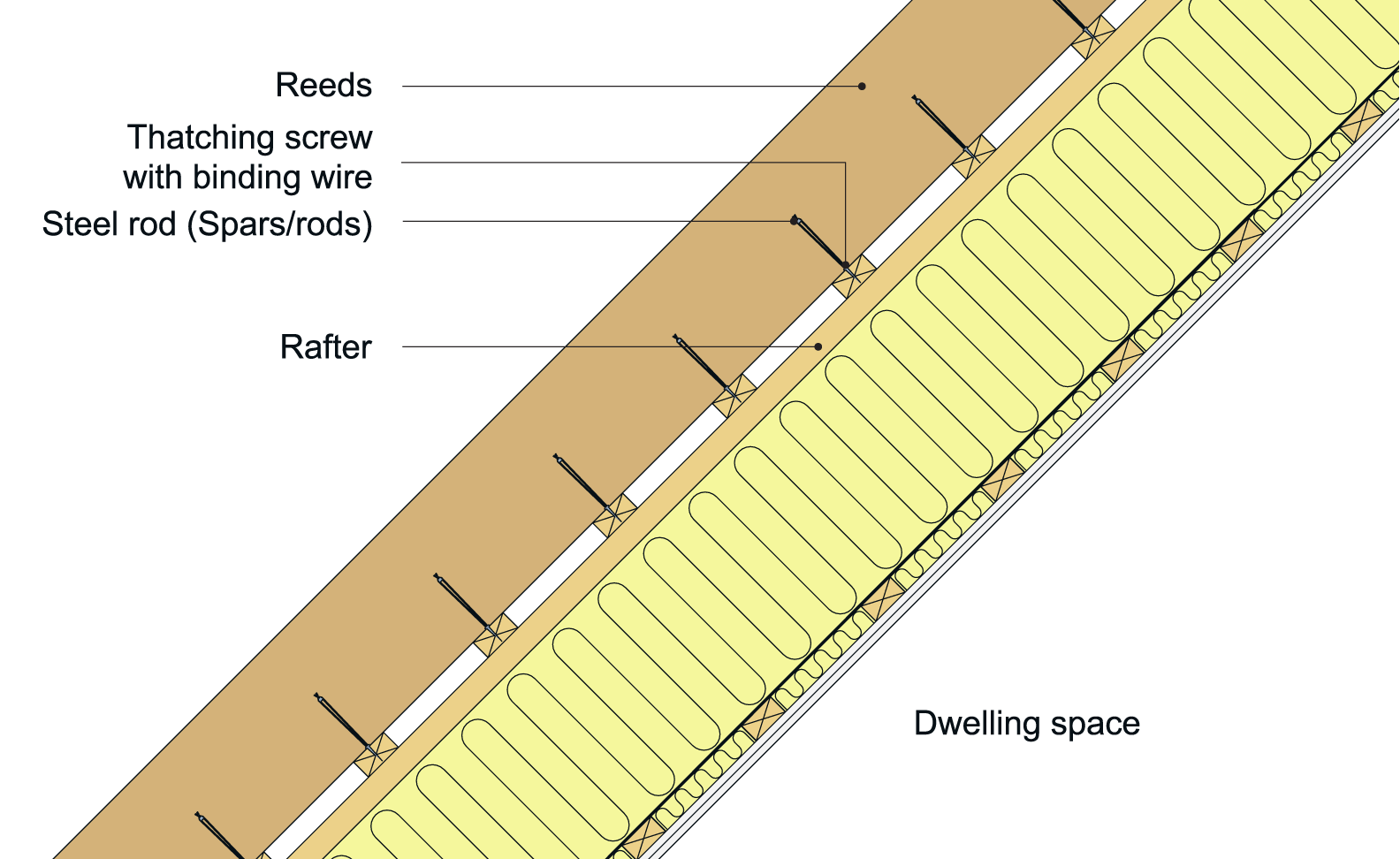
Figure 160. An example of a thatched roof structure on roof battens with an underlying cavity space on an EI 30 decking structure.
5.8.4 Installing a Thatched Roof
Thatched roofs can be installed on roof battens spaced out at 250–350 mm (see Figure 161), or directly on sheet decking (see Figure 157).
Rules and guidelines for roof battens are listed in Section 2.6.1, Roof Battens. For a detailed description see TRÆ 65 (Træinfomation, 2011).

Figure 161. Batten spacing and eaves design for thatched roofs.
Fixing the Coatwork
The coatwork is fixed to the roof battens in one of the following ways:
- Using steel rods (fixed roof)
- Stitched roof
Steel-rod fixing is performed by inserting steel rods in the coatwork. The steel rods consist of 6-mm reinforced steel laid crosswise to the reeds and fixed to the roof battens with corrosion-resistant wire which holds the reeds in place. Steel rods for reed fixing must be made of hot-galvanised or stainless steel. They are fixed using crooks or screws, preferably made from stainless steel. Wire-and-screw fixing is also used when fixing the coatwork to sheet decking.
A stitched roof is executed with reeds tied onto the battens with corrosion-resistant wire.
The coatwork must be 250–300 mm thick and there must be a min. 100 mm thick reed layer (levelling course) above the steel rods (see Figure 162).

Figure 162. An example of a roof assembly for coatwork fixed to roof battens with steel rods and fixing wire. The levelling course must be min. 100 mm thick. As a fireproofing measure, a so-called fireproofing membrane can be installed under the reeds.
5.8.5 Details – Thatched Roofs
This section shows examples of typical detail design applied in thatched roofs. For installation instructions and further information see manufacturer guides and the Tækkelauget (Thatchers’ Guild).
When designing roof details, guidelines for several general issues must be considered (e.g., guidelines for ventilation and Building Regulations provisions concerning fire safety and thermal insulation). General issues concerning the choice of roof are outlined in Section 1.1, Roof Design.
Further examples of roof detail design are shown in Section 6, Dormers, Roof Lights, and Skylights, Section 7, Flashings – Penetrations, and Intersections, and Section 9, List of Examples.
For details such as hips, valleys, and dormers, the reed pitch must be as steep as possible to ensure a long lifespan.
Eaves
The eave-to-roof surface angle must be pointed to enable rainwater to drain away. In some cases, the eaves are executed with clay tiles on the lowermost part to discharge rainwater into a gutter.
Example eaves with visible and concealed tilting fillets are shown in Figure 163.
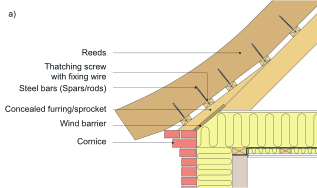
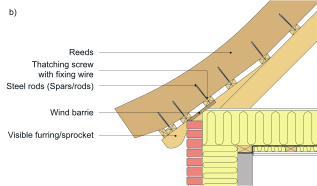
Figure 163. An example of a thatched roof eave design.
- Eaves with a concealed tilting fillet.
- Eaves with a visible tilting fillet.
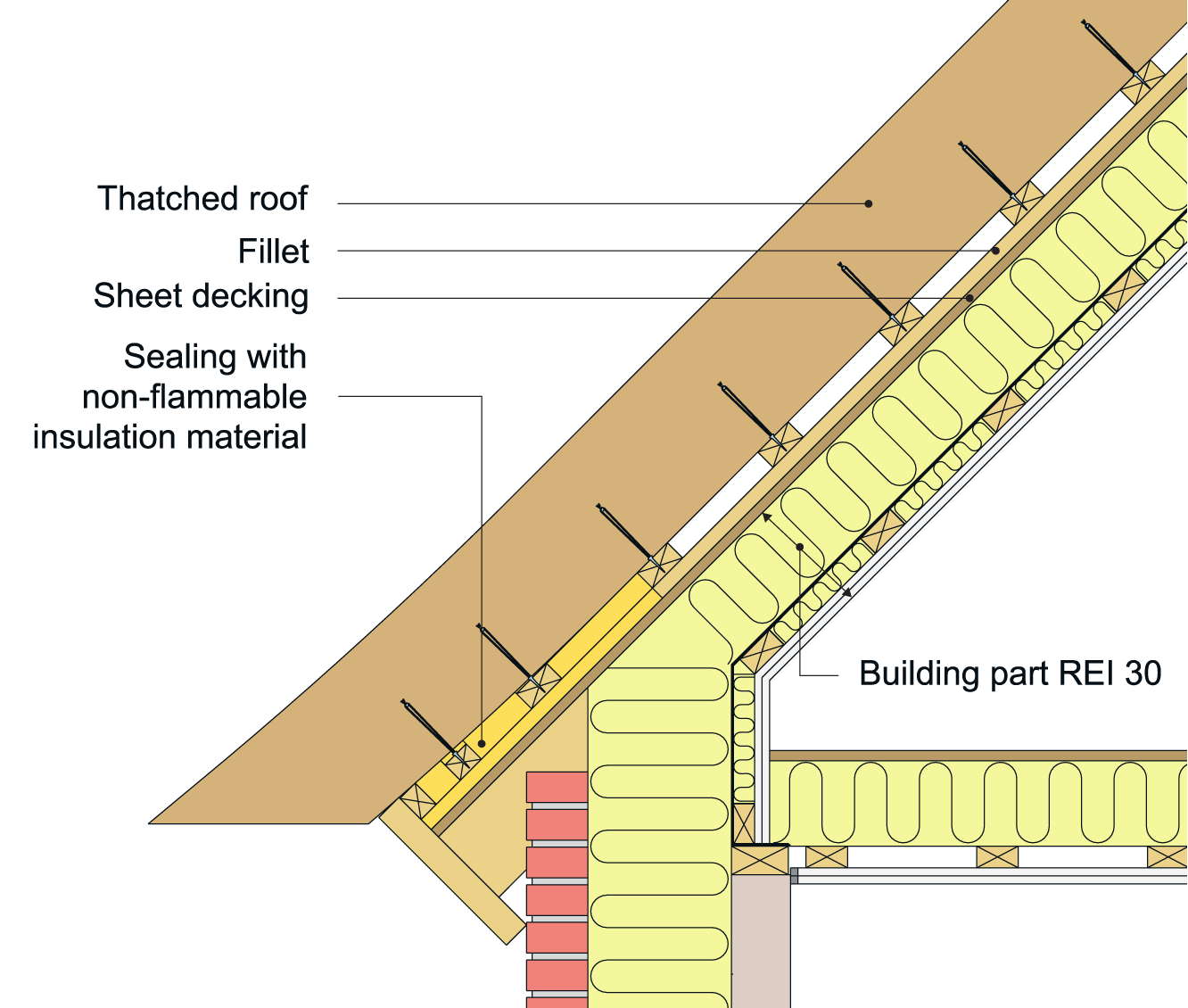
Figure 164. An example of fireproofing within eaves in an integrated single-family dwelling with utilised loft space.
Ridge
Ridges on thatched roofs vary according to area and can be executed with:
- Straw ridges with oak ridge cross poles
- Stitched ridges
- Heather ridges
- Turfed ridges
- Copper ridges
Copper ridges are common in especially in modern thatched roofs. Both straw and heather ridges are typically fixed using wire netting.
Examples of thatched roof detail design are shown in Figures 165–167.
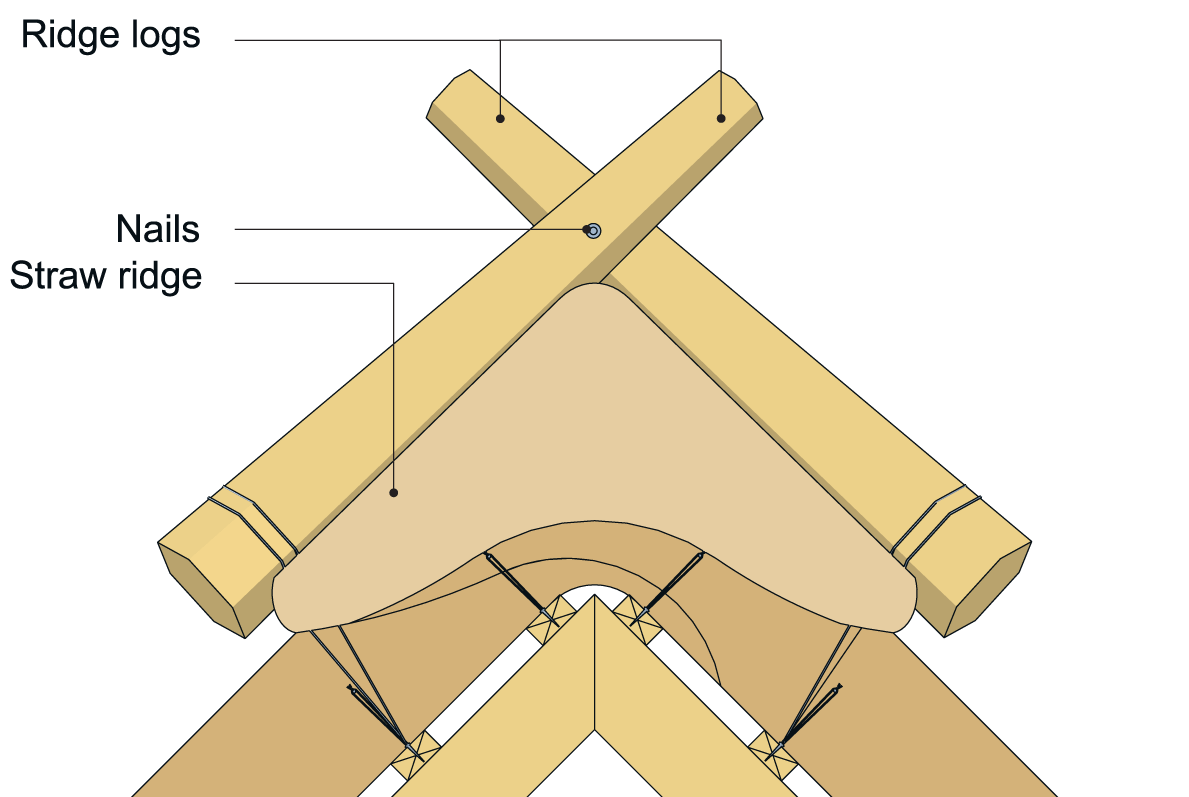
Figure 165. An example of a straw ridge held in place by ridge cross poles.
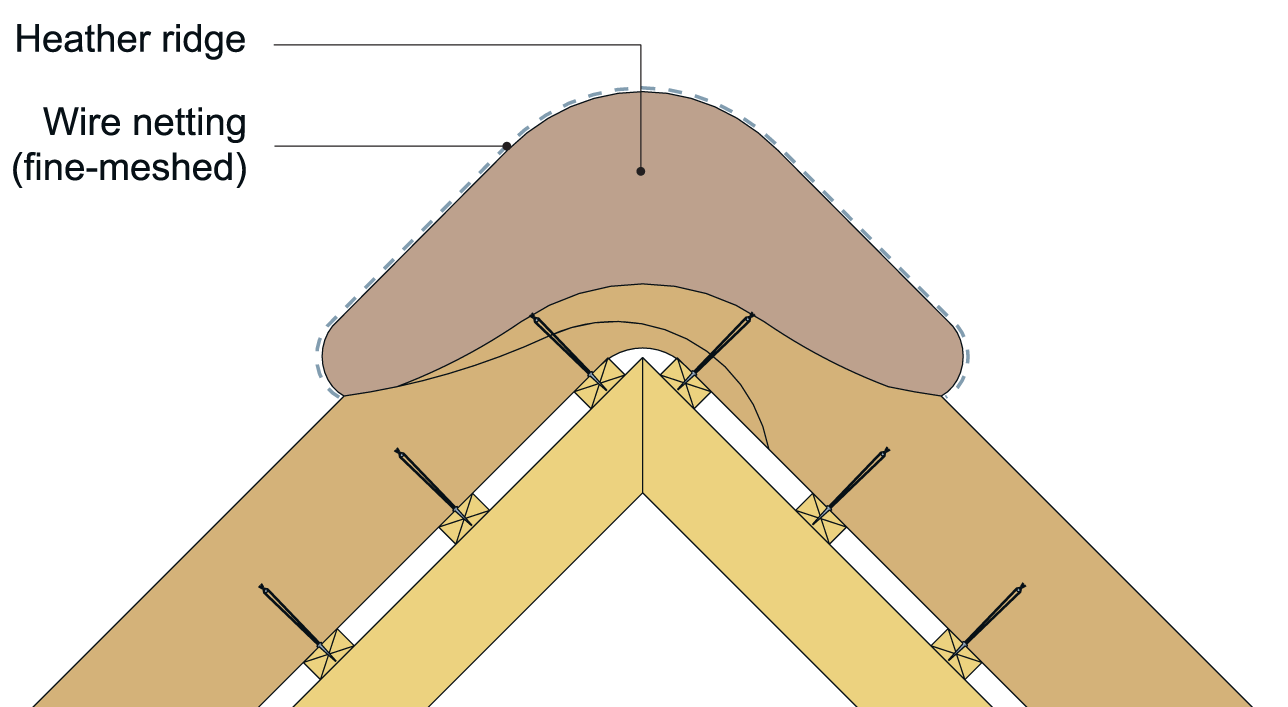
Figure 166. An example of a heather ridge held in place by fine-meshed wire netting.
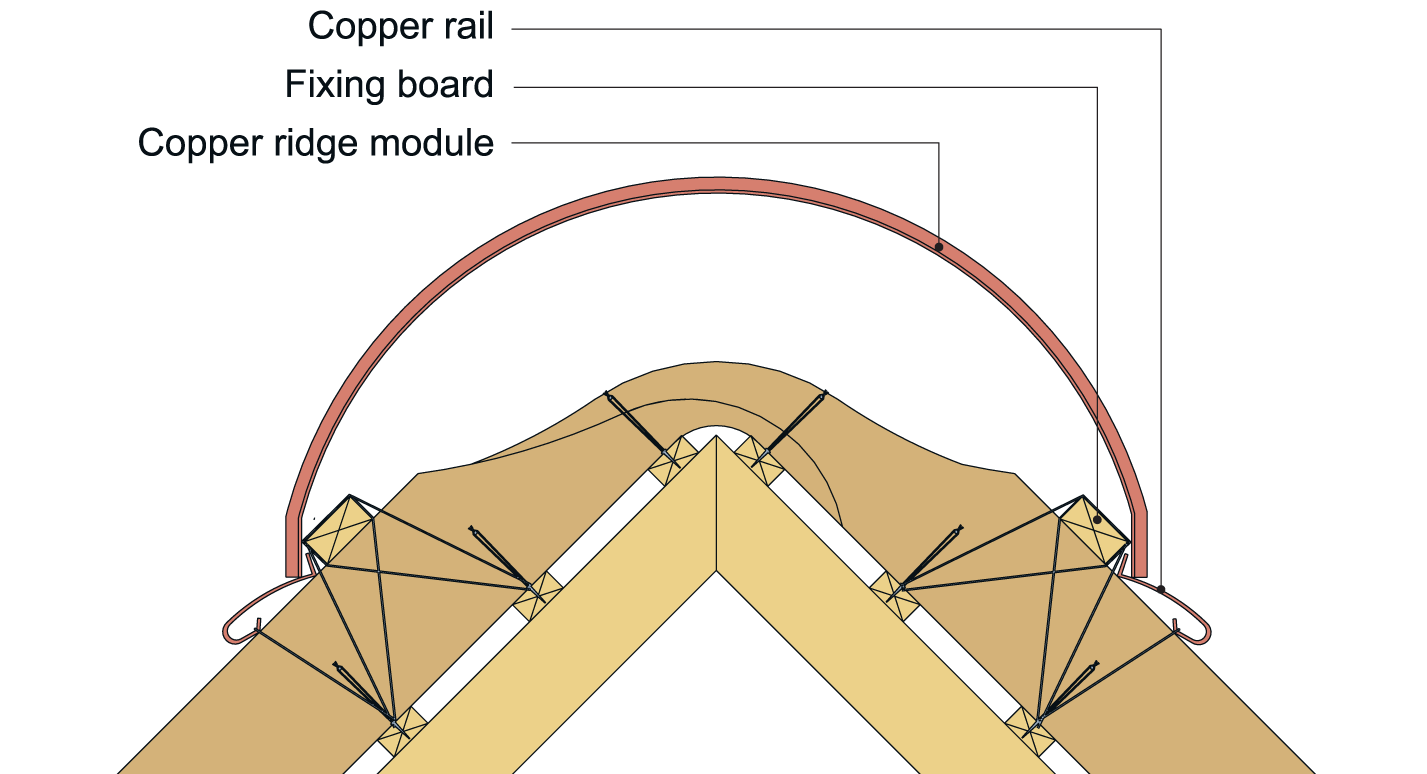
Figure 167. An example of a stitched copper ridge.
Dormers
Dormers can be integrated into thatched roofs but require an underlying timber structure. Below the dormers, wood boards placed at an angle are typically installed to discharge rainwater dripping from the dormer eaves.
Examples of dormer detail design in thatched roofs are shown in Figures 168–169.
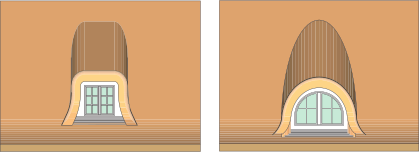
Figure 168. An example of a dormer design in thatched roofs.
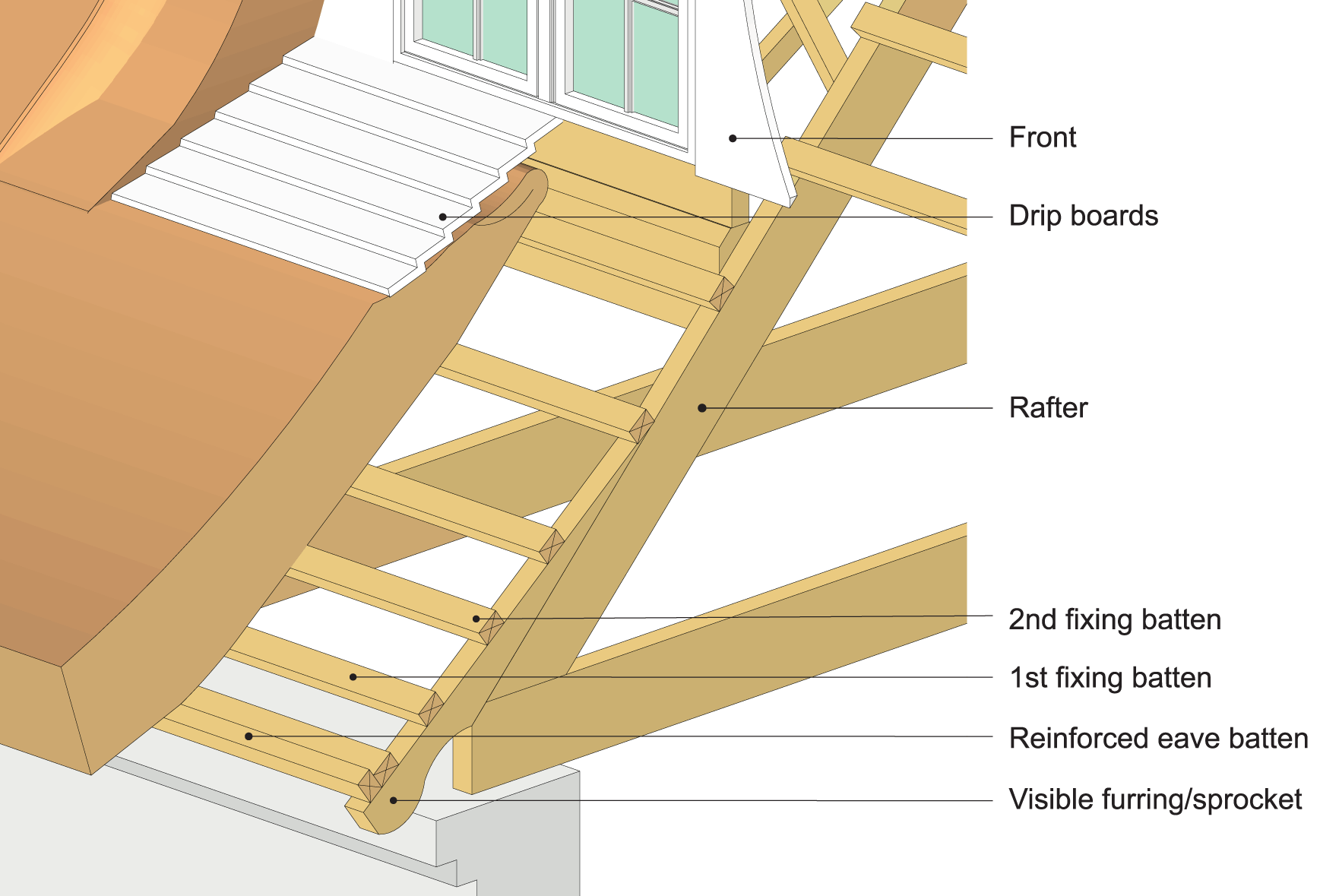
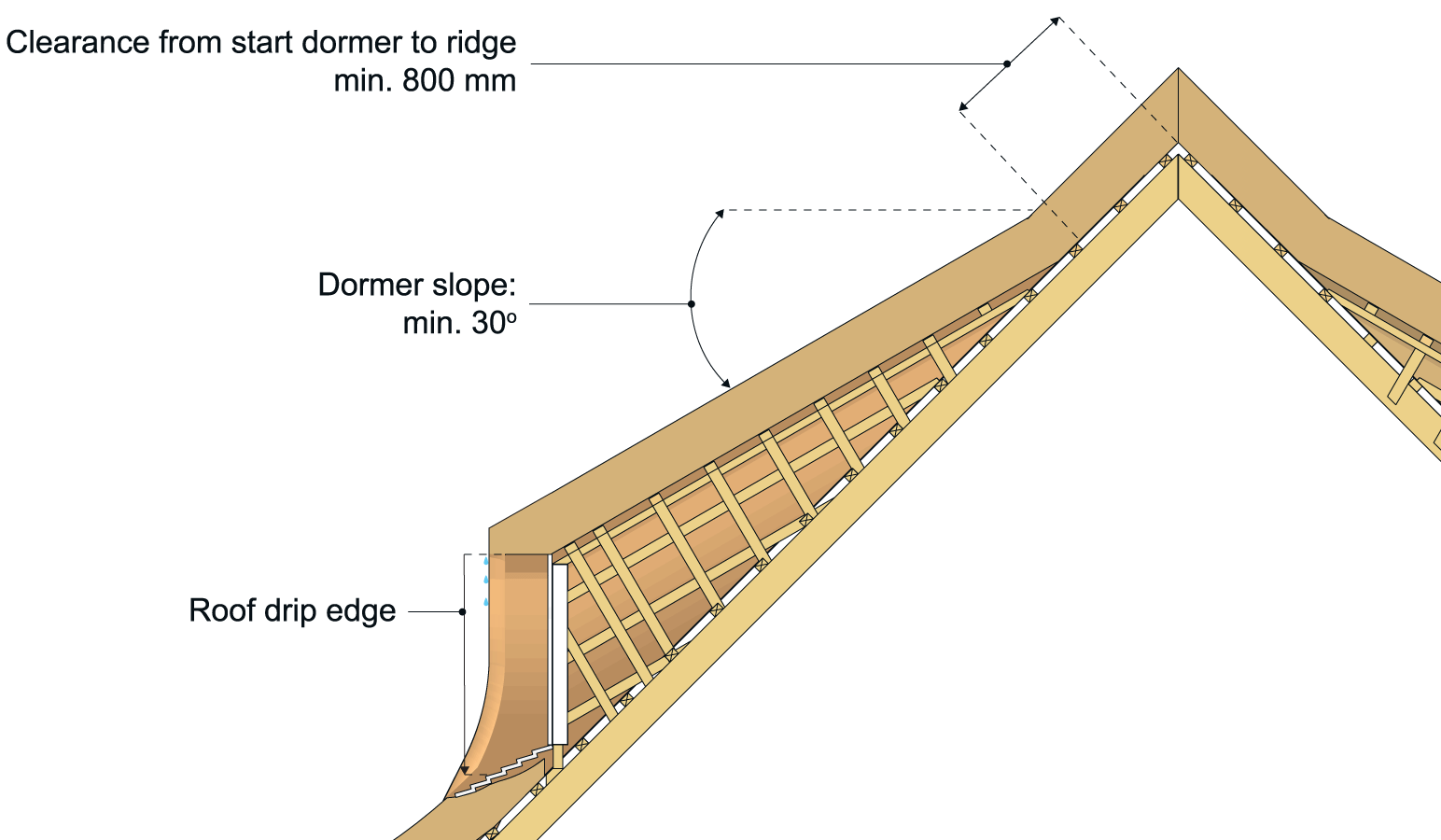
Figure 169. Examples of dormer structures. The roof of the dormer must have a min. pitch of 30 °. The dormer roof must be designed with a ’roof drip edge’, to ensure that water will drip from the eaves onto the canting strip.
Chimney
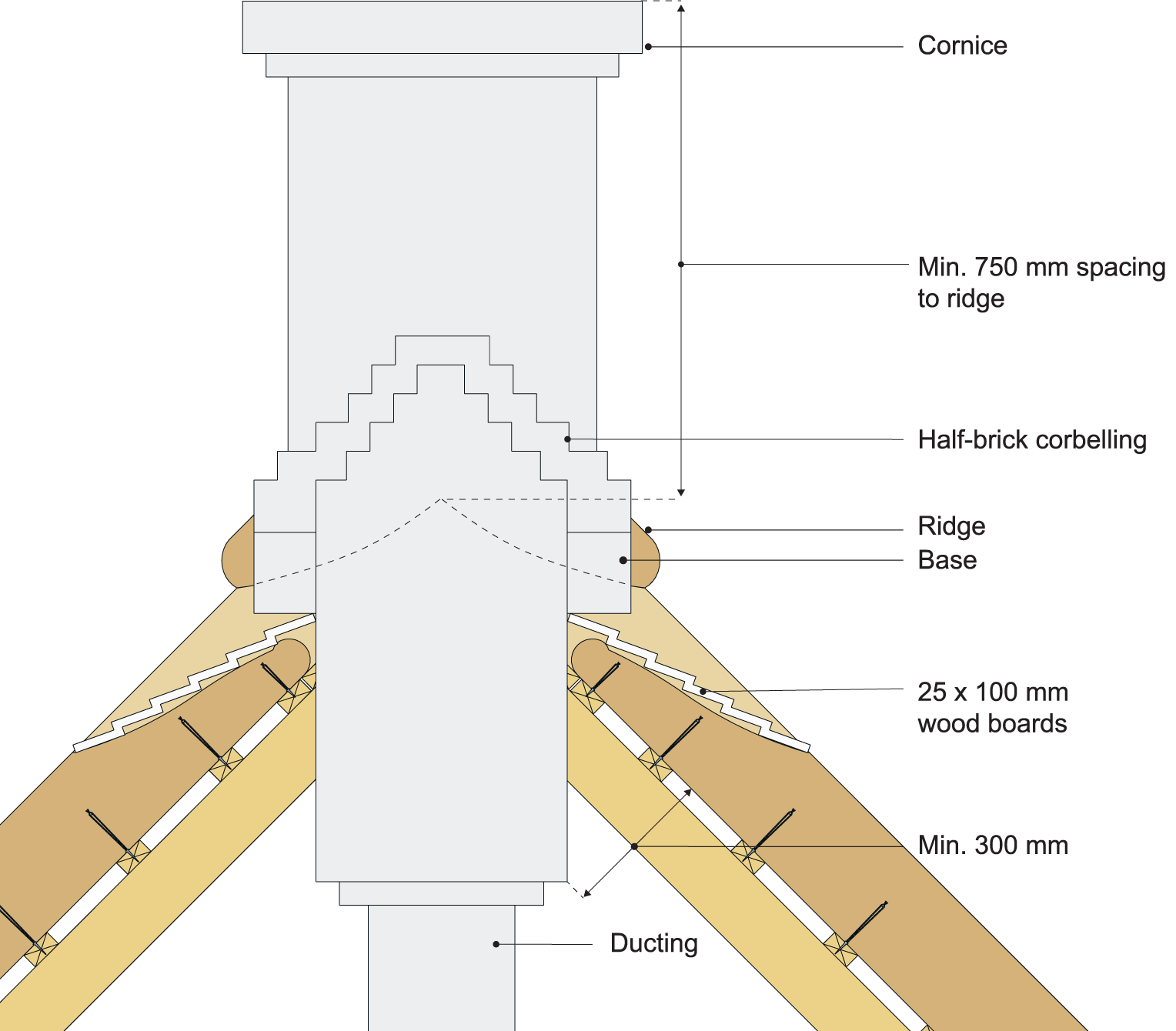
Figure 170. An example of a chimney penetration in a thatched roof bricked up with corbelling above the reeds and ridge. Rainwater from the chimney pot drips onto the canting strip.
5.9 Roofing Shingles
Roofing shingles are wood shingles cut with a tapered cross section enabling them to be laid in a close-fitting layer as roof or facade cladding.
Roofing shingles are made of many different types of wood, but experience shows that the most durable roofs and facades are achieved when core wood from western red cedar, false acacia, oak, larch, or Scots pine is used.
The advantage of roofing shingles is that each shingle (wooden piece) is small and thus fit snugly round the shape they are meant to cover. Roofing shingles can therefore be used on curved surfaces.
Shingle roofs belong to the category of light-weight roofs (i.e., with a load of max. 0.25 kN/m2) (see Section 5.1.3, Roof Pitch and Areal Weight).
Wood shingles for roofs and facades have been used in Denmark since the Viking Age and to varying degrees ever since. In tandem with an intensified focus on sustainability, wood shingles are increasingly used as roof and facade cladding because they are both CO2 neutral and renewable.
Durability and Lifespan
The lifespan of shingle roofs depends primarily on the type of wood used, the roof pitch, and the layer thickness used. For some types of wood routine maintenance can also affect lifespan.
The natural durability of false acacia, western red cedar, and oak is excellent. False acacia is classed in durability classes 1–2, which are the most and second-most durable natural materials, according to the European standard DS/EN 350-2 (Danish Standards, 1995). Western red cedar and oak are both in durability class 2, larch is in class 3, and Scots pine is in classes 3–4.
In practical terms, this means that shingle roofs of western red cedar and false acacia can be used without surface treatment. Although oak may be very durable, experience shows that oak shingles should be protected against deterioration. The natural durability of larch and Scots pine in particular, are less than the three preceding wood types. Consequently, larch and Scots pine roofing shingles should be treated with a wood preservative to achieve adequate durability (see the section Wood Preservation and Surface Treatment).
Wood Preservation and Surface Treatment
Although roofing shingles of western red cedar and false acacia will not require routine maintenance, it is a good idea to treat them once with a clear saturating wood preservative immediately after laying them.
Oak shingles are often used for roofs whose appearance is intended to look tarred. Vacuum-impregnation of oak shingles prior to laying will significantly increase their durability. The impregnation works as a fungicidal primer for subsequent surface treatment (e.g., with wood tar). Wood tar must be applied as quickly as possible after laying to protect the vacuum impregnation against leaching in rainy weather. Wood tar is a potential allergen and harmful to the environment. Therefore, it is essential to study and adhere to the guidelines for the product carefully.
Instead of wood tar, shingle roofs can be treated with a colourless oil-based wood preservative or preferably with a pigmented wood oil product. Pigmented products provide better protection than colourless ones, but the effect is limited.
Untreated larch and Scots pine shingles are not as durable as false acacia and western red cedar, but if they are pressure-impregnated using an agent containing copper, their durability will improve considerably. If a subsequent wood-tar treatment is envisaged, the effect of the impregnation will (as for oak) be improved for the shingle roof.
Surface treatment must prevent rainwater from penetrating the wood and simultaneously allowing moisture from the wood to evaporate. Any surface treatment must therefore be vapour-permeable to ensure that the roof can dry out after rain and snowfall.
Flashing the ridges and hips using copper may substantially prolong the lifespan of shingles.
Fire Rating
To comply with the fire safety provisions in the 2018 Building Regulations, shingle roofs should be fireproofed as outlined in chapter 5, Fire, (BR18, § 82-§ 158) and the accompanying guidelines (The Danish Transport, Construction and Housing Authority, 2018e).
These state that the roof covering must be a minimum class BROOF(t2). If the normal clearance requirements to boundaries and other buildings on the same plot of land are to be complied with, the requirements applicable to thatched roofs are also applicable to shingle roofs (see Section 5.8.1, Fire Safety Regulations for Thatched Roofs).
It is incumbent upon the manufacturer of the roofing shingle to document that wood-shingle roofs comply with the provisions of BR18 and the accompanying guidelines. Since shingle roofs are not among the pre-accepted solutions in BR18, shingle coverings are subject to fire-testing on the actual substrate to ensure that the overall assembly complies with the requirements for class BROOF(t2).
Structural shingle-roof designs complying with class BROOF(t2) are evident from the fire-testing documentation supplied by individual manufacturers and possibly from a voluntary MK-approval based on the content of the fire test. Several manufacturers offer certified solutions (e.g., stipulating that western red cedar shingle roofs must be installed on a substrate of min. 18 mm structural plywood) according to manufacturer instructions to comply with fire class BROOF(t2).
5.9.1 Types of Roofing Shingle
Wood shingles should be quarter-cut (i.e., so that the growth rings are mainly at right angles to the shingle surface) to ensure that they remain dimensionally stable (limiting the curving and shrinking as much as possible).
Most wood shingles are manufactured by sawing while only a minority, known as wood shakes, are made by splitting bolts of wood. A sawn surface is less water-repellent than a split one because sawn fibres allow more moisture absorption than a split surface.
A side view of the wood shingles reveals that they are tapered, enabling them to be laid in layers with the pointed end facing upwards to achieve the best possible tightness and without the overall thickness being excessive. Roofing shingles measure 10–20 mm at the thick end and 3–4 mm at the thin end depending on type of wood and manufacturer.
Viewed from the top, wood shingles are sawn into fixed widths except for western red cedar shingles which are made with decreasing widths so that no two shingles are the same width. Thus, more sophisticated laying skills are required than for fixed-width shingles.
The appearance of the roof is partly determined by the number of shingle layers used for the roof covering and partly by the design of the lower edge of the shingles. Most shingles have a straight lower side, but they are also sometimes cut with a curved or a v-shape.
The various properties for shingles are listed in Table 26. The Latin double names of the wood species are provided to avoid confusion, for example, western red cedar belongs to the thuja family, but neither Danish nor European thujas match the durability of western red cedar
Table 26. Wood shingle properties.
Wood species | Density (U:12%) | Natural Durability According to DS/EN 350-2 | Thickness (Tapered from Bottom to Top) | Dimensions |
|---|---|---|---|---|
False acacia (robinia pseudoacacia) | 720-800 kg/m3 | 1-2 | 20 til 3 mm | Length: 500 mm Width: 75, 100, and 125 mm |
Western Red Cedar (WRC) (thuja plicata) | 330-390 kg/m3 | 2 | 10 til 3 mm | Length: 400 mm Width: 75–300 mm |
Oak, European (quercus robur) | 670-760 kg/m3 | 2 | 20 til 3 mm | Length: 500 mm Width: 75, 100, and 125 mm |
Larch, Siberian (larix sibirica) | 650-755 kg/m3 | 2-4 | 20 til 3 mm | Length: 500 mm Width: 75, 100, and 125 mm |
Scots pine (pinus sylvestris) | 500-540 kg/m3 | 3-4 | 20 til 3 mm | Length: 500 mm Width: 75, 100, and 125 mm |
5.9.2 Shingle Roof Pitch
Shingle roof coverings can be installed on roof pitches from 15 ° to 50 °. Low pitches will shorten the lifespan because water will not drain off as easily as from steeper pitches. The combination of long-term moisture impact and deposits of humus particles from surrounding plants support the growth of moss and fungus, which will further retain moisture.
5.9.3 Constructing a Shingle Roof
Shingle roofs are normally laid on a supporting structure of timber rafters (e.g., attic trusses or lattice trusses).
Besides the shingle itself, the following is used in a shingle roof:
- Roof battens or firm decking of min. 18 mm structural plywood with a roofing membrane
- Roofing underlayment, plywood, or wood board decking (if applicable)
- Spacer bars if using roofing underlayment
- Nails for affixing to the structure
Roof coverings of false acacia, oak, larch, and Scots pine can all be nailed to roof battens. In most cases, shingle roofs meeting the fire safety regulations for class BROOF(t2) is conditional on the use of min. 18 mm structural plywood decking. Western red cedar roof coverings must be nailed to min. 18 mm structural plywood to meet the accredited fire-certified class BROOF(t2).
Shingle roofs are usually installed as a three-layer covering where the shingle overlap is increased for low roof slopes to provide tightness. A three-layer covering is the most durable arrangement and gives the nicest and most uniformly looking roof surface. Furthermore, the advantage of a three-layer covering over a two-layer covering is that it is easier to prevent some of the shingles from rising when the roof dries out. This is especially true of hard wood species such as false acacia and oak.
Shingle roofs can also be executed as a two-layer covering, but the structure will be more open and less durable than a three-layer covering.
It is usually possible to install three-layer coverings without roofing underlayment for pitches down to 35 ° where either no fire safety regulations for the roof assembly exist or an accredited fire certification has been issued. For lower pitches, the overlap of the roofing shingles will have to be increased and a suitable roofing underlayment must be used. For three-layer coverings of oak or false acacia, roofing underlayment should always be used as the outer wood layers of these types of wood tend to rise, causing leakages.
Two-layer coverings should always be installed with suitable roofing underlayment. Examples of roof assemblies with a roofing shingle covering are shown in Figures 171 and 172.
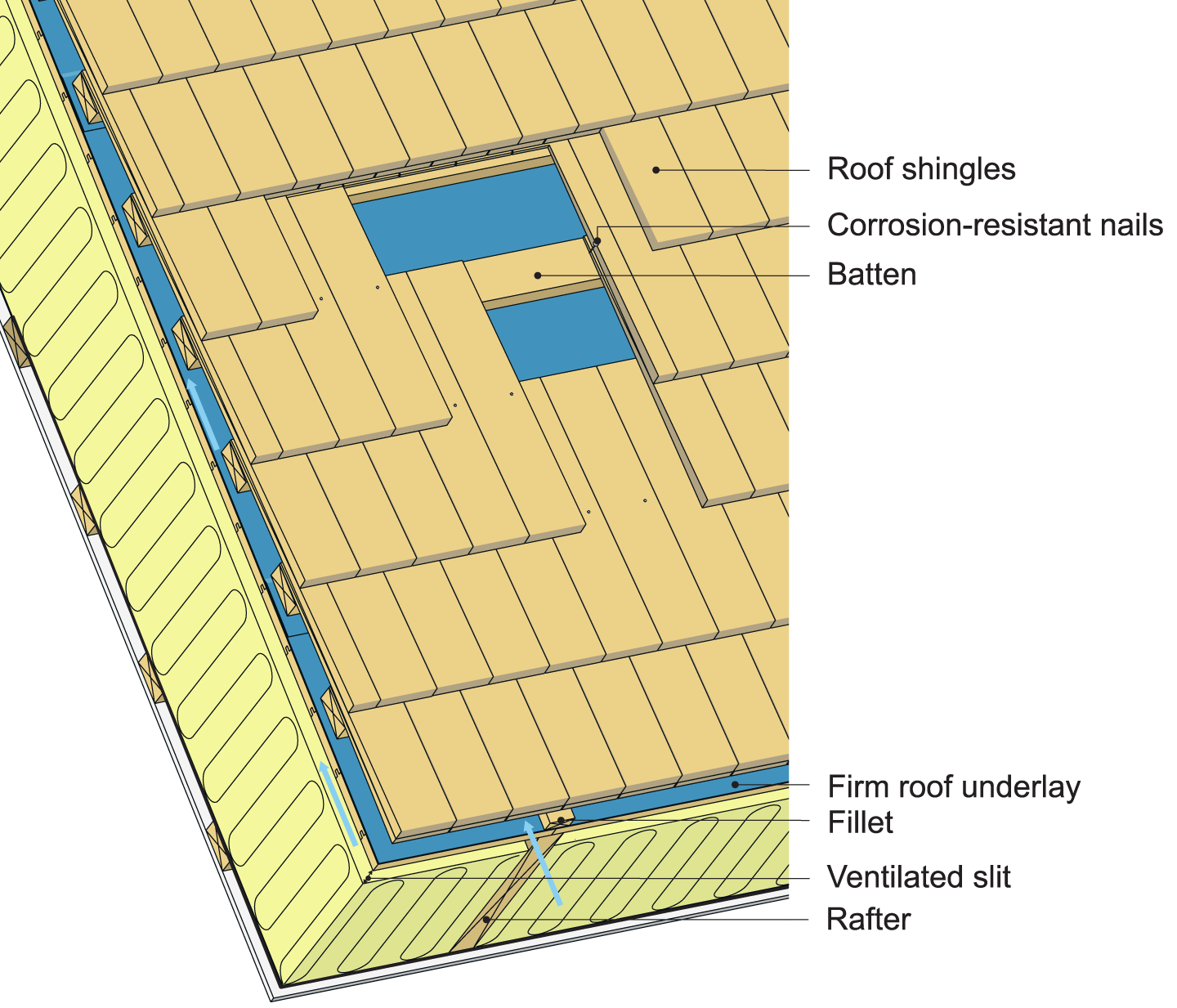
Figure 171. An example of a roof with a two-layer shingle covering with overlap between individual shingles, corresponding to approx. half of the total length of the shingle (500 mm). To ensure watertightness, a firm underlayment has been installed.
Figure 172. An example of a roof with a three-layer shingle covering without underlayment. A solution certifiable as BROOF(t2), requires an 18 mm plywood decking to be installed and the shingle covering to be tested using plywood decking.
5.9.4 Installing Shingle Roofs
When laying, each shingle is positioned to conceal all nails with the specified spacing between them according to manufacturer instructions.
Roof Battens
Rules and guidelines for roof battens are listed in Section 2.6.1, Roof Battens. For a detailed description see TRÆ 65 (Træinfomation, 2011).
The batten spacing must be adjusted to accommodate either a three- or two-layer shingle covering, as stipulated by manufacturer instructions for the relevant construction (see Figure 173).
Spacer Bars
Spacer bars are used for roofs with underlayment to raise the battens, allowing any water and dirt that penetrates the roof covering to be drained off under the battens to the gutter. Spacer bars must be pressure-impregnated, and their dimension must be min. 25 × 45 mm. Issues concerning spacer bars are covered in Section 3.1.2, Spacer Bars.
Fixing
Coniferous roofing shingles of western red cedar, larch, and Scots pine are fixed using corrosion-resistant, ringed, mushroom-head nails (A4-quality). Clamps should not be used, because they will damage the wood. In principle, each shingle is fixed with one nail (two nails are used for wide shingles). Nails are concealed by the next row of shingles. Nails should be driven in just enough to hold the shingle in place and to avoid splitting the shingle.
Because both are hardwood species, roof shingles made of deciduous trees such as false acacia and oak, can be nailed using either acid-resistant, corrosion-resistant ringed nails, or clamps (S16/A4).
Checks
Prior to laying the roofing shingles, checks should be made to ensure:
- The width of shingles should correspond to the width of the roof or the spacing for two- and three-layer coverings, respectively, requires adjustment to the roof width.
- The roof surface should be square (e.g., the diagonals of the roof surface should be identical consistently with the roof lengths at the ridge and eaves.
- The bearing length should correspond to the installation method (two or three layers) and to the spacing specified by the manufacturer.
- Rafters and battens should be true. When checking with a two-metre smoothing board, any deviations should be evenly distributed and should be max. 15 mm.
- There should be a min. distance of 45 mm between the batten underside and the upper side of the thermal insulation if no roofing underlayment is used.
- The roofing underlayment (if used) should lie correctly, should be tightly installed, and should not be damaged.
- The roofing underlayment should be able to be carried up over the barge board (if applicable).
- Spacer bars used between underlayment and battens should be min. 25 mm thick and pressure-impregnated.
Laying roofing shingles usually begins by laying two or more staggered overlapping layers of shingles at the eaves. The shingles are laid with the thin end upwards. Each layer is staggered in a sideways direction 25–35 mm from the joint in the underlying layer (see Figure 173). Wood shingles are always laid with a mutual spacing of 3–5 mm and must never butt up against each other.
When laying roofing shingles on roof battens, the visible part of each shingle, for a three-layer covering, will be 160 mm. For a two-layer covering, it will be 220 mm (see Figure 173). When laying roofing shingles of western red cedar in three layers on structural plywood decking, the visible part of each shingle will be approx. 125 mm for roof pitches of min. 30 °.
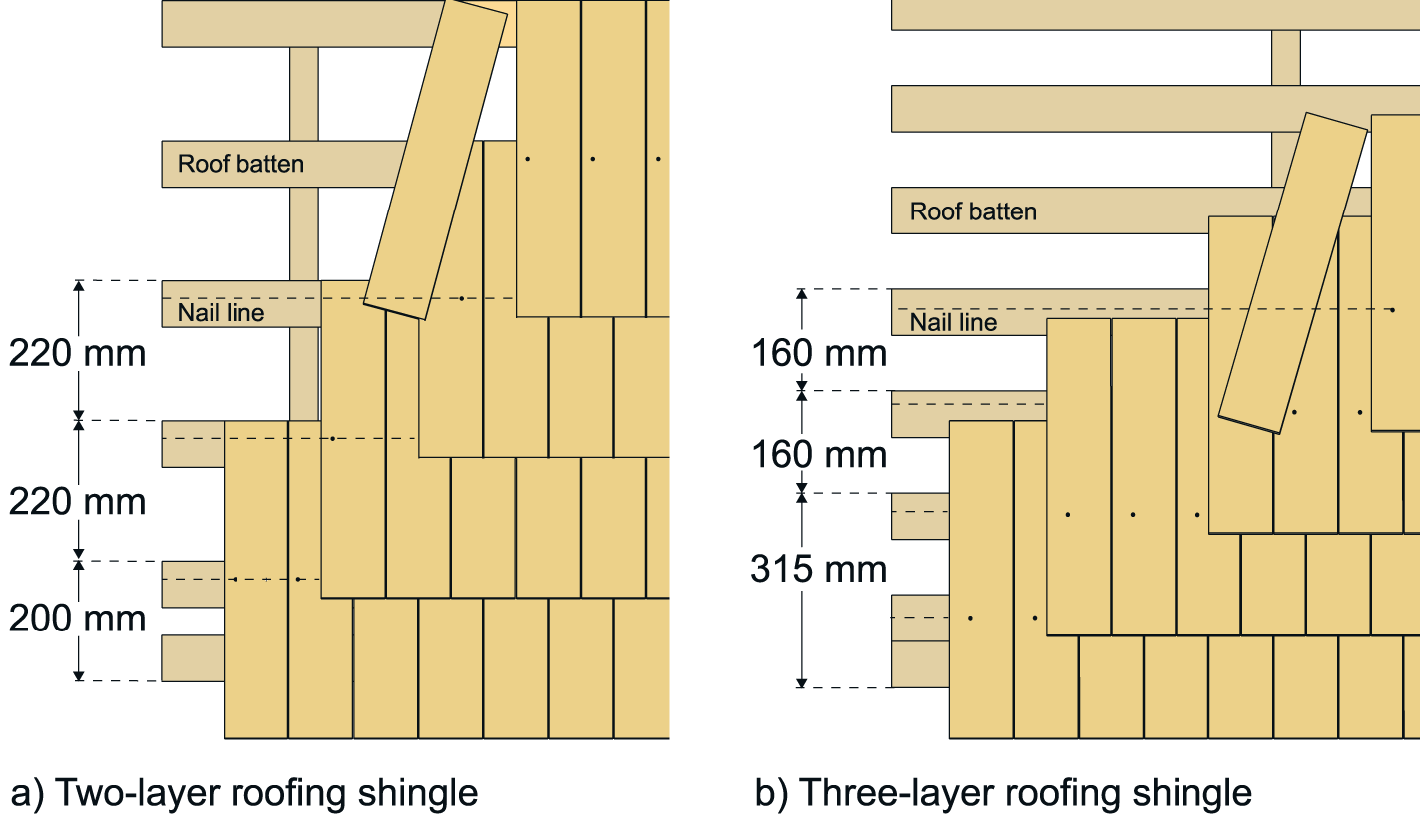
Figure 173. An example of the laying and nailing of roofing shingles.
- Two-layer shingle roof with batten spacing and nail alignment lines.
- Three-layer shingle roof with batten spacing and nail alignment lines.
5.9.5 Details – Roofing Shingles
This section shows examples of typical detail design used in shingle roofs For further information, see also installation instructions and documentation supplied by the manufacturer.
When designing roof details, guidelines for a number of general issues must be considered (e.g., guidelines for ventilation and Building Regulations provisions concerning fire safety and thermal insulation). General issues concerning the choice of roof are outlined in Section 1.1, Roof Design.
Further examples of roof detail design are shown in Section 6, Dormers, Roof Lights, and Skylights, Section 7, Flashings – Penetrations, and Intersections, and Section 9, List of Examples.
Ridges or Hips
Ridges and hips in shingle roofs can be executed using bevelled boards or shingles as shown in Figure 174.
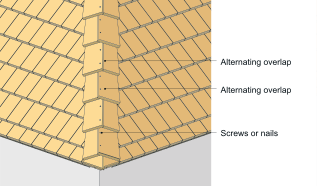
Figure 174. An example of hip design on a shingle roof.
Valleys
Valleys are normally made of aluminium, copper, or zinc, but can also be made of bituminous felt or roofing foil. If western red cedar or pressure-impregnated wood shingles are used, zinc valleys should be avoided due to the risk of corrosion.
Examples of valleys are shown in Section 7.2.4, Valleys.
Other details are similar to slate roofs (see Section 5.4, Slate Roofs).
5.10 Glass Roofs
Glass roofs are normally executed as systems solutions where ready-made profile solutions supplied by the same manufacturer are used. The choice of glass and profiles is important to ensure an efficient glass roof. Like other supporting structures, the roof assembly specification is determined based on load and span. Requirements for personal safety must be complied with. Furthermore, the roof glazing must meet the energy requirements for the building. Profiles used in glass roofs are specially developed for this application.
The glazing in glass roofs is usually insulating or energy-efficient glazing comprising two or three layers of glass. Glass is heavy (approx. 2.5 kg/m2 per mm of thickness) and the weight of the glazing units can therefore be a decisive factor in the handling and size of individual units.
Fire Rating
In glass roofs, the complete structure (including the glass) must be tested and certified. Openings for smoke ventilation must be CE-marked and executed according to DS/EN 12101-2, Smoke and heat control systems – Part 2: Natural smoke and heat exhaust ventilators (Danish Standards, 2017).
Applicable Standards for Glazing Units in Glass Roofs
Roof glazing is subject to the following standards:
- DS/EN 1279-1, Glass in Building - Insulating glass units - Part 1: Generalities, system description, rules for substitution, tolerances, and visual quality (Danish Standards, 2018
- DS/EN 1279-2, Glass in building – Insulating glass units – Part 2: Long term test method and requirements for moisture penetration (Danish Standards, 2018a)
- DS/EN 1279-3, Glass in building – Insulating glass units – Part 3: Long term test method and requirements for gas leakage rate and for gas concentration tolerances (Danish Standards, 2018b)
- DS/EN 1279-4, Glass in Building - Insulating Glass Units - Part 4: Methods of test for the physical attributes of edge seal components and inserts (Danish Standards, 2018c)
- DS/EN 1279-5 + A2, Glass in building – Insulating glass units – Part 5: Product standard (Danish Standards, 2018b)
- DS/EN 1279-6, Glass in building – Insulating glass units – Part 6: Factory production control and periodic tests (Danish Standards, 2018).
5.10.1 Roof Pitch
The glazed surface and roof glazing systems with accompanying profiles must be executed to enable water and snow to drain away (see Figure 175). Glass roofs should always be executed with sufficient pitch to avoid the accumulation of snow, water, and dirt at the edges and to secure all joints, including those surrounding glazing units. For shallower roof pitches, special precautionary measures must be observed to ensure watertightness. Nevertheless, roof glazing is available that has been tested and documented for use in roof pitches as low as 2 °.
For shallow pitches, special consideration must be given to the drainage system of the profiles.
The pitch for single-glazing roofs (e.g., greenhouses) should be min. 27 ° to ensure that condensate will run off without dripping.
5.10.2 Structure
Glass roofs must be watertight, and water must be drained away from its external surface as well as from profile seams and drainage elements. Roof glazing is normally constructed using two-step seamed joints: an external rain shield (able to drain off water and condensate) and an internal sealant (against moist indoor air).
Glass roofs must have a flashing height of min. 150 mm to avoid drainage tubes being blocked and water entering the structure. However, when used as smoke ventilation, the flashing height must be min. 300 mm according to DS/EN 12101-2 (Danish Standards, 2017).
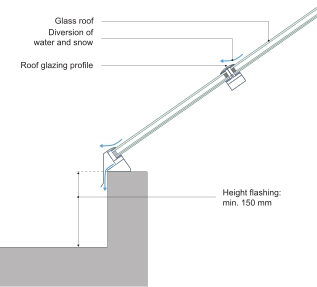
Figure 175. Glass roofs must be designed so that water can drain away (i.e., there must be no mouldings, caps, or similar, preventing drainage). Roofs terminating on upstands as shown must be executed with a flashing height of min. 150 mm. Water entering the profiles must be drained away.
The glazing units must also be sufficiently strong to absorb loads from precipitation, wind, and dead load (deflection). Glass roofs are not normally intended for foot traffic, but such solutions do exist.
Specifications for roof glazing installations must factor in the proven strength of the materials and a calculation of their maximum deflection. For glass roofs where foot traffic is necessary for cleaning and maintenance purposes, the glass must be specified according to applicable standards. The choice of glass must include a safety level specification for personal injury in connection with load impact and falling glass. Further information about specifying glass in building envelopes is available in the SBi Guidelines 215, Dimensionering af glas i klimaskærmen (Specifying glass in building envelopes) (Munch-Andersen & Pedersen, 2018).
The choice of glass is essential in connection with personal safety. The risk of personal injury can be reduced by using safety glass (e.g., laminated glass on the inside and toughened glass on the outside) in areas with a risk of thermal breakage. Guidelines for personal safety when using glass in buildings, according to Building Regulations provisions, are outlined in Bygningsreglementets vejledning om glaspartier, glasflader og værn af glas i bygninger (Building Regulations Guidelines on Glazed Panels, Glass Surfaces and Structural Glazing) (The Danish Transport, Construction and Housing Authority, 2018d).
The max. deflection permitted for insulating glass pane edges is 1/200 of the side length or max. 12 mm (cf. DS/EN 1279-5) (Danish Standards, 2010b).
The glass pane edges must be protected against sunlight (UV radiation) and the panes must be installed so that they do not overlap across unheated areas, which might lead to thermal breakage.
Glass roofs are an integral part of the building’s energy performance framework. The 2018 Building Regulations energy contribution of glass roofs, Eref, is calculated with the pane’s U-value, light transmittance, and solar energy transmittance.
The min. requirement for glass roofs is Eref = 0 kWh/m2 per year. However, it is possible to choose glass with a lower solar heating transmittance (g-value), if this results in proven energy savings (BR18, § 258, item 3).
The U-value of insulating glazing is always used as the U-value of vertical installations. In sloping installations, a reduction in the U-value must be anticipated. The exact U-values for specific roof slopes can be calculated using glass data programs (also the guidelines in Glastag (Glass Roofs)) (Glasindustrien, 2018).
Glass roofs and roof lights must be installed to ensure adequate safety against fall hazards. Careful attention should be given to this proble.
5.10.3 Details – Glass Roofs
This section shows examples of typical detail design in glass roofs. Further information can be found in installation instructions and documentation from manufacturers.
When designing roof details, guidelines for a number of general issues must be considered, including guidelines for ventilation and Building Regulations provisions concerning fire safety and thermal insulation. General issues concerning the choice of roof are outlined in Section 1.1, Roof Design.
Flashing and Draining the Profiles
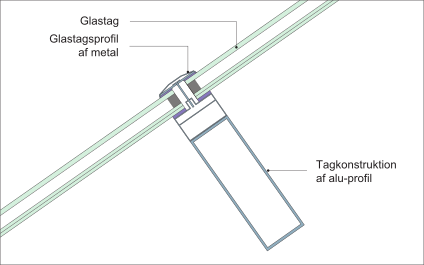
Figure 176. Example of glass roof profile design. Insulating roof glazing units must be installed in suitable metal profiles which can drain the roof efficiently. Profile cavity spaces must be drained.
5.11 Green Roofs
Green roofs are a general concept embracing different types of structures and plantations.
The watertight layer in a green roof is a roofing membrane. Therefore, in several respects the execution and structure of green roofs will be the same as for membrane roofs (see Section 5.7, Roofing Membranes).
Green turfed roofs on a firm underlayment belong to the category of very heavy-weight roofs, see Section 5.1.3, Roof pitch and Areal Weight.
Issues concerning the drainage of green roofs are outlined in Section 2.2.5, Draining Green Roofs.
Maintenance
Green roofs require maintenance to keep drains clean, to check plant growth, and maintain fire safety. Although sedums in an extensive green roof will not damage the roof covering and require little maintenance, uncontrolled plant growth with aggressive root systems may occur over time. When establishing a green roof, a maintenance plan should always be drawn up. For extensive green roofs with a maintenance plan, root inhibiting agent may be omitted.
At a minimum, the maintenance plan must specify that the green roof (including pebble borders, fire breaks, drains, and similar) should be inspected and cleaned at least twice a year. The maintenance plan should also contain information about vegetation, including watering and fertilising according to manufacturer’s instructions and instructions on removing uncontrolled plant growth, foliage, etc.
Durability or Lifespan
Green roofs protect the roof covering by shielding it from solar UV radiation. This reduces temperature variations in the roof covering and, in many cases, the ageing of the roof covering, as well as the risk of physical overload. On the other hand, the roof covering will be exposed to more moisture, as the green roof will endure longer consecutive periods of high relative humidity. There will also be an increased exposure to fine particles being leached from the growing medium. The roof covering must be able to withstand these effects.
Fire Rating
Green roofs are changeable relative to weather conditions, seasons, and plant age, which may be problematic when issuing classifications for green roofs as BROOF(t2) according to Building regulations provisions (see Section 2.5, Fire safety Regulations for Roofs). Several manufacturers on the Danish market, however, have classified their extensive green roof products as BROOF(t2) according to the test method outlined in DS/CEN/TS 1187 (Danish Standards, 2012a).
Measures to safeguard against fire spread via green roofs are outlined in Section 5.11.7, Preventing Fire Spread.
Applicable Standards
Green roofs are normally constructed on a roofing membrane substrate and the same standards apply for this roof membrane as for other membrane roofs (see Section 5.7.1, Bituminous Felt and Section 5.7.2, Roofing Foil).
Where root inhibiting agents are used in the roofing membrane, it should be remembered that leaching from these may occur. This does not normally pose an environmental problem as the leaching is below the detection limit. If in doubt, the leaching can be examined by conducting a so-called tank test according to the provisional test standard DS/CEN/TS 16637-2, Construction products – Assessment of release of dangerous substance - Part 2: Horizontal dynamic surface leaching test (Danish Standards, 2014d). If there are requirements concerning growth layer leaching, this may be documented by means of test methods from the German organisation for green roofs FLL (Forschungsgesellschaft Landschaftsentwicklung Landschaftsbau) (see www.fll.de).
5.11.1 Types of Green Roof
A distinction is made between three types of green roof:
- Extensive roofs
- Semi-intensive roofs
- Intensive roofs.
Choosing a Green Roof Type
The choice of a green roof can be based on the type of planting, the weight of the green roof, and how much maintenance is acceptable.
Green roofs are often specified based on environmental considerations (e.g., to retain rainwater, produce oxygen, prolong the lifespan of the roof covering, reduce the urban heat-island effect), reduce energy consumption in existing buildings, absorb dust particles and CO2, or to establish an animal and plant habitat (biodiversity).
A green roof installed primarily to retain rainwater will be very different from one whose main goal is to support biodiversity. The latter requires a variation of growth layer substrates to secure a greater range of plant species, which in turn, will function as a habitat for an extended range of animal life.
Extensive Green Roofs (Sedum Green Roofing)
The thickness of the growing medium (exclusive of the drainage layer) is limited to max. 60 mm.
Initially, the vegetation consists exclusively of the robust and drought-tolerant plant species, sedum. However, moss growth may occur where growth conditions have not been optimised and this may, in time, take over entire roof surfaces.
A sedum roof typically weighs approx. 35–50 kg/m2 in dry conditions and approx. 50–100 kg/m2 in water-saturated conditions.
Sedum can be used on both flat and pitched roofs where the layer structure will typically vary according to roof pitch and climate (see Figure 177 and Section 5.11.4, Sizing and Fixing).
Sedum can be established using pre-vegetated sedum mats (growing medium with sedum) or by using modular systems (sedum trays).
Extensive green roofs are not suitable for human traffic and require maintenance to a limited extent.
Semi-Intensive Green Roofs
Semi-intensive green roofs usually consist of turves or perennials (or a sedum mix) and require a thicker growing medium and more maintenance than extensive green roofs. The growing medium (exclusive of drainage layer) varies between 60 and 150 mm. Roofs containing a mix of sedum, perennials, and turves can weigh up to 150 kg/m2 when water-saturated. They can be used for both flat and sloping roofs. Solutions using turves are also applicable on semi-intensive and intensive roofs (see Section 5.11.3, Constructing a Green Roof). In the case of pitched roofs, turves must be secured to prevent them from sliding down (see Section 5.11.2, Taghældning for grønne tage (Roof Slope for Green Roofs) and Græstørvstage – opbygning og vedligehold (Turfed Roofs – Structure and Maintenance)) (Byg Erfa, 2008a).
Like sedum roofs, semi-intensive green roofs can be established using pre-vegetated sedum mats (growing medium containing grass and perennials) or by using modular systems (sedum trays). Planting cuttings and sowing are also options, but are more time-consuming.
Intensive Green Roofs or Roof Gardens
The growing medium for intensive green roofs is thicker than for extensive and semi-intensive green roofs. This means greater freedom in the choice of vegetation, since a greater range of plants with a more aggressive root system can be used. The thickness of the growing medium will typically be 150–400 mm thick (or more if small trees are planted). The total weight of an intensive green roof in water-saturated conditions is between 150 and 800 kg/m2 and requires a supporting structure capable of sustaining this. Due to the increased weight, it is not recommended to establish an intensive green roof in connection with the renovation of roof assemblies, unless determined by calculation that the supporting structure can absorb the load.
Intensive green roofs are used as roof gardens for human traffic to a greater extent than other types and they usually need considerable maintenance.
Hybrid Green Roofs
The roof types outlined above can profitably be combined into a hybrid green roof system made up of all three types with various growing-media, thicknesses, and suitable plants. However, it is vital to consider the roof's load-bearing capacity. Large plants, bushes, and trees requiring a thicker growing medium are best placed over supporting structures (e.g., load-bearing walls or columns).
5.11.2 Roof Slope for Green Roofs
Falls on extensive green roofs should be executed according to the same rules as for ordinary roofs (i.e., with falls of min. 1:40) (see Section 5.7.3, Roof Slope for Membrane Roofs). Box gutters with falls of as little as 1:100 are acceptable and, at cricket intersections, falls as little as 1:165 are acceptable.
Intensive green roofs must have a drainage layer installed to allow drainage into discharge systems. For inverted roofs and duo-roofs, falls may be smaller, because the membrane is protected. However, falls must be min. 1:100 and it is a precondition that the decking should be aligned to achieve well-defined falls. If an intensive conventional green roof is established contrary to recommendations (i.e., with the roofing membrane on top), falls should be min. 1:40.
For roof pitches above 1:5 (11 °), the green roof must be prevented from sliding down (e.g., using angular profiles fixed to the roof covering).
Furthermore, roof pitch along with the quantity of precipitation and vegetation will influence the choice of drainage layer. For roof pitches above 5 °, it is recommended that a drainage layer be used which can double as a water reservoir.
Issues concerning the drainage of green roofs are also outlined in Section 2.2.5, Draining Green Roofs, and Section 5.11.6, Rainwater Discharge from Green Roofs.
5.11.3 Constructing a Green Roof
A green roof is constructed as a multilayer structure in which each layer has a special function in the overall structure. The layers of a green roof include (from the bottom up):
- Supporting roof structure (warm or cold roof)
- Thermal insulation
- Roofing membrane
- Protective layer
- Drainage layer
- Filter layer
- Growing medium
- Vegetation
The structure may vary, as a green roof is essentially established as a systems solution where the exact structure is defined by individual manufacturers and user requirements. Solutions may exist which omit one or more of the layers mentioned above.
An example of the construction of an extensive green roof as a warm roof is shown in Figure 177.
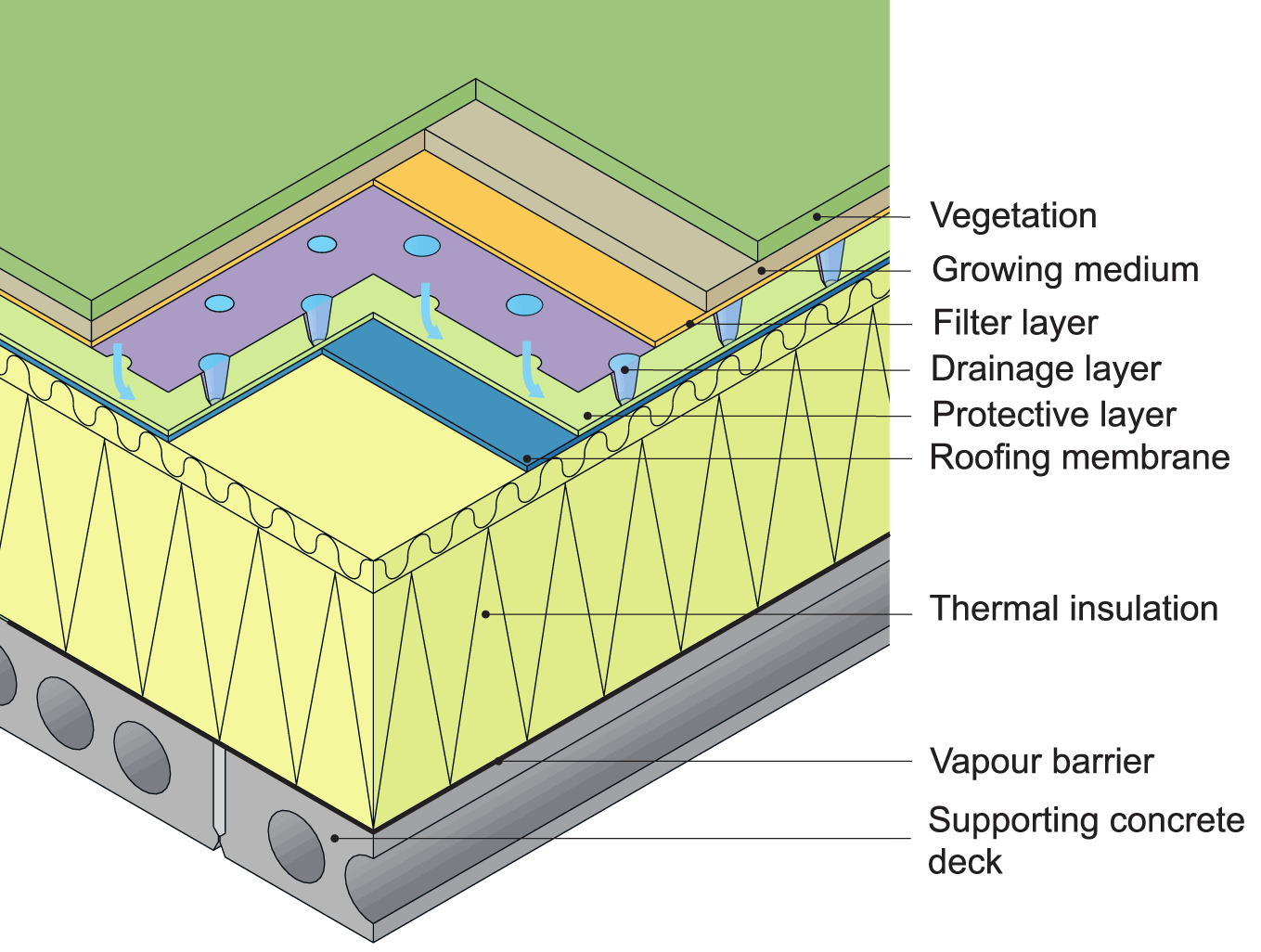
Figure 177. Example of a flat roof structure with an extensive green sedum roof. The example shows a warm roof, but an extensive sedum roof could also be established on a cold roof structure if conditions were right.
Supporting Roof Structure
The supporting roof structure must be capable of absorbing the load from the green roof and must be sized for a load corresponding to the green roof being fully water-saturated using a structural calculation.
Establishing a green roof on an existing building translates added load to the supporting structure, which was not necessarily factored into its initial design. Care must be taken to ensure that the load-bearing capacity of the structure is sufficient to carry the extra load on the roof. In certain cases, it may be necessary to reinforce the existing supporting structure.
To a great extent the structural assembly is conditional on the type of green roof established. Ordinarily, intensive green roofs are exclusively established on a concrete deck while extensive green roofs can often be established on a timber or steel structure. In all cases, the load-bearing capacity must be checked by performing a structural calculation.
Turfed roofs, equal in status to semi-intensive and intensive green roofs, are traditionally established on timber-based materials.
Green roofs are often established as warm roofs on a concrete deck. This construction is considered safe in terms of moisture. To avoid shutting in any moisture from the building process, a ‘tell-tale’ drain can be established from the vapour barrier level as an extra precaution. A warm roof normally defines a conventional roof (i.e., a roof where the roof covering lies above the thermal insulation). However, green roofs can also be structured according to the principles of a duo-roof or an inverted roof.
The difference is the position of the roof covering as outlined in Section 1.3.2, Warm Roofs.
Conventional roofs (in which the roof covering lies on the outside of the thermal insulation) should only be used for extensive and semi-intensive green roofs. For intensive green roofs, there is a risk that the growing medium will freeze to the roofing membrane and potentially tear it. Intensive green roofs should therefore be established as duo-roofs (possibly with a vapour barrier on the warm side of the structure) or inverted roofs, as this provides the optimal protection of the roof covering.
On the other hand, the principles for duo-roofs and inverted roofs are not applicable to extensive green roofs, as the ballast provided by the green roof is insufficient to secure the thermal insulation against wind suction and movement due to thermal uplift when the roof is saturated with water (see Section 5.11.4, Sizing and Fixing).
There are several limitations when establishing a green roof on a cold vented timber structure, since moisture conditions are different to those of an ordinary roof. A green roof can affect the ventilation conditions, as solar heating and the stack effect are reduced. In turn, the cooling down of the roof by emission to the atmosphere and thus moisture absorption from the ventilation air is also reduced.
Cold vented roof assemblies are considered risky and it is therefore recommended that moisture monitoring be installed or that an extra layer of roof covering be installed on a thin layer of thermal insulation as an extra precaution (see also Grønne tage – 238 embrane, dræning, isolering, vækstlag, brandsikkerhed og vedligehold, (Green Roofs – Membranes, Drainage, Insulation, Growing Media, Fire Safety, and Maintenance)) (Byg-Erfa, 2016c). If cold vented roof assemblies are used, the assembly should be open to inspection from the inside.
Green roofs must not be established in unvented timber assemblies due on the effect of a moisture-adaptive vapour barrier. The green roof reduces the heating of the roof assembly, resulting in moisture from the roof not being driven down to the moisture-adaptive vapour barrier as intended. The moisture is therefore not removed.
Thermal Insulation
In warm roof decking for extensive green roofs, ordinary roof insulation with a short-term compressive strength down to 40 kN/m2can be used.
In inverted roofs and duo-roofs, which are typically used for intensive green roofs, various types of thermal insulation with a higher compressive strength can be used. The insulance factor above the roof covering in duo-roofs should constitute min. 1/3 of the total insulance factor.
A vapour barrier may be required on the warm side of the structure in duo-roofs where the roof covering lies between two layers of thermal insulation. In inverted roofs, the roof covering is positioned immediately above the supporting structure, thus also functioning as a vapour barrier.
Roofing Membrane
The choice of roof covering for green roofs is based on the roof assembly (i.e., whether it is an intensive, semi-intensive, or extensive green roof).
For intensive and semi-intensive green roofs, root-inhibitors, or root barriers (in the form of PE foil with welded seams or similar), must always be used. The root-inhibiting qualities of roof membranes are tested according to DS/EN 13948 (Danish Standards, 2007e). Furthermore, roofing membranes for intensive roofs must be resistant to rhizomes where there is evidence of couch grass and bamboo.
In extensive green roofs, root-inhibiting roofing membranes or root inhibitors can be omitted if a maintenance plan has been drawn up (see Section 5.11, Maintenance).
The roof covering must be suitable for the stated purpose and must meet the requirements listed above (see Section 5.7, Roofing Membranes).
Protective Layer
The function of the protective layer is to provide extra protection for the roof covering. This is necessary where drainage layers are used, which may result in deformation of the underlying roofing membrane and insulation. Where the drainage layer contains a felt mat, this can also function as a protective layer.
Drainage Layer
The drainage layer can have several functions depending on the choice of material. It essentially functions as a drainage system, which also vents the roots and drains rainwater not absorbed by the layers above. The drainage capacity required of the drainage layer depends on local rainfall conditions, the size of the roof to be drained, and the roof pitch.
Furthermore, the drainage layer can also function as a water reservoir. A distinction is made between solutions using a felt drainage mat and solutions using drainage plates (‘egg boxes’).
The drainage process differs for the two solution models:
- A felt drainage mat functions both as a water reservoir and encourages drainage. Rainwater discharge takes place horizontally through the drainage layer.
- A drainage plate functions as a water reservoir on the upper side and as drainage on the lower side. Rainwater discharge takes place vertically through the drainage layer and is then discharged horizontally on the roofing membrane. Using drainage plates can thus result in a reduction and delay of the flow. However, the function has a limited effect in the case of extreme rainfall events such as torrential downpours. For further details, please see guidelines from FLL (Forschungsgesellschaft Landschaftsentwicklung Landschaftsbau) (www.fll.de).
Filter Layer
The filter layer ensures that fine particles from the growing medium are not leached and transported to underling layers.
Growing Medium
The growing medium provides fertile soil for the vegetation and must therefore allow root penetration. It must also possess physical, chemical, and biological properties which, along with the thickness of the growing medium, determine which plants can be grown on the roof.
The growing medium has a significant impact on the hydraulic properties of a green roof. The growing medium must be capable of absorbing and retaining precipitation but must also be permeable to allow excess precipitation to pass through. In addition, it must provide optimal air and water conditions for plant growth.
Several different growing media are available, depending on vegetation and the manufacturer, but they usually consist of substrates with a mix of mineral and organic material adapted to the specific purpose in terms of weight, nutrients, and drainage. The mineral element could be pumice or crushed bricks. For further details, please see guidelines from FLL (Forschungsgesellschaft Landschaftsentwicklung Landschaftsbau) (www.fll.de).
Vegetation
Vegetation comes in many varieties depending on the thickness and quality of the growing medium and the usage intended for the roof. Furthermore, other factors such as shade and wind load shape what plants may be grown. To achieve an efficient green roof, it is important to choose plants adapted to the specific roof conditions. Plants capable of persisting through long periods of drought, rain, and moisture, are especially suitable for this purpose.
5.11.4 Sizing and Fixing
Depending on their design, extensive green roofs retain approx. 50% rainwater during the year.
Sizing the roof of a building for specific rainfall intensity will depend on the usage of the building and thus the risk of damage and whether allowances need to be made for future climate changes. Green roofs have only a limited effect in the event of torrential downpours but are nevertheless able to retain some of the rainwater and contribute to the delaying of discharge. Data about water retention capacity can normally be obtained from the producer of the specific system (typically around 10–25 l/m2). In thicker green roofs, water retention figures can be obtained through testing (e.g., obtained with FLL’s testing method). In recent heavy downpours, rainfall events with 100 l/m2 over a few hours have occurred.
Normally, a rain intensity corresponding to an overload (230 l/s ha) every tenth year should be used to specify the design (see Section 2.2, Roof Drainage). For further details, see SBi Guidelines 255, Afløbsinstallationer – systemer og dimensionering (Wastewater Installations – Systems and Sizing), Section 7.1.3, Acceptabel risiko for oversvømmelse (Acceptable Risk of Flooding) (Brandt & Faldager, 2015).
Wind
Roof surfaces are especially vulnerable to wind load in peripheral and corner zones where they are exposed to upward-flowing forces in the form of wind suction (see Section 5.7.5, Sizing and Fixing).
Wind suction on the green roof itself depends on the possibility of pressure compensation between the green roof and the actual roof covering. If drainage plates are used, it is possible to distribute wind load by 2/3 on the roof covering and by 1/3 on the green roof. These facilitate pressure compensation (cf. Eurocode 1 – Parts 1–4 with the accompanying Danish annex) (Danish Standards, 2007c).
To ensure that the products are resistant to wind load, green roof solutions with an areal weight below 25 kg/m2 in dry conditions (50 kg/m2 in water-saturated conditions) should not be used.
A specific assessment must be made in each case where factors such as building height, terrain category, wind speed, and building geometry (e.g., the height of the parapet) are included.
In wind sensitive locations, the green roof can be replaced by ballast in peripheral and corner zones (e.g., a min. 500 mm wide border with a 50 mm thick layer of 16/32 mm pebbles, or 50 mm thick concrete paving slabs).
Fixing
Roofing membranes in green roofs are fixed in the same way as for roofing membranes generally (see Section 5.7.6, Fixing Systems for Roofing Membranes).
For extensive roofs, the roof covering is normally fixed with no consideration for the weight of the growing medium. If a calculation and assessment is made, the weight of the green roof may be subtracted from the wind load factor.
For intensive roofs, the weight of the assembly is normally sufficient to secure the roof against wind suction. Care must be taken to ensure that the roof covering will not blow away during construction (e.g., by securing the roof covering mechanically).
5.11.5 Tightness Test
Given that it is difficult to locate leakages once a green roof has been laid, a tightness test of the roofing membrane should be conducted before beginning construction work. However, in most green roof systems it is relatively easy to remove small, localized areas of the roof for repairs or changes.
The tightness test is performed by establishing a temporarily watertight demarcation on those areas to be examined and then subjecting them to water-loading. For roof surfaces which are geometrically complex with awkward details (e.g., integrated buildings and penetrations), these should be examined thoroughly. If the roof covering has been established in sections sealed individually against the deck, it will be easier to locate leakages. This reduces the risk of damage and any secondary damage.
Alternatively, the roof surface can be scanned prior to laying the green roof. In this way, the tightness of the roof is checked for precipitation which the roof covering could have been exposed to during construction. Furthermore, sensors or an electric detection system can be installed. However, in Denmark there is only limited experience with the latter.
5.11.6 Rainwater Discharge from Green Roofs
Drainage
For extensive green roofs, a distinction should be made between systems using drainage plates and felt mats. In drainage plates, part of the rainwater can be discharged below the plates while rainwater will be discharged through the green roof assembly itself in solutions using felt mats.
The distance between roof outlet and ‘ridge’ should be limited to 7.2 metres, but in systems using drainage plates, this can be increased to 10.8 metres (see Figure 178).
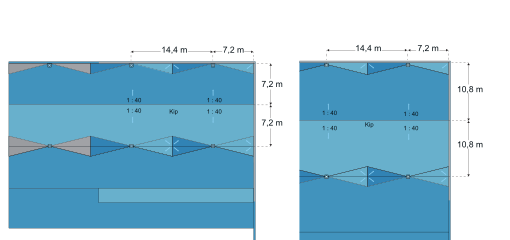
Figure 178. The spacing between roof outlet and ‘ridge’ for extensive green roofs.
- Spacing when using felt mats.
- Spacing when using drainage plates.
If possible, green roofs should be kept away from valleys. Valley finishes, therefore, typically consist of a slit angular profile of stainless steel or seawater-resistant aluminium fixed to the roof with a strip of roofing membrane. This enables water to pass while the growing medium is held in place. The profile must be fixed without introducing potential leaks (i.e., without penetrating the membrane).
The advantage of these valley finishes is that the occurrence of plant residues in the valley is reduced.
It is recommended that box gutters and intersections near to tapered firrings be kept free of plant growth. A ballast of 32/64 pebbles without felt may be laid in box gutters. However, solutions with drainage plates may be installed across intersections. Felt mat solutions could be supplemented with drainage plates across intersections.
In intensive green roofs, the spacing between roof outlets should not exceed 6 metres in both directions and tapered falls are recommended (see Section 5.7.3, Roof Slope for Membrane Roofs). Valleys and counter-flashings can be used if rainwater discharge is secured (e.g., with drainage plates).
Roof Outlets
Measures must be taken to prevent blockages in roof outlets and they must be installed to facilitate cleaning.
The outlets must be kept free of plant growth at a clearance of 0.5 metres to all sides. Instead, pebble ballast of min. 16/32 mm stones can be used. Alternatively, a special grating can be used, which prevents the growing medium from entering the roof outlet while ensuring that rainwater can accumulate and be discharged there over the top (if the sides become blocked). An example of a roof outlet in a green roof is shown in Section 2.2.5, Draining Green Roofs.
The roof outlets are countersunk, thereby ensuring free discharge as shown in Section 2.2.4, Draining Flat Roofs.
In extensive green roofs, ordinary roof outlets and UV-outlets can be used, but in the case of UV-outlets, it should be kept in mind that the low discharge coefficient from green roofs will reduce the self-cleaning options. When using UV-outlets, it is recommended that valleys be kept free from plant growth and outlets are cleaned regularly.
In intensive green roofs, special purpose-built roof outlets should be used, allowing the drainage of all layers in the assembly. UV-outlets are not recommended for intensive green roofs. It will also be necessary to establish normal emergency outlets if the roof is designed like a ‘bathtub’. Emergency outlets are placed at a lower level than the lowermost flashing on the roof. Emergency outlets are sized at min. one Ø 50 mm outlet per roof outlet (see Section 2.2.4, Draining Flat Roofs).
5.11.7 Safeguarding Against Fire Spread
To limit fire spread, fire safety measures should be implemented using pebble ballast around roof lights and against adjoining buildings as shown in Figure 179.
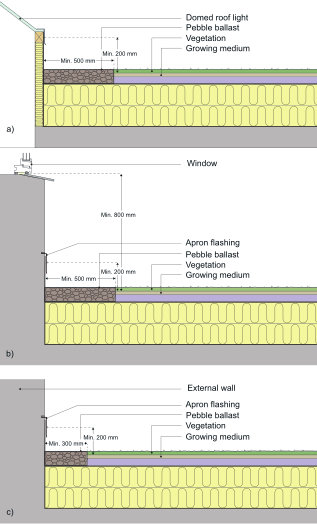
Figure 179. Fire breaks against adjoining building parts with recommended dimensions.
- Fire break with pebble ballast against domed roof light.
- Fire break with pebble ballast against external wall with window.
- Fire break with pebble ballast against external wall with a fire class K1 10 B-s1,d0 surface, or better. If the surface of the outer wall is less than cladding class K1 10 B-s1,d0, the width of the fire break is increased to 500 mm.Brandbælte med stenballast mod ovenlyskuppel.
Furthermore, pebble-ballast or paving-slab fire breaks min. 1 metre wide should be installed every 40 metres. Annual inspections should be carried out to ensure that the fire breaks retain their function. For green roof systems carrying BROOF(t2)-documentation, fire breaks for every 40 metres may be omitted. The fire safety regulations concerning green roofs can also be assessed based on the functional fire safety regulations outlined in the Building Regulations for the actual building project.
5.11.8 Details – Green Roofs
This section shows examples of typical detail design in green roofs. Please see installation instructions and further information from manufacturers.
When designing roof details, guidelines for a number of general issues must be considered (e.g., guidelines for ventilation and Building Regulations provisions concerning fire safety and thermal insulation). General issues concerning the choice of roof are outlined in Section 1.1, Roof Design.
Further examples of roof detail design are listed in Section 6, Dormers, Roof Lights, and Skylights, Section 7, Flashings – Penetrations, and Intersections and Section 9, List of Examples.
Flashings
Green roof detailing is important and the flashing height must be sufficient, especially in flashings against adjoining buildings. Normal flashing heights for roof gardens are 150 mm. For green roofs, the recommended flashing height is 200 mm, because green roofs tend to grow slightly in thickness over time. The flashing height should be understood as the height above the growing medium (see Figure 180). If flashing termination bars are used, the distance between the upper side of the growing medium to the screw holes in the flashing termination bar will determine the height. For flashings near external doors and low windows, it is usually best to install the flashing into the seam (see Section 7.3.7, Flashings for Roof Gardens).

Figure 180. The flashing height for green roofs must generally be 200 mm above the upper side of the growing medium, as the green roof will often grow thicker over time.